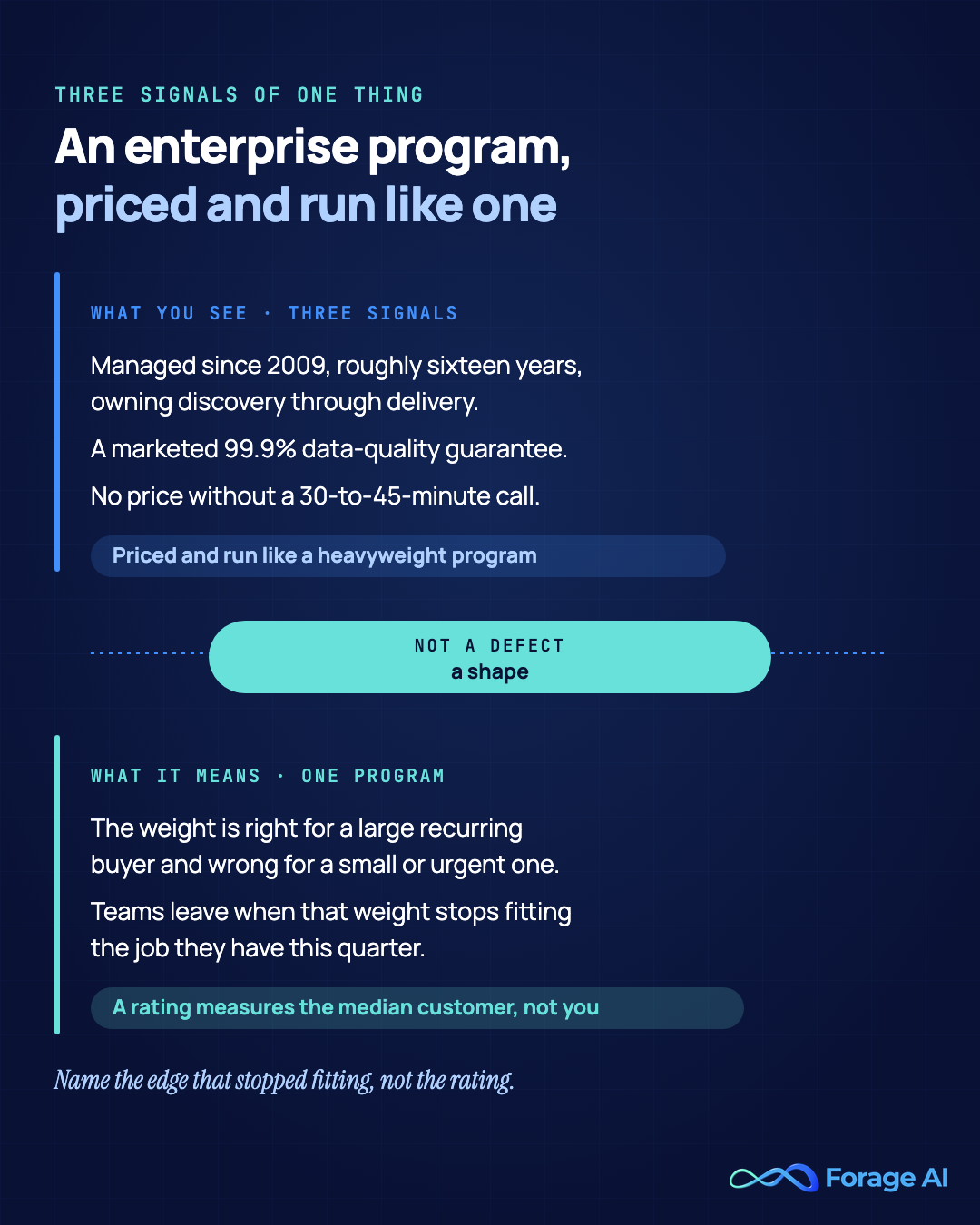
PromptCloud has run managed web data extraction for enterprise clients since 2009, roughly sixteen years, and markets a 99.9% data-quality guarantee. Its entire public voice-of-customer is 14 Capterra reviews, the most recent from 2023 (accessed July 2026). And you cannot see a price for any of it without a 30-to-45-minute scoping call.
Three signals of one thing. This is an enterprise program, priced and run like one.
Most lists of PromptCloud alternatives skip that read. They sort vendors by category and hand you an inventory, when the thing that decides your answer is which edge of the program stopped fitting the job you have this quarter. An enterprise program is a shape, not a defect, and changing a managed data vendor is routine procurement. Name the edge you hit, see which alternatives genuinely answer it, and see what each one takes away before you move.
Quick Digest
- Why teams leave an enterprise program: PromptCloud is a roughly sixteen-year managed DaaS priced and run like a heavyweight program, so teams leave when that weight stops fitting a job. A rating measures the median customer, not your workload.
- The two edges: Overhead (cost and minimums, a scoping-call onboarding with a paid proof-of-concept, a learning curve, a one-month-notice contract) and delivery (completeness, QA, freshness visibility, support cadence). They have opposite answers.
- Pricing is a note, not the story: PromptCloud publishes no fixed price and scopes each engagement, as several managed peers do. The friction is enterprise-program weight, not opacity, and it is genuinely configurable, so control is not the issue either.
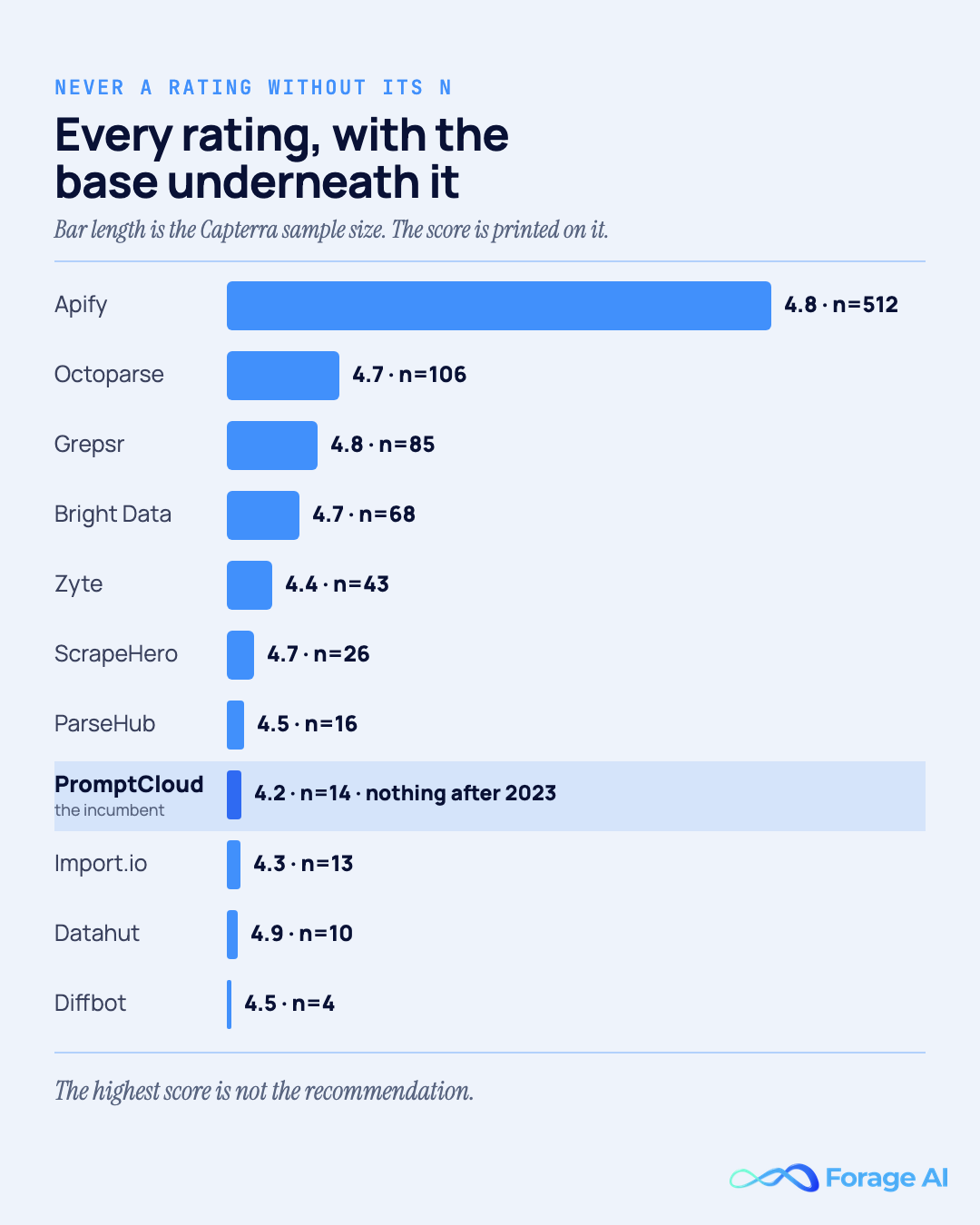
- How to read the ratings: Every score here carries its sample size. PromptCloud’s own 4.2 sits on 14 Capterra reviews with nothing after 2023, behind a wall of enterprise logos.
- The 9 alternatives: Grouped by the edge each answers, Forage AI first, each with published pricing, review evidence with n, and an honest watch-out. ParseHub and Import.io are no longer general-purpose alternatives.
- The honest trade: Self-serve tools answer the overhead edge by handing back parsing, QA and anti-bot work. Bots were 53% of web traffic in 2025, so that work costs more every year, and it is the worst trade if you left over data quality.
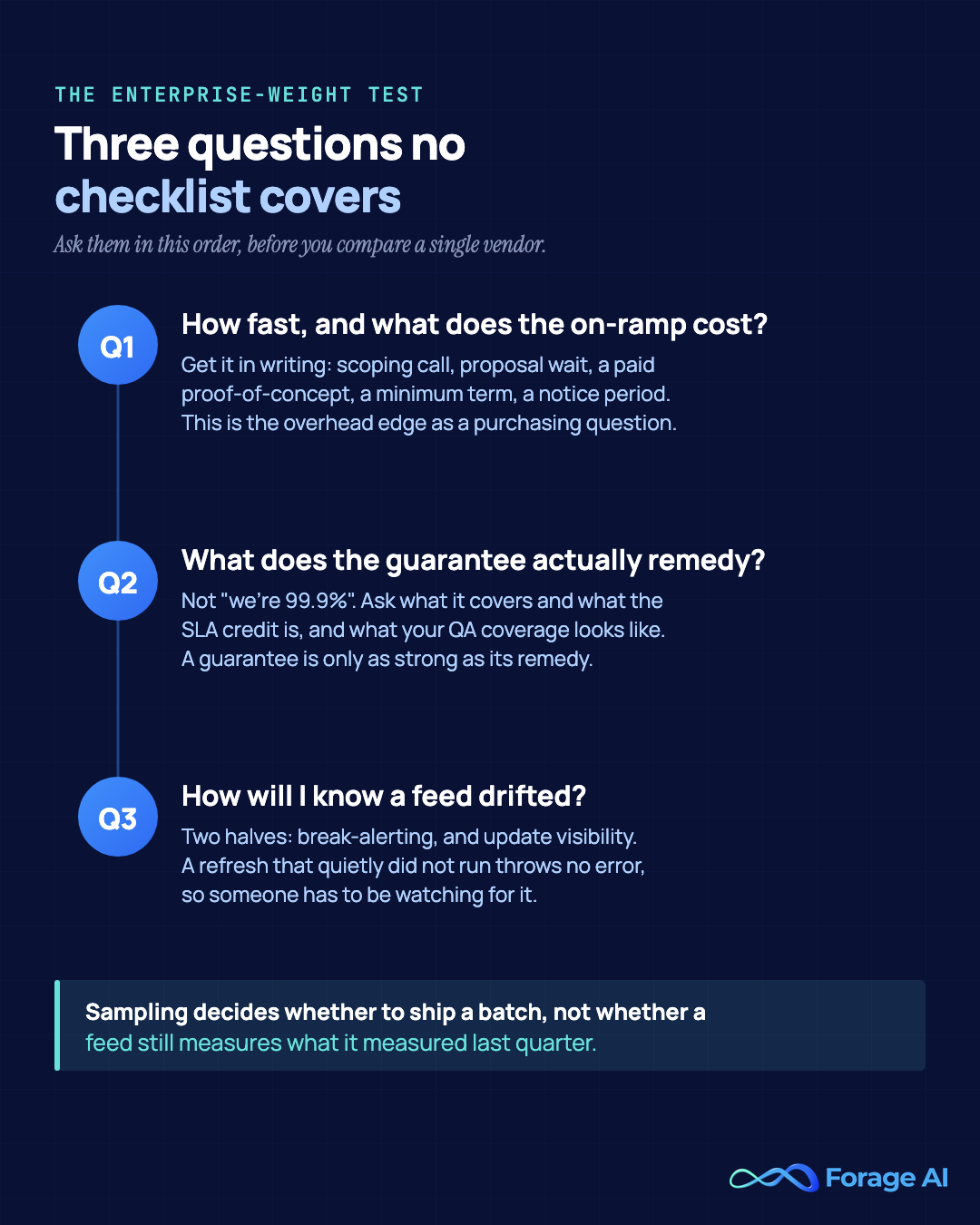
- The Enterprise-Weight Test: Three questions no checklist covers, how fast is time-to-first-data and what does the on-ramp cost, what does the guarantee actually remedy, and how will you know a feed drifted.
- When to stay, and the exit: PromptCloud’s weight is a real fit for a large recurring buyer (Support and Value both 4.6). If you leave, establish crawler ownership first, plan around the one-month notice, and parallel-run before cutting over.
Why teams leave a provider built for the enterprise
The rating is not the question. A 4.2 out of 5 (n=14, Capterra) measures how PromptCloud performs for its median customer, not for your workload, and teams leave managed vendors on one specific edge an aggregate score rarely shows.
PromptCloud runs fully managed web data extraction as a Data-as-a-Service, operating since 2009, roughly sixteen years, from Bangalore: you provide URLs and requirements, it owns scraper setup, hosting, QA, maintenance and delivery. You receive data, not a pipeline.
So the frame is fit, not failure. Changing a managed vendor is routine procurement, not a verdict: the closest measured analogue puts average vendor tenure at four years, and PromptCloud’s own contract contemplates a one-month notice to unwind. A specific edge you hit is the reason to switch; more alternatives existing is not. Name the two edges, overhead and delivery. (Funding or headcount is company due-diligence, and lives elsewhere.)
Quick Summary
Q: Why do teams look for PromptCloud alternatives when it rates 4.2 out of 5?
A: Because PromptCloud is an enterprise program, priced and run like one, and teams leave when that weight stops fitting a specific job. A rating measures the median customer, not your workload, and changing a managed data vendor is routine: the closest measured estimate puts average vendor tenure at four years (Peukert, 2010), and PromptCloud’s own contract carries a one-month notice.
Which wall did you hit, the overhead wall or the delivery wall?
The diagnosis is the whole thing, because an overhead wall and a delivery wall have opposite answers. The reasons teams leave PromptCloud sit at two edges of one program, graded by recency and specificity, not by how bad they sound.
| Edge | What it sounds like in your team | What the evidence says | What actually fixes it | What that costs you |
|---|---|---|---|---|
| Overhead: cost and minimums | “The program is too big and too expensive for what we need.” | “For smaller companies, price is on a higher side” (Aishwarya B., Financial Services, 2+ yrs, Oct 2023, Capterra). Value-for-money still scores 4.6/5. | A lighter self-serve tool, or a managed peer with a published price. | With self-serve, the whole pipeline. With a peer, another procurement cycle. |
| Overhead: time-to-first-data | “We needed data this month, not after a scoping call and a paid trial.” | Onboarding is a 30-45 min scoping call, a proposal in 24-48 hours, then a 30-day paid proof-of-concept before contract (promptcloud.com, July 2026). | A provider with a light on-ramp, or a marketplace scraper you configure yourself. | The paid-PoC vetting step, and any managed hand-holding. |
| Overhead: learning curve | “The first-run experience took work to get comfortable with.” | Dashboard and first-run friction appear in older reviews (2020, Capterra), all stale. | No-code tooling, or a peer that onboards you rather than handing you a console. | Simpler tools cap out on complex or defended websites. |
| Overhead: commitment | “We are locked into a term and a notice period.” | The contract carries a term with renewal and termination clauses and a one-month notice to release resources (promptcloud.com FAQ, July 2026). | Self-serve or monthly-in-arrears terms you can pause or cancel. | You give up a dedicated team and negotiated SLAs. |
| Delivery: completeness | “The feed is missing a lot of values.” | “results provided are missing a lot of values” (Jeffrey H., Internet, <6 mo, 2019, Capterra), stale, and balanced by “extremely reliable data with multi-level quality checks” (Kaustubh S., Oct 2023). | A better managed partner, not a different model. | A move to self-serve makes you your own QA. |
| Delivery: QA rigor | “I wanted more testing before delivery.” | “perform more rigorous tests before passing the results to the customer” (Omer G., Consumer Services, 2019, Capterra), stale. | A managed provider with stated QA coverage. | Same: leaving managed returns QA to you. |
| Delivery: freshness visibility | “We cannot tell whether a record was refreshed.” | “not always possible to know if a card has been updated” (2020, Capterra). | Break-alerting and update observability, from any model. | Nothing, if you ask for it up front. |
| Delivery: support cadence | “We needed weekend cover.” | Conflicted: a 2021 review reports no weekend support; PromptCloud’s FAQ states 24/7. Report both. | A negotiated SLA, in place or at a new vendor. | Often fixable in place before you switch. |
Sources: Capterra PromptCloud reviews (4.2/5, 14 reviews, accessed 2026-07-16); promptcloud.com/pricing and /web-data-scraping-faqs (accessed 2026-07-19).
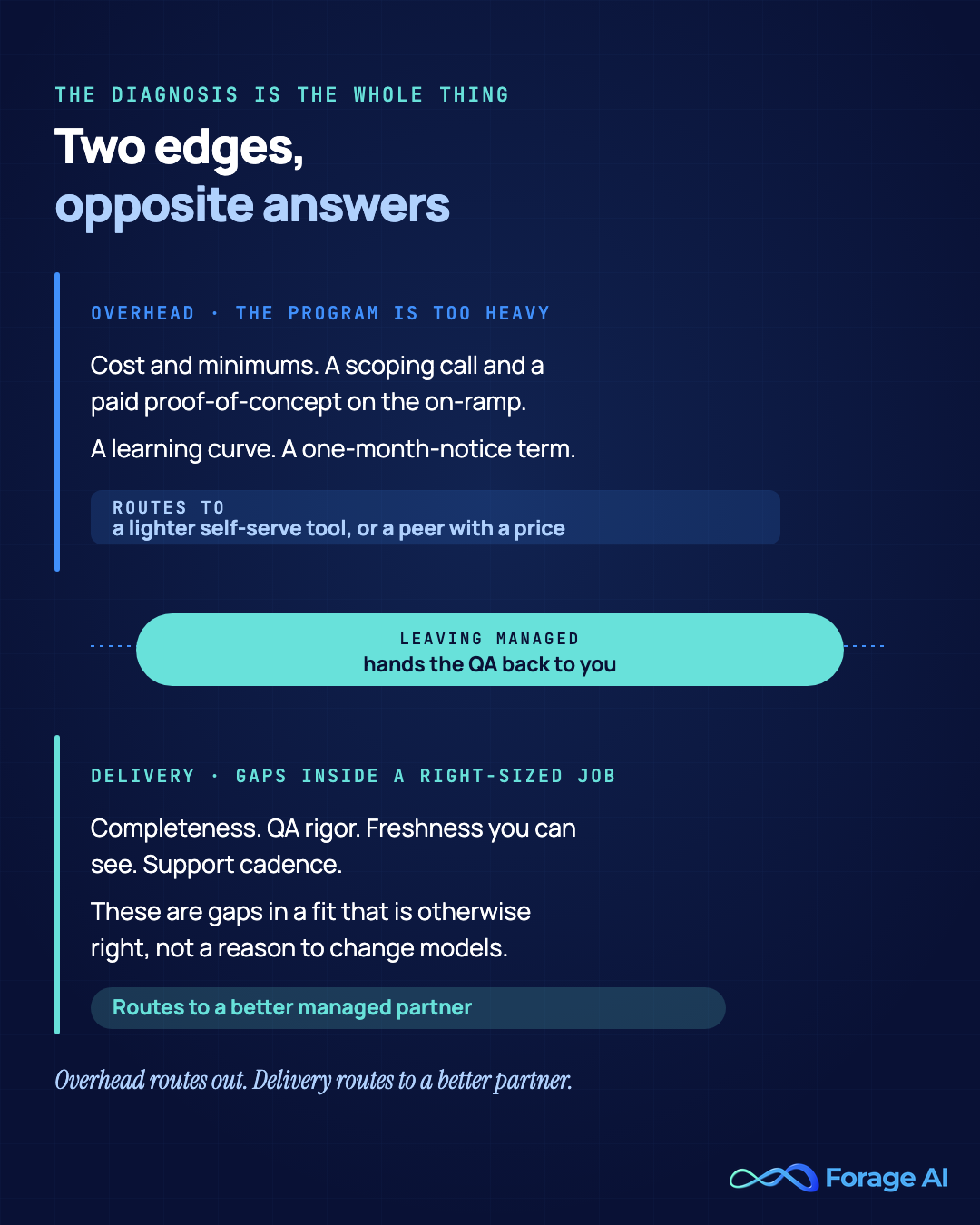
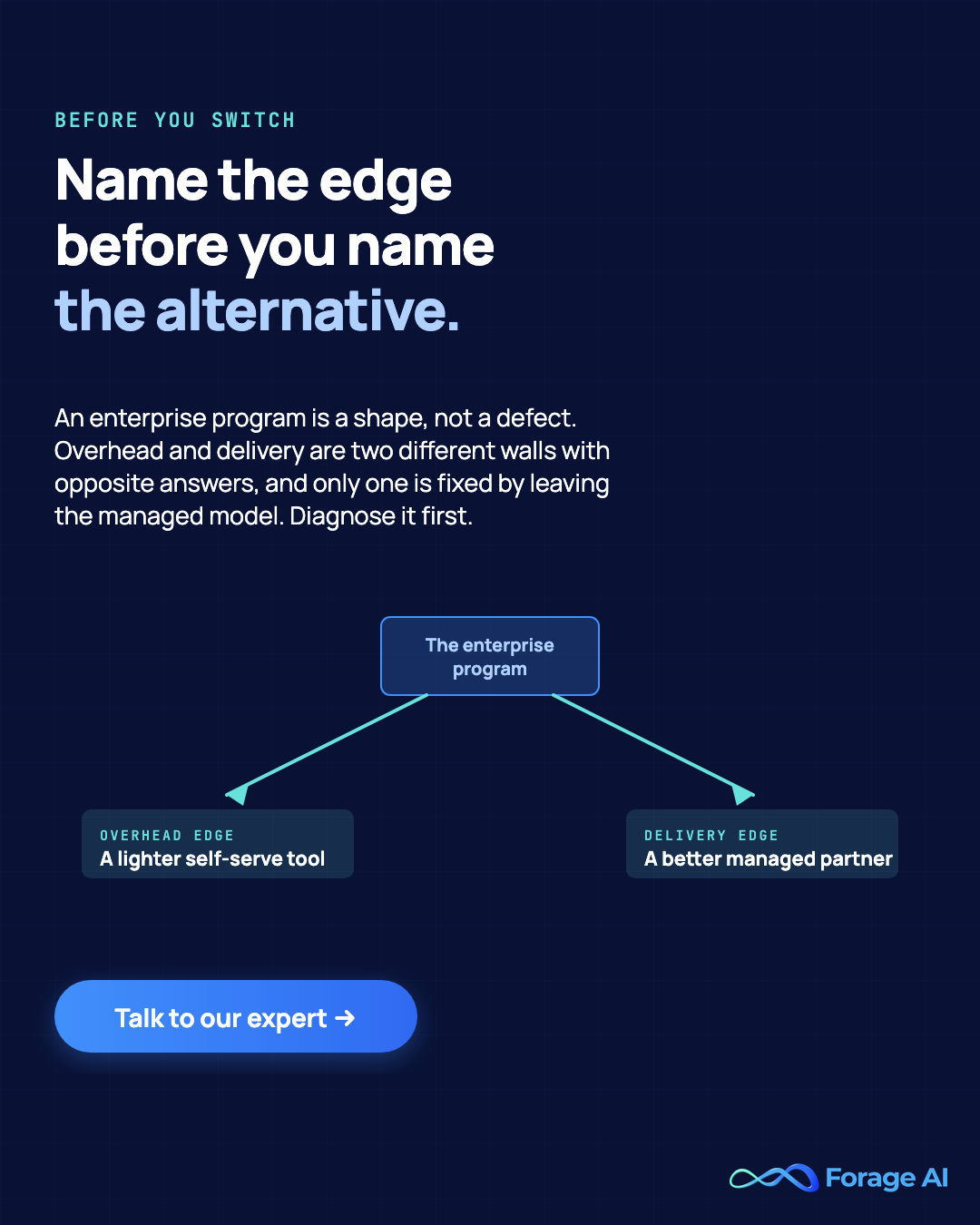
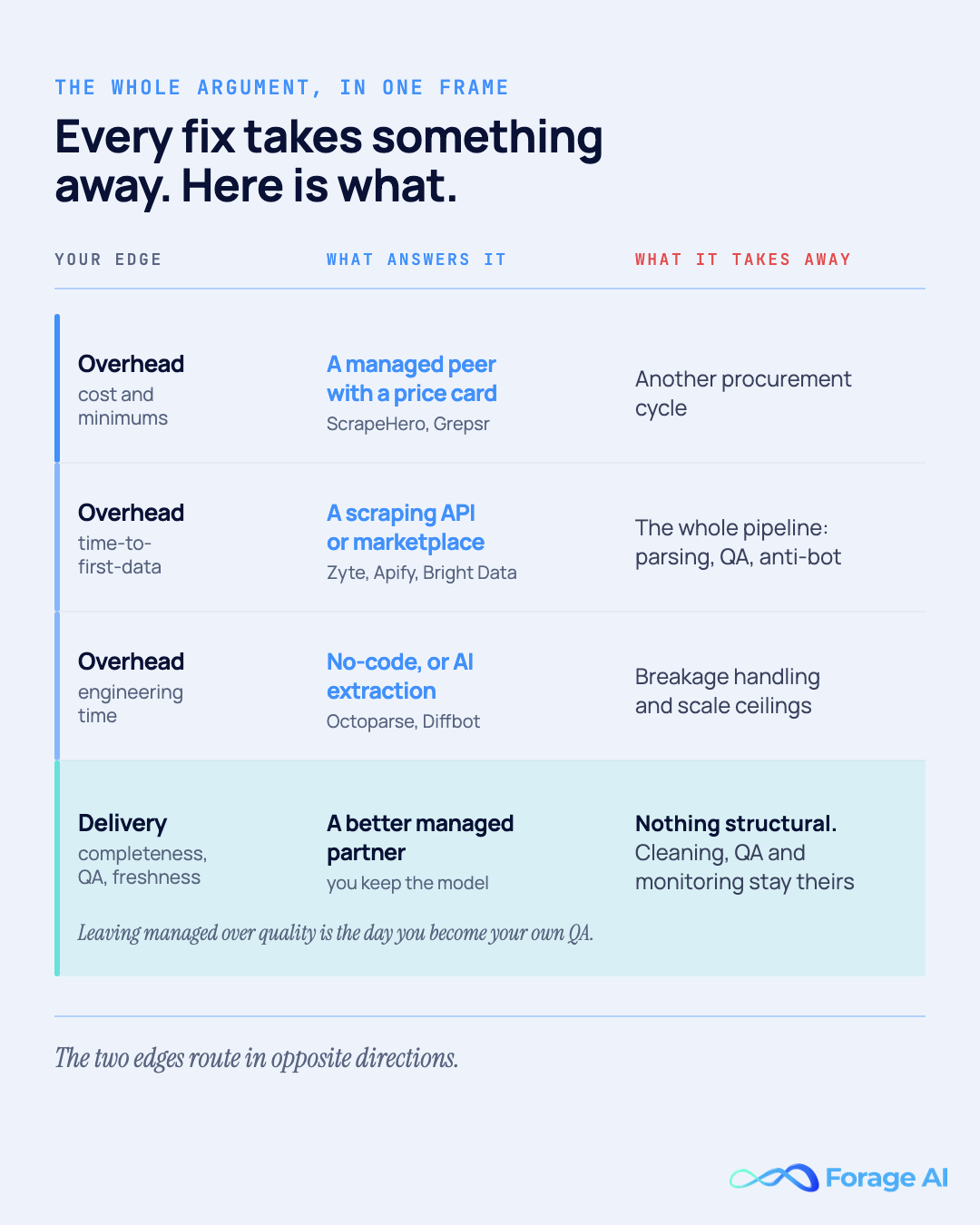
The two edges route in opposite directions. An overhead problem, the program too heavy, slow, expensive or committing for the need, points to a lighter self-serve tool. A delivery problem, gaps inside a right-sized engagement, points to a better managed partner, because leaving managed hands the QA and maintenance back to you. No page on this SERP makes that diagnosis.
One clarification on the overhead evidence. PromptCloud publishes no fixed price and scopes each engagement; its FAQ shows a dated illustrative example (a per-site setup fee plus $79 per site) that conflicts with the “no fixed tiers” page and is not current pricing. The claim is quote-gated and enterprise-oriented, not overpriced: value-for-money scores 4.6/5. “PromptCloud is slow” is false too, turnaround is a most-praised attribute; the only speed issue is time-to-first-data at onboarding.
The delivery edge has a neutral, peer-reviewed name. Nithya Sambasivan and colleagues at Google Research interviewed 53 AI practitioners and found 92% reported data cascades, compound downstream failures that originate in data, with 45.3% reporting two or more in one project (Sambasivan et al., CHI ’21, 2021). No aggregate rating surfaces that failure; only the diagnosis does.
Common misconception. “PromptCloud can’t be customized” is false. It markets configurability: you can change source sites, collection frequency, the data points extracted, and the delivery mechanism. The reason teams leave is not a control ceiling; it is the weight of the enterprise program around it, quote-only pricing, a scoping-call onboarding with a paid proof-of-concept, a learning curve, and a one-month-notice contract.
Quick Summary
Q: Which PromptCloud wall did you hit, overhead or delivery, and does it change the answer?
A: It changes everything, because the two walls have opposite answers. Overhead (cost and minimums, a scoping-call onboarding with a paid proof-of-concept, a learning curve, a one-month-notice contract) routes to a lighter self-serve tool. Delivery (completeness, QA, freshness visibility, support cadence) routes to a better managed partner, not a different model. PromptCloud is genuinely configurable, so the reason teams leave is the enterprise-program weight, not a control ceiling.
How we picked these alternatives, and how to read the ratings
Naming the edge narrows the roster; reading the evidence is the other half, and it starts with the number most lists omit. Every rating here carries its sample size. A 4.9 on ten reviews and a 4.4 on 43 are not the same claim.
| Factor | What we checked | Why it decides |
|---|---|---|
| Model | Managed, scraping API, no-code, or AI extraction | Determines who owns the pipeline after you sign |
| The edge it answers | Overhead or delivery, and which sub-symptom | The only axis that maps an alternative to your reason for leaving |
| Published pricing | Vendor page only, never an aggregator | Aggregators mislabel tiers, units and billing periods routinely |
| Review base | Rating with n and recency | A score without a base is noise |
| Independent evidence | Anything beyond one review corpus | Sites in one network are one source, not three |
| The honest watch-out | The real one, not a decorative one | An alternative with no downside has not been researched |
PromptCloud alternatives at a glance
| Alternative | Model | Best for | The edge it answers |
|---|---|---|---|
| 1. Forage AI | Managed | Teams needing managed bespoke extraction without the enterprise-program weight | Delivery, plus overhead price/terms clarity |
| 2. ScrapeHero | Managed | Teams needing a managed price point readable before a call | Overhead |
| 3. Grepsr | Managed | Teams wanting a published entry price and flexible exit | Overhead |
| 4. Datahut | Managed | Cost-sensitive teams accepting a full-service, no-control model | Overhead (cost only) |
| 5. Zyte | Scraping API | Python and Scrapy teams that want to own the pipeline | Overhead |
| 6. Bright Data | Scraping API | Teams whose bottleneck is access to defended targets | Overhead + hard targets |
| 7. Apify | Scraping API | Technical-ish teams wanting prebuilt scrapers fast | Overhead |
| 8. Octoparse | No-code | Analysts on stable, simple websites | Overhead |
| 9. Diffbot | AI extraction | Teams whose overhead is engineering time on standard pages | Overhead (engineering time) |
ParseHub and Import.io appear on most rival lists and are covered in a compact band below the roster. Neither is a general-purpose alternative as of July 2026. Last updated July 2026; no vendor paid for placement.
Three notes on method. We listed only things actually in the category, not the RPA and sales-contact tools these lists pad with. Capterra and Software Advice are both Gartner-owned and share one corpus, so the same 4.2 on both is one dataset, not two. G2, Trustpilot and TrustRadius return HTTP 403 to direct fetch, so their figures are corroborated via secondary sources and labelled as such; where sources conflict, we report both.
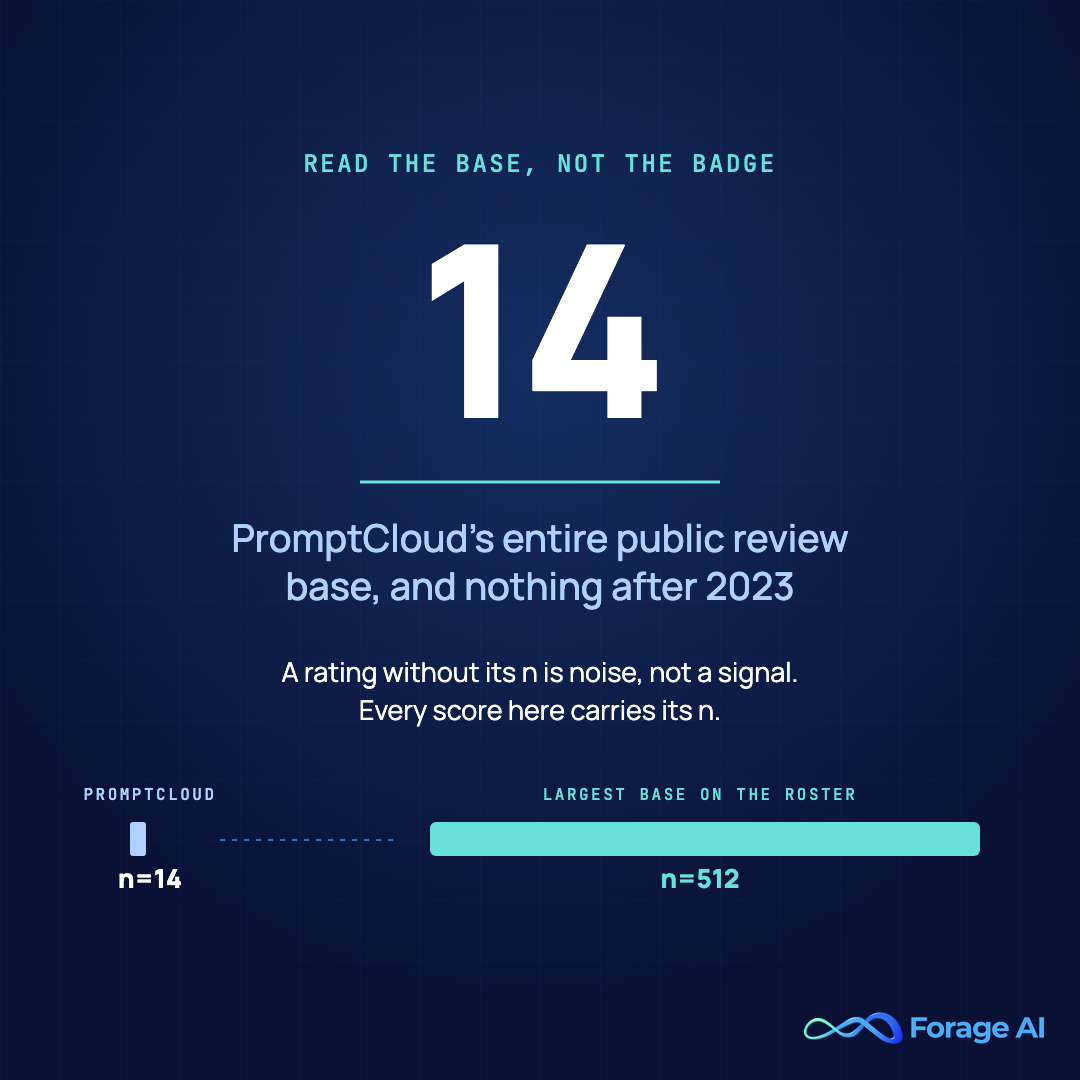
The same standard applies to PromptCloud, and to us. PromptCloud’s public voice-of-customer is 14 Capterra reviews (4.2/5) plus roughly 16 on G2 (4.6/5), no Trustpilot, nothing after 2023, behind an Apple, Uber and McKinsey logo wall. That does not mean PromptCloud is bad; it means the public record cannot tell you how it performs on a large, current engagement. Forage AI’s own G2 rating sits on roughly eight reviews, and if a thin corpus is a caveat for PromptCloud, it is a caveat for us.
One number sets the reading. Tadhg Nagle, Thomas Redman and David Sammon ran 75 data-quality assessments over two years and found 47% of newly created records held at least one critical, work-impacting error, with only 3% of quality scores acceptable under the loosest standard (Harvard Business Review, 2017). It cuts both ways for a PromptCloud customer: most organizational data is worse than people assume, so “our feed looks fine” is not evidence, and the feed you are second-guessing may be cleaner than your internal data.
Quick Summary
Q: How should you read the ratings in a PromptCloud alternatives list?
A: Always with the sample size and the date. A 4.9 on 10 reviews is not comparable to a 4.8 on 512, Capterra and Software Advice share one Gartner corpus rather than confirming each other, and PromptCloud’s own 4.2 sits on 14 reviews with nothing after 2023. That thin, stale base cannot tell you how it performs on your workload.
9 PromptCloud alternatives, mapped to the edge each one answers
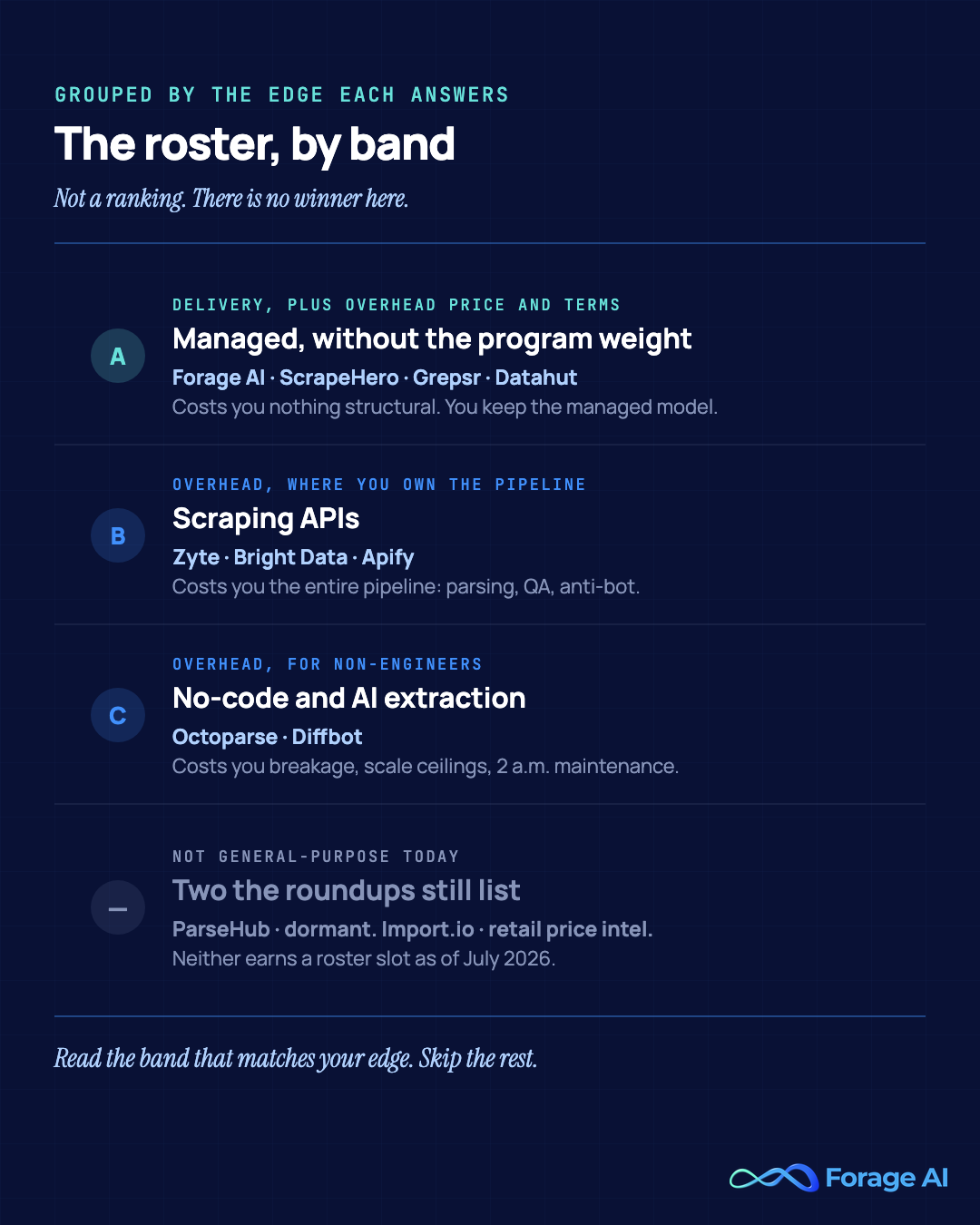
Entries are grouped into four bands by the edge they answer: managed peers without the program weight, scraping APIs, no-code and AI extraction, and the two that are no longer general-purpose. Every rating carries its n and access date, and every full entry carries a “better than PromptCloud when” line and a “not for” line, because an alternative with no downside has not been researched. Read the band that matches your edge; the others are there so you can see what you are choosing against.
Band A: managed, without the enterprise-program weight
Answers a delivery gap with a better managed partner, and answers the overhead sub-symptom of price and terms clarity. Costs you nothing structural, because you keep the managed model; you do not take a pipeline back. This band is for a reader who needs managed bespoke extraction but hit the program’s weight, or a delivery gap inside it, and has no wish to become their own QA. If the managed versus automated web scraping distinction is what you are weighing, that comparison runs it in full. Within this band the split is price transparency: ScrapeHero and Grepsr publish what PromptCloud does not, Datahut trades control for a budget price, and Forage sits at the top on a bespoke, dedicated-team model. Note that the SERP’s own top managed “alternatives” (CrawlNow, Datamam, BWT) are opaque, with no published pricing and no retrievable review base, so swapping one opaque managed contract for another is not a fix, and they are not listed here.
1. Forage AI
| Attribute | Detail |
|---|---|
| Model | Managed (fully managed, dedicated-team custom contract) |
| Best for | Teams needing managed bespoke extraction without the enterprise-program weight |
| The PromptCloud edge it answers | Delivery (completeness, freshness visibility, support cadence), plus the overhead sub-symptom of on-ramp weight |
| Pricing (as published) | Not published. Custom contract, no per-unit card |
| Who owns maintenance | The vendor |
| Watch-out | Also a managed partnership with a contract and SLAs, not self-serve, not pay-as-you-go, no published price card. Every engagement starts with a conversation |
| Attribute | Detail |
|---|---|
| Ratings (with n, accessed 2026-07-16) | G2 4.8 / 5, shown first-party on forage.ai, on a base of roughly eight reviews. We hold no third-party review count comparable to the larger bases on this roster, and we say so rather than manufacture one |
| Evidence quality | Named first-party client testimonials, a different evidence class from the third-party Capterra and G2 platform sentiment used for every competitor row here. Labelled as such, not passed off as anonymous platform reviews |
| What customers are saying | “Forage’s consistent performance and reliability in maintaining the pipelines they’ve set up for us have exceeded our expectations.” Dave Thornton, CEO, Vested. “What sets Forage AI apart is that they don’t just provide off-the-shelf solutions; instead, they delve deep into our requirements.” Rachel DeMel, Director of Product & Content Strategy, Expert Institute. “The Forage AI team has an uncommon ability to cut through the hype.” Kevin Black, Partner, 22C Capital. (Named client testimonials, forage.ai) |
| What customers complain about | Documented externally: no self-serve access, no published pricing, no free trial or sandbox to evaluate independently before a conversation |
| Source | G2 (first-party display) and named client testimonials on forage.ai. A third-party review count comparable to the competitor rows here does not exist for us, and we do not claim one |
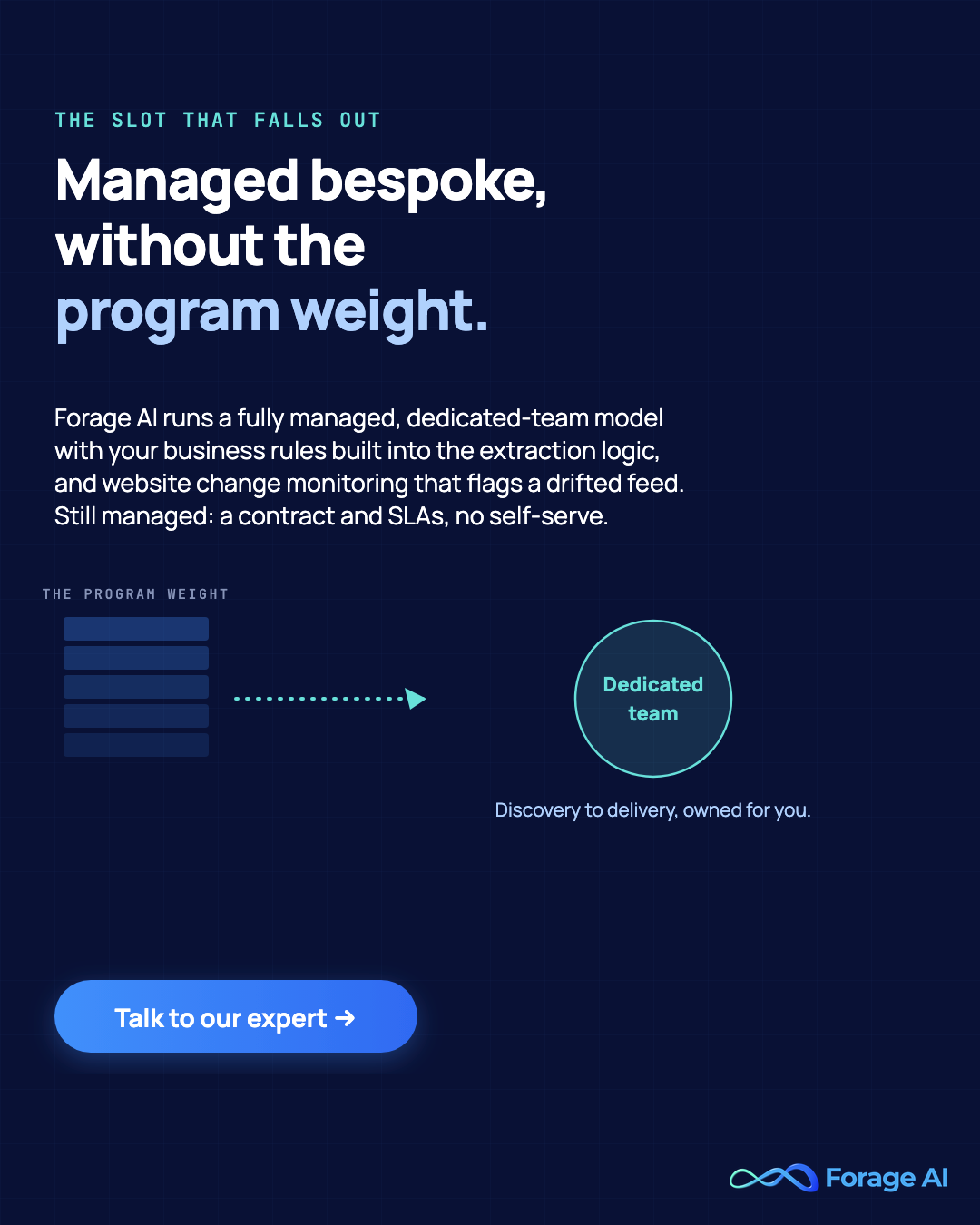
Read the diagnosis again and a requirement falls out that no vendor name satisfies on its own. If your wall is a delivery gap, leaving the managed model hands you back the QA and maintenance you were paying to avoid, worst of all for a quality complaint. And if your wall is the enterprise-program overhead but you still need managed bespoke, a self-serve tool is not the answer either. What is left is narrow: a managed provider that delivers bespoke custom extraction without the weight of an enterprise program.
Forage AI is built for that slot. It runs fully managed extraction on a dedicated-team custom-contract model, owning discovery, crawling infrastructure, extraction logic, cleaning, multi-layer QA, monitoring and delivery, with your business rules built into the logic rather than bolted onto the output. The concrete difference from PromptCloud’s scoping-call to paid-PoC to term motion is the on-ramp: onboarding typically runs one to two weeks from brief to a live pipeline, with a dedicated team from day one. On the delivery edge, website change monitoring flags a drifted or missed refresh rather than leaving you to notice, so the freshness question is answered with visibility, not with a louder guarantee. Because the managed model keeps cleaning, multi-layer QA and monitoring with the vendor, a delivery leaver does not hand the quality problem back to their own team, which is the trap the scraping-API band represents.
Who it’s for: teams where the data is the product and the schema keeps changing, which is the case the testimonials describe. The watch-out is real, and it is the same structural trade PromptCloud makes: this is a managed partnership with a contract and SLAs, there is no published price and no pay-as-you-go, and every engagement starts with a conversation. Forage does not escape the managed model; it differs on the on-ramp weight and the delivery observability inside it. Better than PromptCloud when: you need managed bespoke extraction but the enterprise-program weight, or a delivery gap inside it, has stopped fitting. Not for: a developer who wants an API key tonight, or a one-off scrape.
2. ScrapeHero
| Attribute | Detail |
|---|---|
| Model | Managed (with a self-serve cloud tier) |
| Best for | Teams needing a managed price point readable before a sales call |
| The PromptCloud edge it answers | Overhead (price and terms clarity) |
| Pricing (as published) | Managed price points: Business from ~$199/mo per website, Professional from ~$1,500/mo, Enterprise from ~$8,000/mo (scrapehero.com; carried from prior research, re-verify) |
| Who owns maintenance | The vendor |
| Watch-out | Email-only support, no phone. Per-site pricing gets expensive across many websites |
| Attribute | Detail |
|---|---|
| Ratings (with n, accessed 2026-07-16) | Capterra 4.7 (n=26) · G2 4.7 (n≈63, corroborated-via-secondary). Cite as “4.7 across roughly 63 G2 and 26 Capterra” |
| Evidence quality | Moderate base, mixed recency; praise runs 2021 to 2024 |
| What reviewers praise | Published price points, competitive value, fast responses in business hours |
| What reviewers complain about | Its own base splits on price, so present both or neither. Multi-week turnaround on urgent asks; email-only support |
| Source | Capterra; G2 seller listing (corroborated-via-secondary) |
ScrapeHero is a US-based managed provider, founded 2014, built for large-scale, ongoing extraction across complex websites, with a self-serve Cloud tier sitting under the done-for-you service. It is the roster’s closest structural analogue to PromptCloud: the same you-receive-data posture, the same vendor-owns-maintenance model, which is exactly why its one real advantage is legible rather than buried. ScrapeHero earns its slot on published managed price points where PromptCloud shows a quote-only funnel. Business starts around $199 per month per website, Professional around $1,500, Enterprise around $8,000. A buyer who needs a number before a sales call gets one here, and that is a genuine overhead win against a scoping-call program. The self-serve Cloud tier gives the same buyer a lighter on-ramp inside the one vendor.
The review base backs the pricing story more than the delivery story. ScrapeHero rates 4.7 across roughly 63 G2 and 26 Capterra reviews, a moderate base with mixed recency, praise running 2021 to 2024, and reviewers who split on whether the price is competitive or steep. Present both readings or neither. Because ScrapeHero is the roster’s closest structural twin to PromptCloud, the delivery edge barely moves here: the same multi-layer QA you cannot inspect, the same report-a-problem-and-wait loop. What changes is the number you get before the call, not who owns the outcome after you sign.
Who it’s for: a team whose wall is genuinely price and terms clarity. The counterweight is that it stays managed, so onboarding weight and QA-dependency are largely unchanged from PromptCloud, per-site pricing compounds fast across many websites, and support is email-only with no phone, a regression against PromptCloud’s 4.6-rated, phone-inclusive support. Reviewers also flag multi-week turnaround on urgent asks. Better than PromptCloud when: you need a published managed price before you talk to sales. Not for: anyone whose wall is a delivery gap, since the model is the same, or a team running many websites at once.
3. Grepsr
| Attribute | Detail |
|---|---|
| Model | Managed (with self-serve platform and a free Chrome extension) |
| Best for | Teams wanting a published entry price and flexible entry and exit |
| The PromptCloud edge it answers | Overhead (price visibility, flexible terms) |
| Pricing (as published) | Starter Pack $350 one-time on simple websites; Growth and Enterprise custom-quoted; recurring work billed monthly in arrears, pausable from the dashboard (grepsr.com/pricing, July 2026) |
| Who owns maintenance | The vendor |
| Watch-out | Shares the managed model, so a delivery gap is not obviously better answered. Its own most-cited complaint is the customization ceiling |
| Attribute | Detail |
|---|---|
| Ratings (with n, accessed 2026-07-16) | Capterra 4.8 (n=85), higher than PromptCloud’s 4.2, and on a larger base |
| Evidence quality | The largest managed-peer base on the roster, and current |
| What reviewers praise | Turnaround, support, published entry pricing, flexible cancellation |
| What reviewers complain about | Advanced changes route through the Grepsr team (the customization ceiling), a property PromptCloud does not share |
| Source | Capterra |
Grepsr is a managed provider, founded 2012, that publishes exactly what PromptCloud does not. This is the cleanest overhead contrast on the roster: a published $350 one-time Starter Pack and self-serve, pausable terms against a scoping-call, paid-PoC, term-contract program. The $350 is one-time, not monthly. Recurring crawls are billed monthly in arrears and cancellable from the dashboard, a materially more flexible entry and exit than PromptCloud’s contract term plus one-month notice. Growth and Enterprise work is custom-quoted, so the published figure is the entry point, not the whole story, and a free Chrome extension lets a buyer test before committing.
The evidence base is the strongest of any managed peer on the roster. Grepsr rates 4.8 on 85 Capterra reviews, higher than PromptCloud’s 4.2 and on a base roughly six times larger, and the reviews are current rather than stale. Praise clusters on turnaround, support, the published entry price, and the flexible cancellation. It is the roster’s clearest single sign that the incumbent is not the safe default on evidence alone: a peer rating higher, on a larger and more recent base, at a published entry price PromptCloud does not offer.
Who it’s for: a buyer whose wall is price visibility or commercial flexibility, who wants to enter and exit on their own terms. The counterweight: Grepsr shares the managed model, so a delivery gap is not obviously better answered here, and its own most-cited complaint is a customization ceiling, advanced changes route through the Grepsr team, a property PromptCloud, which markets configurability, does not share. Better than PromptCloud when: you want a published entry price and flexible terms. Not for: a buyer whose wall is a delivery gap, or who needs the largest-scale enterprise program.
4. Datahut
| Attribute | Detail |
|---|---|
| Model | Managed (full-service only) |
| Best for | Cost-sensitive teams accepting a full-service, no-control model |
| The PromptCloud edge it answers | Overhead (cost only) |
| Pricing (as published) | Volume-based; the only retrievable source is dated (~2019). No free trial, upfront payment required (re-verify current pricing) |
| Who owns maintenance | The vendor |
| Watch-out | Zero control over the extraction software, full-service only, a worse control posture than PromptCloud’s configurability |
| Attribute | Detail |
|---|---|
| Ratings (with n, accessed 2026-07-16) | Capterra 4.9 (n=10). A 4.9 on ten reviews is directional, not a signal; never read it against a larger base without the n |
| Evidence quality | Warm and genuinely small: ten reviews is directional |
| What reviewers praise | Real savings, quality datasets at competitive pricing |
| What reviewers complain about | Zero control over the extraction software; no free trial; upfront payment |
| Source | Capterra |
Datahut is a budget-oriented managed provider that produces feeds full-service, meaning it owns the pipeline end to end and you configure nothing. Pricing is volume-based, and the only retrievable source is dated to roughly 2019, so any figure is a conversation starter rather than a current quote. Its Capterra 4.9 sits on ten reviews, genuinely warm and genuinely small: a 4.9 on ten is directional, not a signal, and should never be read against a larger base without the n attached.
What the ten reviews praise is real savings and quality datasets at competitive pricing. The disqualifying line sits in that same review base: zero control over the extraction software. For a team that valued PromptCloud’s configurability, that is a worse control posture, not a better one, and it answers a delivery gap not at all, because you cannot inspect or tune what you cannot touch. Datahut answers exactly one overhead sub-symptom, the cost of the program, and leaves the others, onboarding weight and delivery observability, untouched or worse.
Who it’s for: a lean team where the only wall is cost, on stable requirements, that accepts a full-service, no-control model. Watch-out: no free trial, payment required upfront, and stale published pricing. Better than PromptCloud when: your only wall is cost and you accept a full-service, no-control model. Not for: anyone who valued PromptCloud’s configurability, or whose wall is delivery.
Band B: scraping APIs, the overhead answer where you own the pipeline
Answers the overhead edge decisively, no scoping call, public per-unit pricing, no contract, but it fixes that edge by handing you back the entire pipeline: parsing, QA, maintenance and anti-bot. That is covered in full in the honest-trade section below. This band is the worst answer for a delivery leaver, because it makes you your own QA. The three entries here differ mainly in the hard problem each is built for, a Scrapy-native pipeline, defended-target access, or fast prebuilt scrapers, but they share one posture: the vendor sells capability, not an outcome, and the outcome is yours to run.
5. Zyte
| Attribute | Detail |
|---|---|
| Model | Scraping API (managed tier as a fallback) |
| Best for | Python and Scrapy teams that want to own the pipeline |
| The PromptCloud edge it answers | Overhead (no scoping call, no paid PoC, no contract term) |
| Pricing (as published) | Usage-based, an auto-assigned site-difficulty tier with a published spread from ~$0.06 to ~$16.08 per 1,000 requests (zyte.com; re-verify) |
| Who owns maintenance | You |
| Watch-out | You take back parsing, QA, anti-bot and maintenance, and the per-request price depends on a difficulty tier you cannot see until you start |
| Attribute | Detail |
|---|---|
| Ratings (with n, accessed 2026-07-16) | Capterra 4.4 (n=43) · G2 4.3 (n=114, corroborated-via-secondary) · Trustpilot conflict: 4/5 (n=24) versus 3.1/5. Report both or use neither |
| Evidence quality | Solid Capterra and G2 bases; Trustpilot contradicts itself |
| What reviewers praise | Scrapy integration, flexibility, no onboarding gate |
| What reviewers complain about | Opaque per-request tiering; support signal contradicts across platforms |
| Source | Capterra; G2 and Trustpilot (corroborated-via-secondary) |
Zyte, the team behind the open-source Scrapy framework, offers deep Scrapy integration and a managed tier as a fallback. This is where the roster crosses from managed into scraping-API territory, and the overhead answer gets sharper and more literal. You get data without a scoping call, a paid proof-of-concept or a contract term, the cleanest answer on the roster to PromptCloud’s onboarding and commitment overhead. Pricing is usage-based, an auto-assigned site-difficulty tier with a published spread from roughly $0.06 to $16.08 per 1,000 requests.
The review base is solid where it counts and contradictory where it does not. Zyte rates 4.4 on 43 Capterra reviews and 4.3 on 114 at G2, with Trustpilot returning a 4 out of 5 on 24 reviews against a separate 3.1, a conflict worth reporting rather than resolving. Reviewers praise the Scrapy integration and the absence of an onboarding gate, and complain about opaque per-request tiering. The 268x spread between the cheapest and dearest tier is the shape of that complaint: the sticker looks tiny at the floor and is not tiny at a defended target, and you learn which one you have only after you start.
The honest counterweight the article has to state: you take back parsing, QA, anti-bot and maintenance, and you trade PromptCloud’s quote opacity for a different cost problem, a difficulty tier and a roughly 268x price spread you cannot see until you start. Who it’s for: teams with Python and Scrapy capacity and the appetite to own the pipeline. Better than PromptCloud when: your wall is onboarding weight or commitment and you have engineers. Not for: teams without that capacity, or whose wall was delivery, since you just became your own QA.
6. Bright Data
| Attribute | Detail |
|---|---|
| Model | Scraping API and proxy infrastructure |
| Best for | Teams whose bottleneck is access to aggressively defended targets at scale |
| The PromptCloud edge it answers | Overhead + hard targets (PAYG, no contract) |
| Pricing (as published) | Pay-as-you-go; advertised rates are promo-gated, so quote the regular card (brightdata.com; re-verify) |
| Who owns maintenance | You |
| Watch-out | You inherit the whole pipeline; price is the consistent complaint across years |
| Attribute | Detail |
|---|---|
| Ratings (with n, accessed 2026-07-16) | Capterra 4.7 (n=68) · Trustpilot 4.4 (n≈970). G2 figures are all-product seller aggregates, so do not print them as product review counts |
| Evidence quality | Large Trustpilot base; recent and specific praise and complaints both exist |
| What reviewers praise | “lower error rate” on access at scale (Feb 2026) |
| What reviewers complain about | A Sept 2025 one-star reviewer reports “high data fetching failure rates” and being “charged for queries that did not return real data” |
| Source | Capterra; Trustpilot (corroborated-via-secondary) |
Bright Data is a scraping-API and proxy-infrastructure provider best for teams whose bottleneck is access: beating aggressively defended targets at scale, pay-as-you-go, no contract. If PromptCloud’s weight was never the problem and a hard-target wall was, this is the entry that answers it. Advertised rates are promo-gated, so the regular card is the honest number to quote.
Bright Data pairs a scraping API with large-scale proxy infrastructure, which is what lets it reach targets that block lighter tools. Access is a different wall than program weight: if PromptCloud never felt heavy and the blocker was getting the data at all, this is the entry that answers it. The evidence base is unusually large for the category. Bright Data rates 4.7 on 68 Capterra reviews and 4.4 on roughly 970 at Trustpilot, a big base with recent, specific signal on both sides. Its G2 figures are all-product seller aggregates, so they are not printed as product review counts. Fresh praise is concrete about a lower error rate on access at scale (February 2026). The watch-outs are equally specific: price is the consistent complaint across years, and a September 2025 one-star reviewer describes high failure rates and being charged for queries that returned no real data, a cost-control problem of its own.
Who it’s for: a team whose hard problem is anti-bot access at scale and who accepts owning the pipeline. Better than PromptCloud when: your wall is onboarding or commitment and your hard problem is access. Not for: anyone who wanted to stop owning a pipeline, because you inherit all of it, parsing and QA included.
7. Apify
| Attribute | Detail |
|---|---|
| Model | Scraping API and actor marketplace |
| Best for | Technical-ish teams wanting prebuilt scrapers fast |
| The PromptCloud edge it answers | Overhead (time-to-first-data) |
| Pricing (as published) | Usage-based: compute units plus separately metered proxy GB, with monthly credits that expire without rollover (apify.com; re-verify) |
| Who owns maintenance | You (and community-maintained actors vary in quality) |
| Watch-out | Usage-based billing is the defining complaint; credits expire monthly with no rollover |
| Attribute | Detail |
|---|---|
| Ratings (with n, accessed 2026-07-16) | Capterra 4.8 (n=512), the only large review sample on the entire roster, bigger than any managed peer’s |
| Evidence quality | The strongest base here by a wide margin. Trustpilot’s flat 5.0 on n=614 is near-implausible and not printed |
| What reviewers praise | “configured in about 20 minutes” (Jun 2026), fast time-to-data |
| What reviewers complain about | Compute-unit billing plus metered proxy GB; expiring credits; variable community actors |
| Source | Capterra |
Apify is a scraping-API platform built around an actor marketplace: prebuilt scrapers you can rent or assemble fast, the sharpest answer on the roster to PromptCloud’s scoping-call onboarding overhead. Pricing is usage-based, compute units plus separately metered proxy gigabytes, with monthly credits that expire without rollover.
If this article prints one rating with confidence, it is Apify’s Capterra 4.8 on 512 reviews. That is the only large review sample on the entire roster, bigger than any managed peer’s and by a wide margin the strongest base here, which is worth more than the half-point separating the top ratings. Trustpilot’s flat 5.0 on 614 is near-implausible and is not printed. Fresh praise is specific about speed: one reviewer configured a working scraper in about twenty minutes (June 2026), which is the whole pitch. The watch-out has a mechanism: usage-based billing is the defining complaint, compute units plus separately metered proxy GB plus expiring credits, and community-maintained actors vary in quality, so the actor you rent is only as good as whoever maintains it.
Who it’s for: a technical-ish team whose wall is time-to-first-data and who has the capacity to wire prebuilt scrapers together. Better than PromptCloud when: your wall is time-to-first-data and you have technical capacity. Not for: teams that hired a managed provider precisely so they would not have to watch a metered bill, or maintain the scrapers they rented.
Band C: no-code and AI extraction, overhead for non-engineers
Answers the overhead edge with public price cards and no scoping call, for teams with no engineers or no appetite for selectors. Costs you breakage handling, scale ceilings and 2 a.m. maintenance, which become yours. The two entries split by who is driving: a no-code builder for an analyst who wants a visual tool, and AI extraction for an engineer who wants to skip selector-writing on standard pages. Both trade the managed outcome for a console you operate yourself, and the wider data extraction tool landscape sits underneath this band.
8. Octoparse
| Attribute | Detail |
|---|---|
| Model | No-code (point-and-click, cloud scheduling) |
| Best for | Analysts on stable, simple websites, with no engineers |
| The PromptCloud edge it answers | Overhead (cost, no-code control) |
| Pricing (as published) | Free tier; Standard ~$69/mo, Professional ~$249/mo (octoparse.com vendor page; an aggregator renders these per year, off by 12x, so use the vendor page) |
| Who owns maintenance | You |
| Watch-out | “It can struggle with dynamic websites occasionally” (Jun 2025), exactly what a managed customer was avoiding |
| Attribute | Detail |
|---|---|
| Ratings (with n, accessed 2026-07-16) | Capterra 4.7 (n=106) · G2 4.8 (n=52) · Trustpilot 4.1 (n=96) · TrustRadius 7.0 out of 10 (n=13). Report the spread |
| Evidence quality | The spread itself is the fact: the same product scores a full grade lower on the platform with the smallest base. Allege no mechanism |
| What reviewers praise | Genuine free tier, point-and-click templates, cloud scheduling |
| What reviewers complain about | Struggles with dynamic or heavily defended websites |
| Source | Capterra, G2, Trustpilot, TrustRadius (the last three corroborated-via-secondary) |
Octoparse (legal entity Octopus Data Inc., the same company, so do not double-count it as two) is a point-and-click, template-driven no-code tool with a genuine free tier and cloud scheduling. It is the overhead answer for a non-engineer: public price cards, no scoping call, a visual builder instead of selectors. Standard runs around $69 per month and Professional around $249 on the vendor page. One aggregator renders these per year and lands 12x off, so use the vendor page.
The evidence to read is the spread, not the headline: 4.7 on Capterra (n=106), 4.8 on G2 (n=52), 4.1 on Trustpilot (n=96), and 7.0 out of 10 on TrustRadius (n=13). The same product scores a full grade lower on the platform with the smallest base. We report the spread and allege no mechanism behind it, because the spread itself is the fact worth carrying: a single headline number for Octoparse would be a choice about which platform to believe, and the honest answer is to show all four with their bases and let the reader weigh them.
Who it’s for: an analyst on simple, stable websites with no engineers. Watch-out: its own reviewers note it can struggle with dynamic or heavily defended websites, which is precisely the failure a PromptCloud customer hired a managed provider to avoid. Better than PromptCloud when: your wall is cost and overhead, your sites are simple and stable, and you have no engineers. Not for: complex or heavily defended targets, the exact case that sends people to a managed provider in the first place.
9. Diffbot
| Attribute | Detail |
|---|---|
| Model | AI extraction (structured data without writing selectors) |
| Best for | Teams whose overhead is engineering time on standard page types |
| The PromptCloud edge it answers | Overhead (engineering time) |
| Pricing (as published) | Free tier; from ~$299/mo (diffbot.com; re-verify) |
| Who owns maintenance | You (still self-serve QA) |
| Watch-out | Pivoted toward LLM and knowledge-graph, so it answers a narrower question than a custom managed crawl |
| Attribute | Detail |
|---|---|
| Ratings (with n, accessed 2026-07-16) | Capterra 4.5 (n=4). A tiny base, most recent review 2021; not headlined |
| Evidence quality | Too small to signal; treat as directional only |
| What reviewers praise | Extraction without writing or maintaining selectors |
| What reviewers complain about | Less control over bespoke schemas; a narrowing product focus |
| Source | Capterra |
Diffbot is a different model from the rest of this roster: AI extraction that returns structured data without writing or maintaining selectors, the answer to a reader whose overhead is engineering time on standard, well-structured pages. There is a free tier, with paid plans from around $299 per month. It removes selector work, not QA, so the maintenance question stays with you.
The evidence is too thin to lean on, and the honest move is to say so. Diffbot’s Capterra rating sits on four reviews, most recent 2021, directional at best and not something to headline. What those reviews praise is extraction without writing or maintaining selectors; what they flag is less control over bespoke schemas and a narrowing product focus. Diffbot is the roster’s edge case: a real answer to a narrow overhead, engineering time on standard, well-structured pages, and the wrong tool the moment the schema turns bespoke or the pages stop being standard, which is the exact territory a custom managed crawl exists for.
Who it’s for: a team whose overhead is engineering time on standard page types. Watch-out: Diffbot has pivoted toward LLM and knowledge-graph work, so it answers a narrower, different question than a custom managed crawl, with less control over bespoke schemas and self-serve QA that stays yours. Better than PromptCloud when: your wall is engineering time on standard, well-structured pages. Not for: bespoke schemas, or teams that wanted someone else to own QA.
Band D: no longer general-purpose alternatives
Both appear on most rival lists. Neither is a general-purpose alternative as of July 2026, and recommending either to an enterprise buyer without the caveat would be malpractice. They are here because leaving them off would let a reader assume the rival lists are complete; the honest note is that one is dormant and the other has repositioned away from general extraction entirely, so a multi-year commitment to either carries a roadmap risk the star rating does not show.
ParseHub
| Attribute | Detail |
|---|---|
| Model | No-code desktop scraper |
| Best for | Not currently recommendable for enterprise use |
| The PromptCloud edge it answers | None it can be counted on for today |
| Pricing (as published) | Sources conflict, page is JS-rendered (re-verify) |
| Rating (with n, accessed 2026-07-16) | Capterra 4.5 (n=16) |
| Watch-out | Alive but dormant: last funding a seed round in January 2017, roughly 1 to 10 employees, and about one Capterra review since 2022 |
ParseHub is alive but dormant: the site returned 200 in mid-2026 with no sunset notice, but last funding was a seed round in January 2017 and there has been roughly one Capterra review since 2022. The article cannot honestly characterize current sentiment because there isn’t any, and that absence is the finding. For an enterprise buyer, dormant is disqualifying on its own: a tool with no active development and no recent review signal is a maintenance-mode bet, whatever its old rating says. (Do not confuse it with Parse, Facebook’s backend, shut down in 2017.)
Import.io
| Attribute | Detail |
|---|---|
| Model | Repositioned to retail price intelligence |
| Best for | Retail price and assortment monitoring, not general-purpose extraction |
| The PromptCloud edge it answers | None as a general-purpose alternative |
| Pricing (as published) | Not published for the repositioned product (re-verify) |
| Rating (with n, accessed 2026-07-16) | Capterra 4.3 (n=13) |
| Watch-out | Acquired by Neuralogics on 14 October 2025 and actively repositioning, so most rival listicles describe the old product |
Import.io is alive and actively shipping, but the product a 2019 reviewer describes is not what is sold today. Neuralogics acquired it on 14 October 2025, and the homepage is now real-time pricing intelligence for retail and brands, a narrowing from general-purpose extraction. The review base is a time capsule, and the roadmap risk on a multi-year contract is real. A 2019 review of a general-purpose extractor tells you nothing about a 2026 retail-pricing product, which is why the 4.3 on 13 reviews rates something that no longer exists.
Quick Summary
Q: Which PromptCloud alternative should you actually look at?
A: It depends on the edge. If your wall is the enterprise-program overhead but you still need managed bespoke, a managed peer without the program weight. For a published managed price, ScrapeHero or Grepsr’s one-time entry. For a lighter self-serve path, the scraping APIs and no-code tools, which answer overhead by handing you back the pipeline. And if your wall is a delivery gap, a better managed partner, not a different model, because leaving managed makes you your own QA.
PromptCloud and the alternatives, side by side
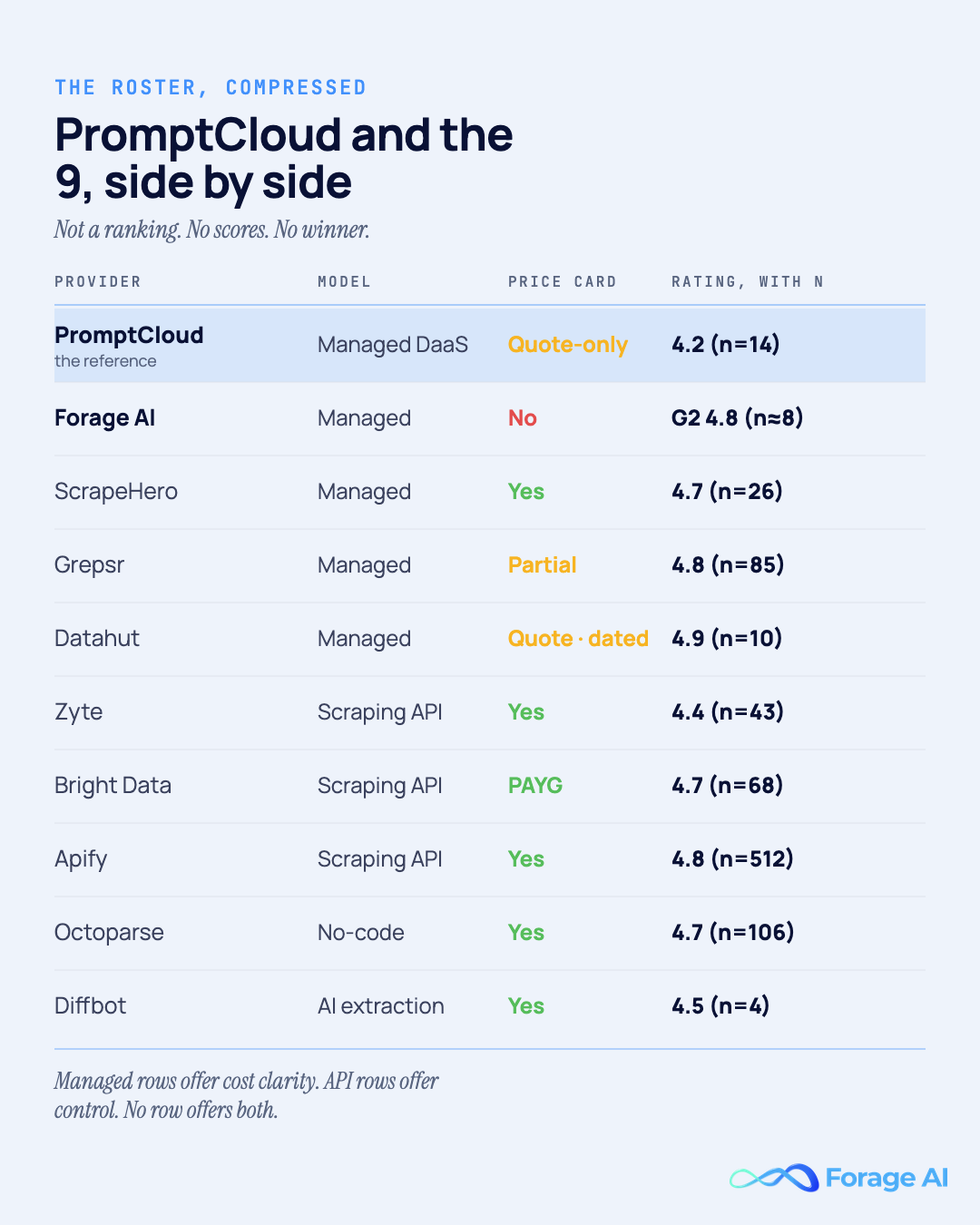
The roster answered the edges one entry at a time; the grid answers them all at once. This is a comparison against PromptCloud, not a ranking. There are no ranks, no scores and no winner; read down the last column and the shape of the choice appears.
| Provider | Model | Pricing (published?) | Rating (with n, accessed Jul 2026) | Best for | Better than PromptCloud when… |
|---|---|---|---|---|---|
| PromptCloud | Managed DaaS | Quote-only | Capterra 4.2 (n=14, nothing after 2023) | Large recurring enterprise programs | (reference point) |
| Forage AI | Managed | Quote-only | G2 4.8 (n≈8, first-party) | Managed bespoke without the program weight | You need managed bespoke and the weight, or a delivery gap in it, stopped fitting |
| ScrapeHero | Managed | Published | Capterra 4.7 (n=26) · G2 4.7 (n≈63) | A managed price before a call | You need a published managed price |
| Grepsr | Managed | Partial ($350 one-time) | Capterra 4.8 (n=85) | Published entry price, flexible terms | You want a published entry price and flexible exit |
| Datahut | Managed | Quote-only (dated) | Capterra 4.9 (n=10) | Budget, no-control feeds | Your only wall is cost |
| Zyte | Scraping API | Published | Capterra 4.4 (n=43) · G2 4.3 (n=114) | Scrapy teams owning the pipeline | Your wall is onboarding or commitment and you have engineers |
| Bright Data | Scraping API | PAYG (promo-gated) | Capterra 4.7 (n=68) · Trustpilot 4.4 (n≈970) | Anti-bot access at scale | Your hard problem is access |
| Apify | Scraping API | Published (usage-based) | Capterra 4.8 (n=512) | Fast prebuilt scrapers | Your wall is time-to-first-data and you have engineers |
| Octoparse | No-code | Published | Capterra 4.7 (n=106) · Trustpilot 4.1 (n=96) | Analysts on simple websites | Your sites are simple and you have no engineers |
| Diffbot | AI extraction | Published | Capterra 4.5 (n=4) | Extraction without selectors | Your overhead is engineering time on standard pages |
| ParseHub | No-code | Conflicting | Capterra 4.5 (n=16) | Dormant, not recommendable | Rarely; it is maintenance-mode |
| Import.io | Retail price intel | Not published | Capterra 4.3 (n=13) | Retail price monitoring | Only for retail price intelligence |
Sources: Capterra, G2, Trustpilot as applicable (accessed July 2026; G2 and Trustpilot corroborated-via-secondary); pricing from vendor pages only. Ratings and pricing drift, so re-check before you sign.
Read down the “better than PromptCloud when” column and the argument appears in one glance. The overhead answers, a published price, no contract, no scoping call, no-code, cluster on one side. The delivery answer, a better managed partner, sits alone on the other, and nothing self-serve says “better delivery.” Note too that several alternatives rate on far larger review bases than PromptCloud’s 14, and Grepsr at 4.8 across 85 rates higher outright.
The grid has a market reading. Within web scraping, services grow at 18.62% CAGR, faster than software’s larger 58.35% share of 2025 revenue, and the market runs from $1.34B in 2025 to a projected $3.49B by 2031 (Mordor Intelligence, July 2026). The self-serve column is wider only because it answers a narrower edge, not because the market is migrating from done-for-you to DIY.
Quick Summary
Q: How do PromptCloud and its alternatives compare side by side?
A: Read down the “better than PromptCloud when” column. Managed peers beat it on published pricing or flexible terms; scraping APIs and no-code tools beat it on onboarding weight but hand back the pipeline; only a better managed partner answers a delivery gap without making you your own QA. Several alternatives rate on far larger review bases than PromptCloud’s 14 Capterra reviews, and Grepsr (4.8 across 85) rates higher outright.
The honest trade: leaving managed hands the QA and maintenance back
Every competing page hands a PromptCloud customer a self-serve link without noting they just took the QA and maintenance back in-house. There are five models here, not two: managed DaaS, scraping API, no-code, AI extraction, and ready-made datasets. The tool-roundups miss the last: if a standard dataset already exists, buy it, no scoping, no PoC, no build, at the cost of all customization.
What “taking the maintenance back” means, itemized: parsing, scheduling, QA, breakage response, anti-bot, proxy management and monitoring, the full stack PromptCloud absorbed, and it is getting harder. Automated bots were 53% of all web traffic in 2025, up from 51% in 2024, and 27% of bot attacks now target APIs directly (Imperva/Thales, April 2026). You inherit not a fixed cost but an escalating one, which is what teams discover after they bring scraping in-house.
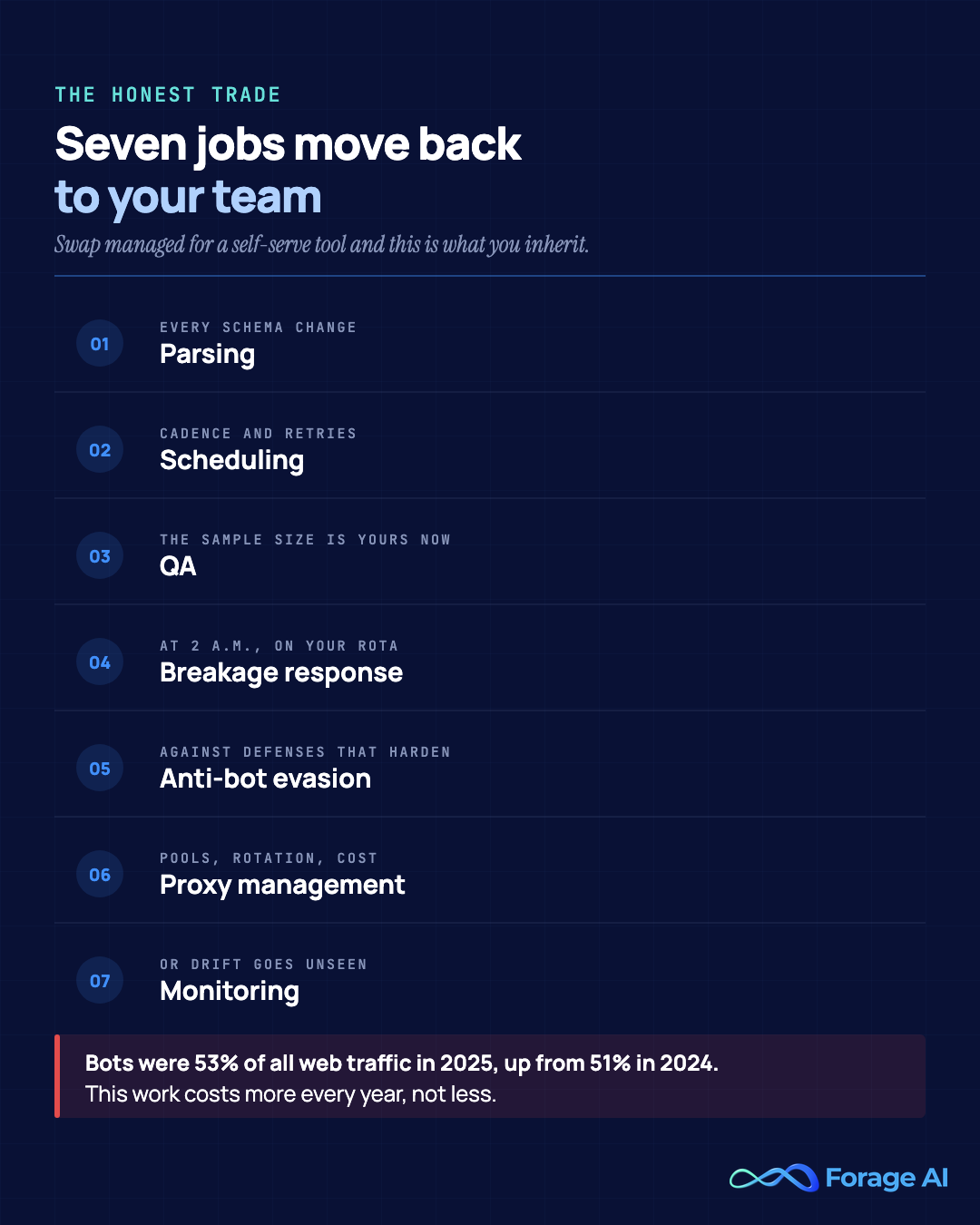
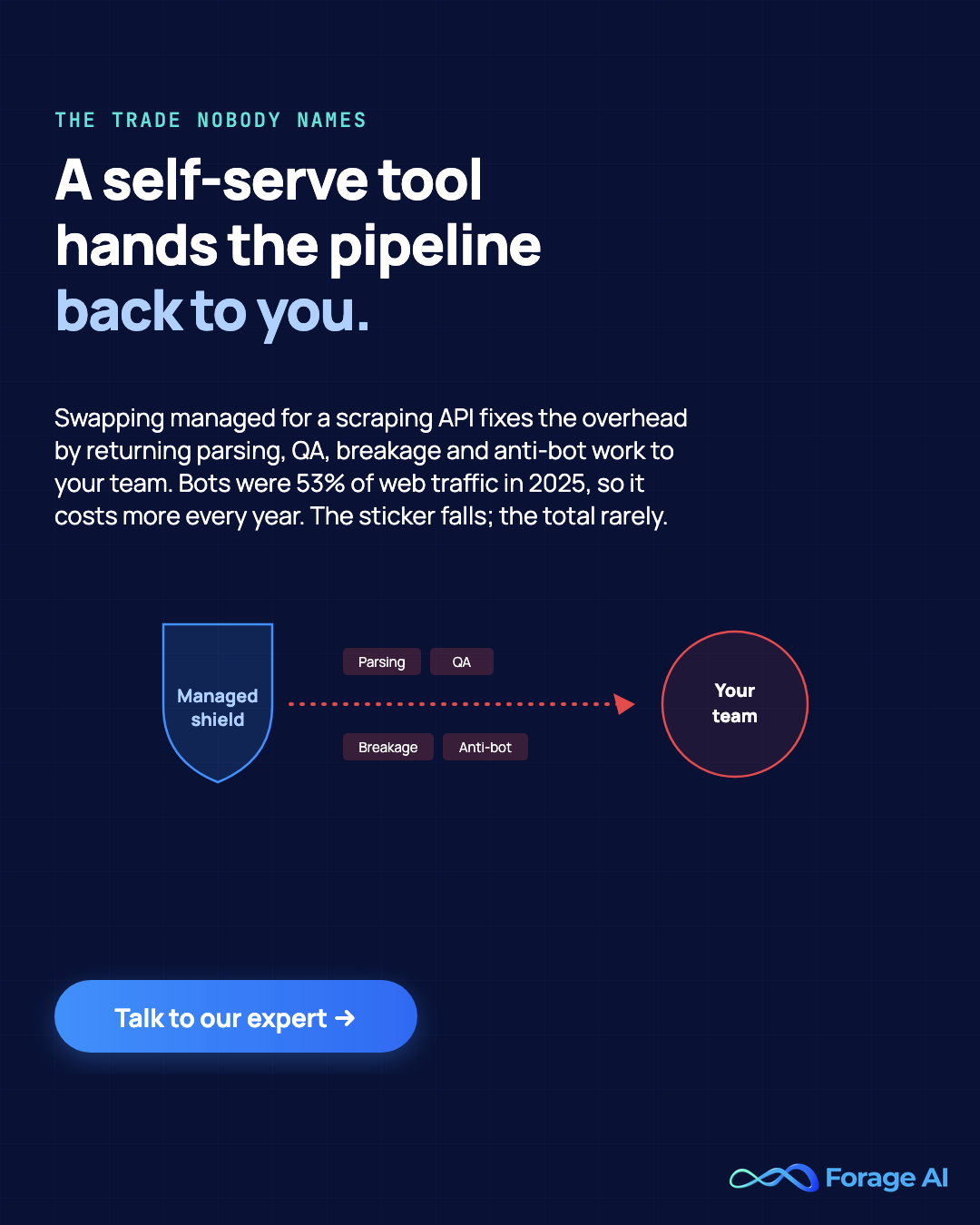
Common misconception. Swapping a managed provider for a scraping API does not fix the enterprise-program overhead for free. It fixes it by handing back the parsing, QA, breakage and anti-bot work PromptCloud absorbed, and bot traffic hit 53% of the web in 2025, so that work costs more every year, not less. It is the worst trade of all for a team that left over data quality, because it makes you your own QA.
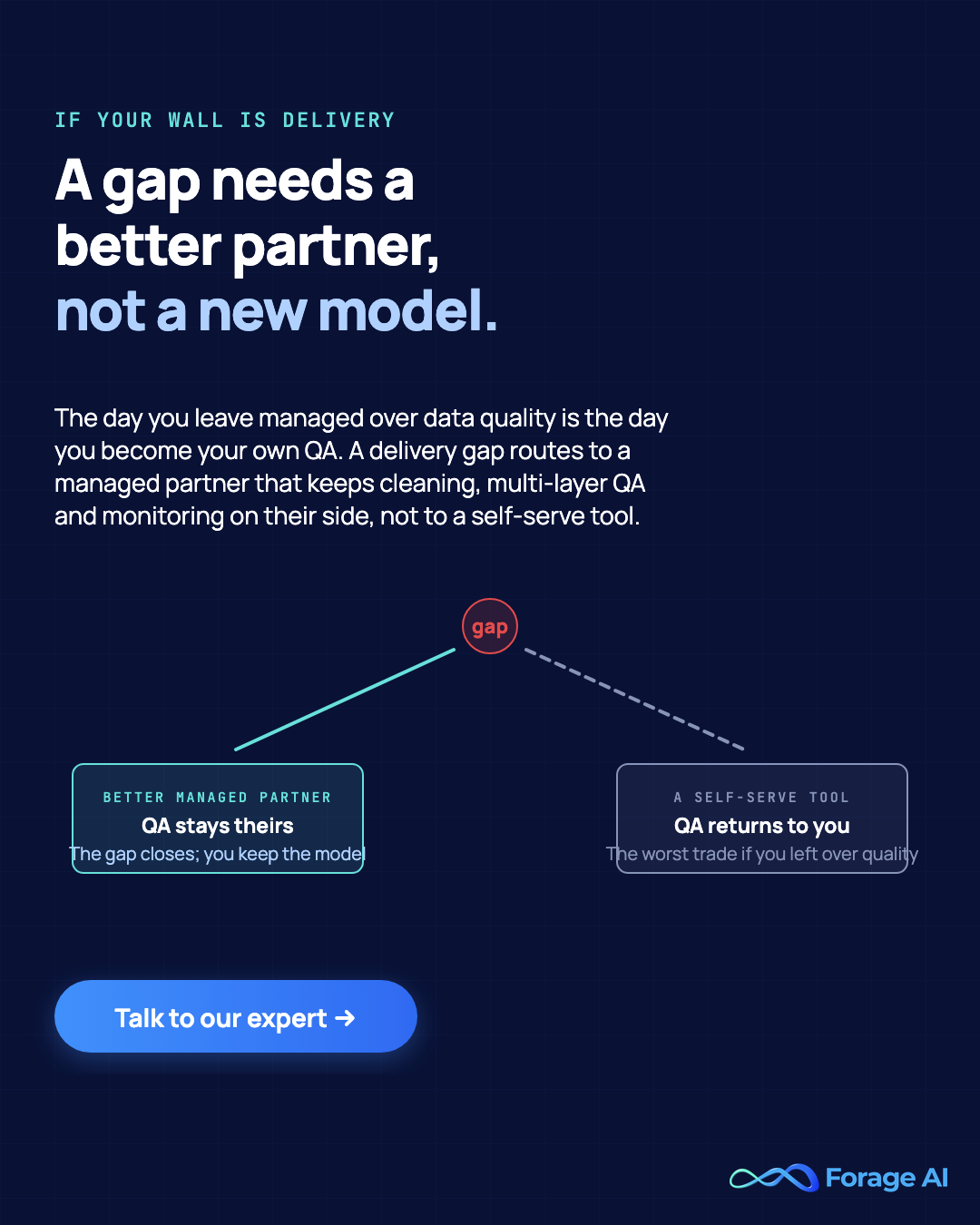
Converting a managed outcome into engineering headcount is a trade, not an upgrade: the sticker price falls, the total cost usually does not. That is what routes a delivery-edge reader back to a better managed partner in Band A, not to a different model.
Quick Summary
Q: Can you replace a managed provider like PromptCloud with a self-serve scraping tool?
A: Yes, and it is a trade rather than an upgrade. The self-serve tool fixes the enterprise-program overhead by returning parsing, QA, breakage response and anti-bot work to your team, and that work is escalating (bots were 53% of all web traffic in 2025, per Imperva). The sticker price falls; the total cost usually does not, and it is the worst trade of all if you left PromptCloud over data quality, because you become your own QA.
Three questions nobody puts on the checklist
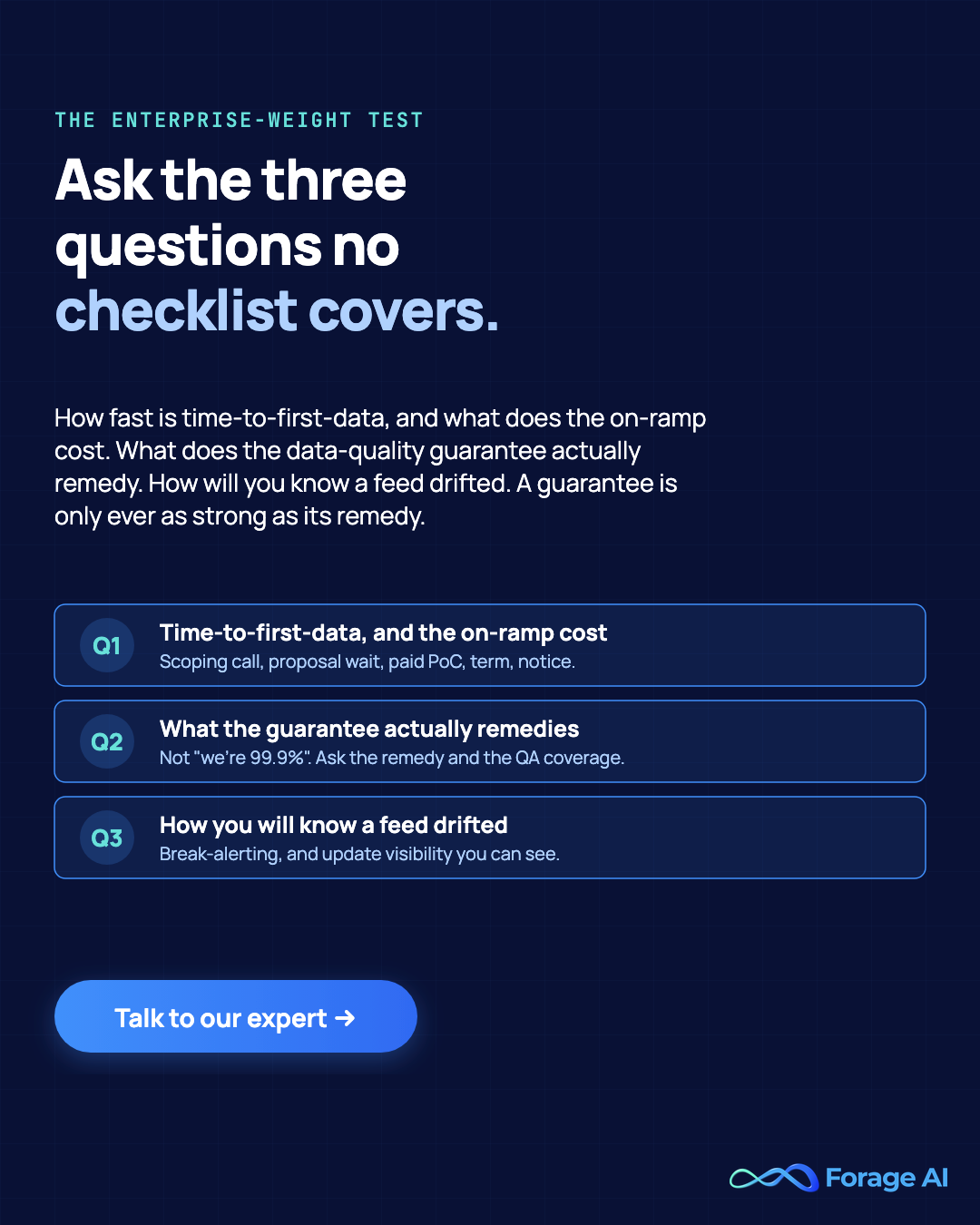
You have the list; now the method. Three questions come from the three things the evidence says actually bite for an enterprise-program buyer, and none appears on any checklist on this SERP. Call it the Enterprise-Weight Test, and ask them in order.
Q1: How fast is time-to-first-data, and what does the on-ramp cost me? Get it in writing: a scoping call, a proposal wait, a paid proof-of-concept, a minimum term, a notice period? This is the overhead edge as a purchasing question, and PromptCloud’s scoping-call to paid-PoC to term motion makes it concrete.
Q2: What does the data-quality guarantee actually remedy, and what is your QA coverage? Not “we’re 99.9%.” Ask what the guarantee covers and what the SLA credit is. A guarantee is only as strong as its remedy.
Q3: How will I know a feed drifted or a refresh didn’t run? The freshness question: break-alerting and update visibility. The literature names the failure it prevents, data cascades that are “opaque and delayed” (Sambasivan et al., 2021).
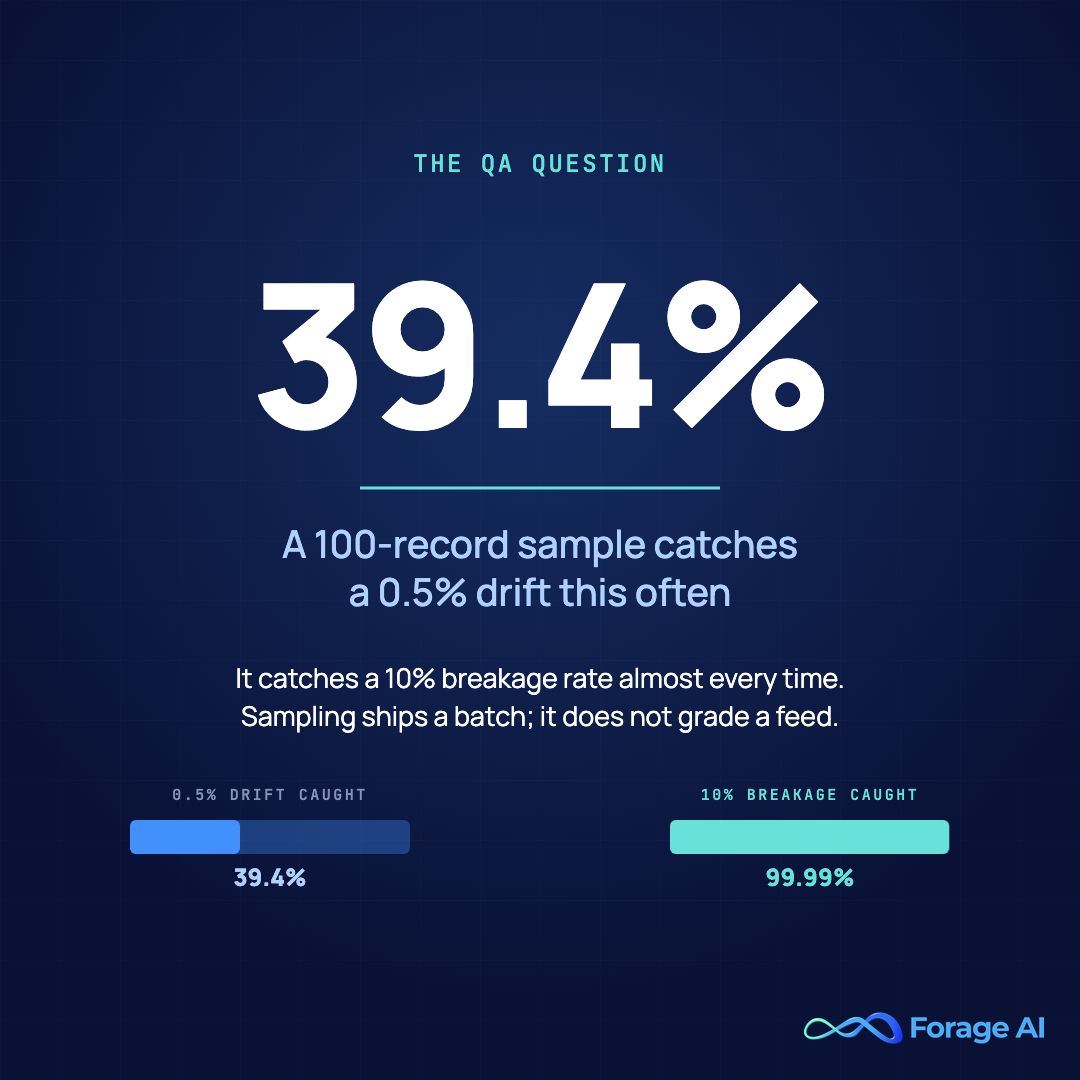
On Q2, the guarantee can be pressure-tested without an accusation, using a framework for evaluating data quality and a standards body. NIST’s handbook puts it in one sentence: “The main purpose of acceptance sampling is to decide whether or not the lot is likely to be acceptable, not to estimate the quality of the lot” (NIST/SEMATECH §6.2.1). Sample-based QA answers “should we ship this batch?”, not “is this feed still measuring what it measured last quarter?” This is a tool for any provider, Forage included, not a claim about PromptCloud’s numbers, which it does not publish.
Catch probability of a random sample, by drift rate: 1 - (1 - p)^n
n = 100 records
  p = 10%   (0.10):  1 - 0.90^100  = 99.997%   (caught essentially always)
  p = 1%    (0.01):  1 - 0.99^100  = 63.4%
  p = 0.5%  (0.005): 1 - 0.995^100 = 39.4%
To catch a 1% drift with 95% confidence, you need n = 299 records.
(Binomial; computed and verified by Forage AI, 2026-07-16.)
A 100-record sample catches a 10% breakage rate essentially every time, which is why reliability reputations, PromptCloud’s included, are real and earned; it catches a 0.5% drift under 40% of the time, exactly where the “missing a lot of values” review sits. The buyer’s exposure to a sampling plan has a name, “consumer’s risk” (NIST/SEMATECH §6.2.2), and it belongs in Q2.
The requirement these three questions point to is a managed provider that can answer Q1 with a light on-ramp and Q3 with real break-alerting. Forage AI, entry #1 above, is built to answer both: a one-to-two-week onboarding rather than a scoping-call-to-paid-PoC motion, and website change monitoring that flags a drifted feed rather than leaving you to notice.
Quick Summary
Q: How should you choose between PromptCloud and its alternatives?
A: Ask three questions no checklist covers, in order: how fast is time-to-first-data and what does the on-ramp cost (scoping call, paid proof-of-concept, term, notice period), what does the data-quality guarantee actually remedy, and how will I know a feed drifted. The second matters because a guarantee is only as strong as its remedy, and sampling is built to decide whether to ship a batch, not to estimate a feed’s quality (NIST/SEMATECH): a 100-record sample catches a 10% breakage rate almost always and a 0.5% drift under 40% of the time.
What does switching off a managed provider actually involve?
Say the three answers point you off PromptCloud. The exit itself is contractual before it is technical, and for PromptCloud more so than most: the contract carries a term with renewal and termination clauses and a one-month notice period to release project-specific resources (PromptCloud FAQ, July 2026). That is why it is harder than a self-serve migration, and why nobody has written it. Five steps, only one engineering.
- Establish who owns the crawlers PromptCloud built, before you sign, not on the way out. This clause decides whether an exit is a migration or a rebuild.
- Export the historical dataset in a readable format, before notice starts.
- Hold the schema constant, or every downstream consumer breaks on cutover day.
- Plan around the notice period. PromptCloud’s term plus one-month notice means you plan a month ahead; a monthly-in-arrears alternative such as Grepsr unwinds faster.
- Parallel-run the new provider before you cut over. Never flip.
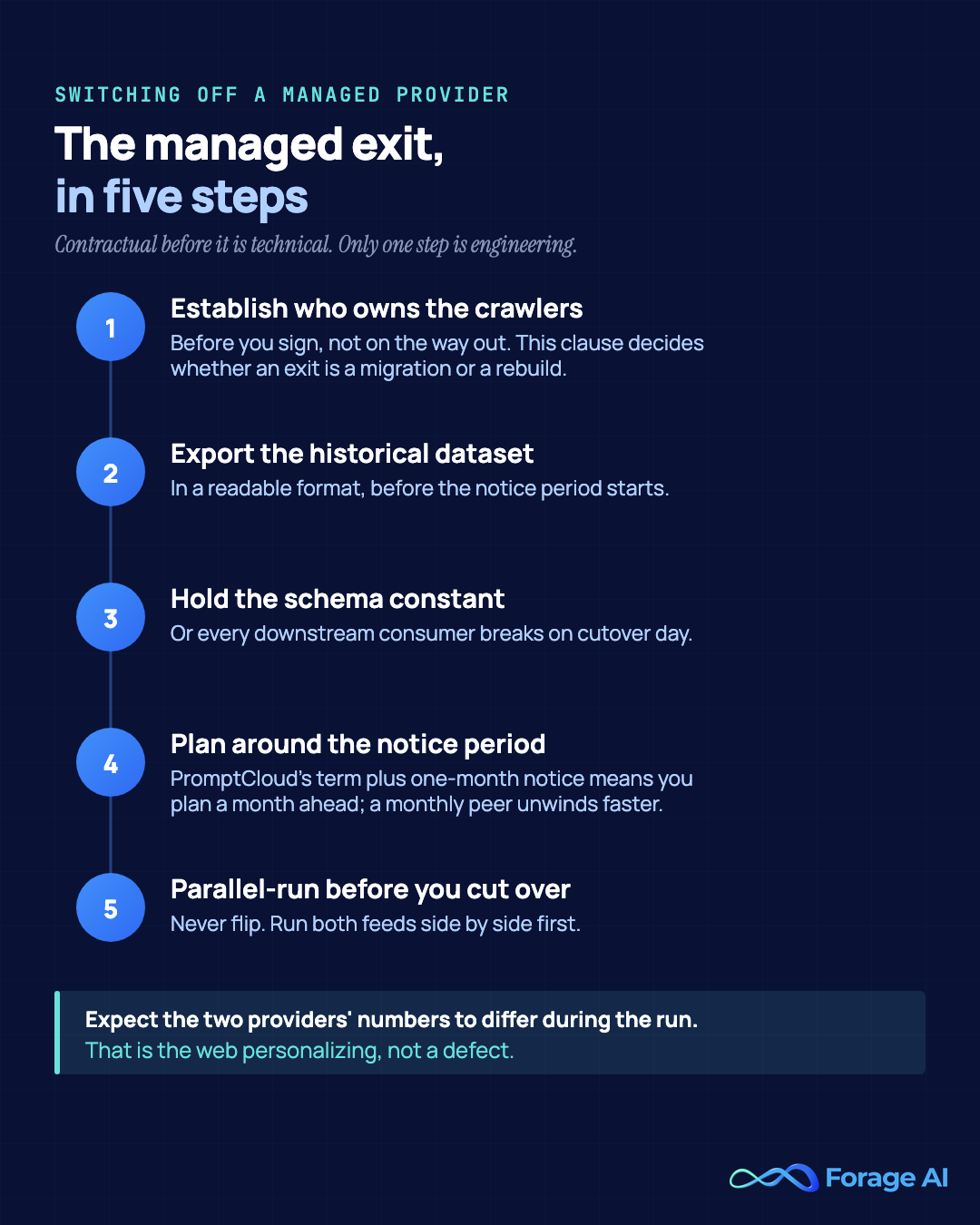
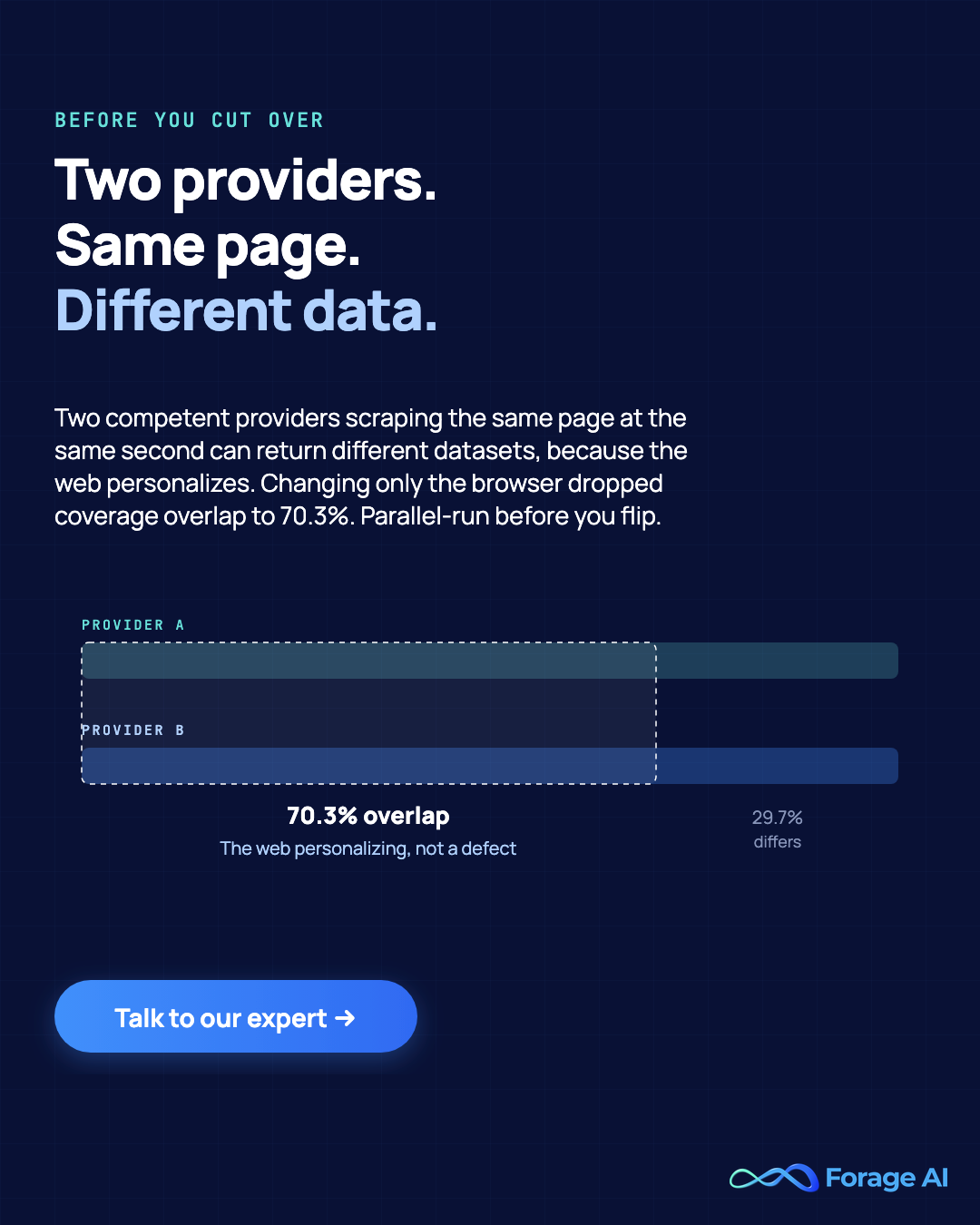
The parallel run is where most bake-offs go wrong: two providers side by side will not match, and that is expected, not proof either is wrong. If the real question is whether to bring extraction in-house, build or buy your web data extraction runs that calculation.
One measured figure sizes the parallel-run surprise. Changing only the requester moved coverage of the same target to between 61.8% and 73.7% overlap in Foerderer’s experiment (2023), which is why a bake-off must control request configuration or it decides on an artifact rather than a provider.
Common misconception. Mismatched numbers during a parallel run are not proof the new provider is wrong. Foerderer’s experiment held time constant and changed only the requester: a different browser dropped coverage overlap of the same target to 70.3% of the benchmark, and different US locations ranged from 61.8% to 69.2% (2023). Two competent providers scraping the same page at the same second can legitimately return different datasets, because the web personalizes. Control the request configuration before you draw a conclusion.
Quick Summary
Q: What does switching off a managed web scraping provider actually involve?
A: Five things, only one technical: establish who owns the crawlers you paid to have built, export the historical dataset, hold the schema constant so downstream consumers don’t break, plan around the notice period (PromptCloud’s contract carries a one-month notice), and parallel-run before you cut over. Expect the two providers’ numbers to differ, since changing only the browser drops coverage overlap of the same target to 70.3% (Foerderer, 2023).
When PromptCloud is still the right call
A guide that cannot say when to stay has no standing to say when to go, and nobody on this SERP does. PromptCloud’s enterprise weight is a real fit for a real buyer: the overhead that pushes a small or urgent team away is precisely the program a large recurring buyer pays for.
Stay if you are a true enterprise buyer running a large, recurring, multi-source program: the scoping-call, PoC and term motion is a feature at that scale, not a bug. Stay if standard, reliable managed delivery is what you buy and your extraction logic is stable. Stay if the failure mode you fear is systemic breakage, which randomized sample QA catches essentially every time. Stay if you value responsive, hands-on support: on Capterra, Support and Value-for-money both score 4.6 out of 5, Ease 4.6, Functionality 4.4 (July 2026). PromptCloud has run since 2009, and reliability is among its most-praised themes, “extremely reliable data with multi-level quality checks” (Oct 2023).
The honest limit, once. The public record is thin (14 Capterra reviews) and stale (nothing after 2023), so it cannot tell you how PromptCloud performs on a large, current engagement. That is an absence of evidence, not evidence of a problem, and the answer is a bake-off on your own workload. And sometimes the problem is not the vendor: an SLA or cadence never negotiated, weekend cover or freshness alerts, can be fixed in place before you switch.
Quick Summary
Q: When is PromptCloud still the right call?
A: Stay when you are a true enterprise buyer running a large, recurring, multi-source program, when standard reliable managed delivery is what you buy and your extraction logic is stable, and when the failure mode you fear is systemic breakage. PromptCloud has run since 2009, its Support and Value-for-money both score 4.6 out of 5 on Capterra, and the weight that pushes small teams away is exactly the program a large recurring buyer is paying for.
What the research shows
Expert Insights
Christian Peukert’s panel of US credit unions, 69,638 observations and 3,357 switches from 1999 to 2009, put average vendor tenure at four years and average per-period switching cost near 3% of annual expense (Ulm University, 2010). It is the closest thing the literature has to a measured switching cost, not a business-case number, and it frames changing a managed data vendor as routine rather than radical.
Nithya Sambasivan and colleagues at Google Research described the delivery edge before this article named it: data cascades are “opaque and delayed, with poor indicators and metrics” (Sambasivan et al., CHI ’21, 2021). A feed that quietly misses values or refreshes without visibility is exactly that, the failure no aggregate rating surfaces.
Jens Foerderer, then Professor of Information Systems at the Technical University of Munich, framed the mechanism: “naïve web scraping procedures can lead to sampling bias… sampling bias emerges from web content being volatile, personalized, and unindexed” (2023). His measurements show why it is invisible rather than merely expensive: a scraper run ten minutes after publication missed 2.1% of items, and at an eight-hour lag 5.4%, with statistically significant bias.
The field’s heuristic for what bad data costs comes from Thomas C. Redman, who coined it: “It costs ten times as much to complete a unit of simple work when the data are flawed…” (Harvard Business Review, 2012), a rule of thumb, as he says himself. It sets the two-sided frame for any quality guarantee: the value rests on the remedy and the coverage, which is what you ask for.
Two numbers set the backdrop. The web scraping market runs from $1.34B in 2025 to a projected $3.49B by 2031, with services growing faster than software (Mordor Intelligence, July 2026), so the market is not migrating from done-for-you to DIY. And across this roster the review bases range from Apify’s 512 down to Diffbot’s four, a factor of about fifty, which is why treating any two star ratings as comparable evidence is a category error. The base is the signal, not the badge.
FAQ
What is a managed web scraping service?
One where the provider owns the whole chain: source discovery, extraction, cleaning, QA, maintenance and delivery. You receive data, not a pipeline. PromptCloud is one, positioned as a full Data-as-a-Service. The counter-intuitive part is that the same thing that makes it easy, the provider owning everything, is what makes it a program, with a scoping call, a proof-of-concept and a contract term around it.
How much does PromptCloud cost?
PromptCloud publishes no fixed price and scopes each engagement; its inquiry form uses budget bands from $250 to $5,000-plus, and you get a number after a 30-to-45-minute scoping call and a proposal in 24 to 48 hours (promptcloud.com, July 2026). This opacity is enterprise-DaaS-normal, and several managed peers scope the same way, so the friction is budgeting, not a trap. Third-party per-site figures conflict with the vendor’s live page; treat them as estimates.
Can I replace PromptCloud with a cheaper self-serve tool?
Only if you are ready to own the pipeline. A scraping API or no-code tool fixes the enterprise-program overhead by returning parsing, QA, breakage response and anti-bot work to your team. The sticker price falls; the total cost usually does not, and it is the worst trade if you left over data quality, because you become your own QA.
What does PromptCloud’s 99.9% data quality guarantee actually cover?
PromptCloud markets a “99.9% data quality guarantee” (its own claim); the public terms, remedy and SLA credit are not published anywhere we could find. A guarantee is only as strong as its remedy, so the fair move is to ask what it covers and what happens when it is missed, and to ask any managed vendor how its QA coverage works. Sampling answers “should we ship this batch?”, not “is this feed still measuring what it measured last quarter?” (NIST/SEMATECH).
PromptCloud vs ScrapeHero or Grepsr, which managed service?
The honest split is price transparency against everything else. ScrapeHero publishes managed price points and Grepsr publishes a $350 one-time entry with self-serve cancellation, where PromptCloud is quote-only with a contract term. Neither clearly beats PromptCloud on data quality or support: Grepsr rates 4.8 across 85 Capterra reviews, higher than PromptCloud’s 4.2 across 14, and ScrapeHero is email-only.
How do I switch away from PromptCloud, and who owns the crawlers?
Establish crawler ownership before you sign, not on the way out; then export the historical dataset, hold the schema constant, plan around PromptCloud’s contract term and one-month notice period, and parallel-run before cutting over. Expect the two providers’ numbers to differ during the parallel run, which is the web personalizing, not a defect (Foerderer, 2023).
Where this leaves you
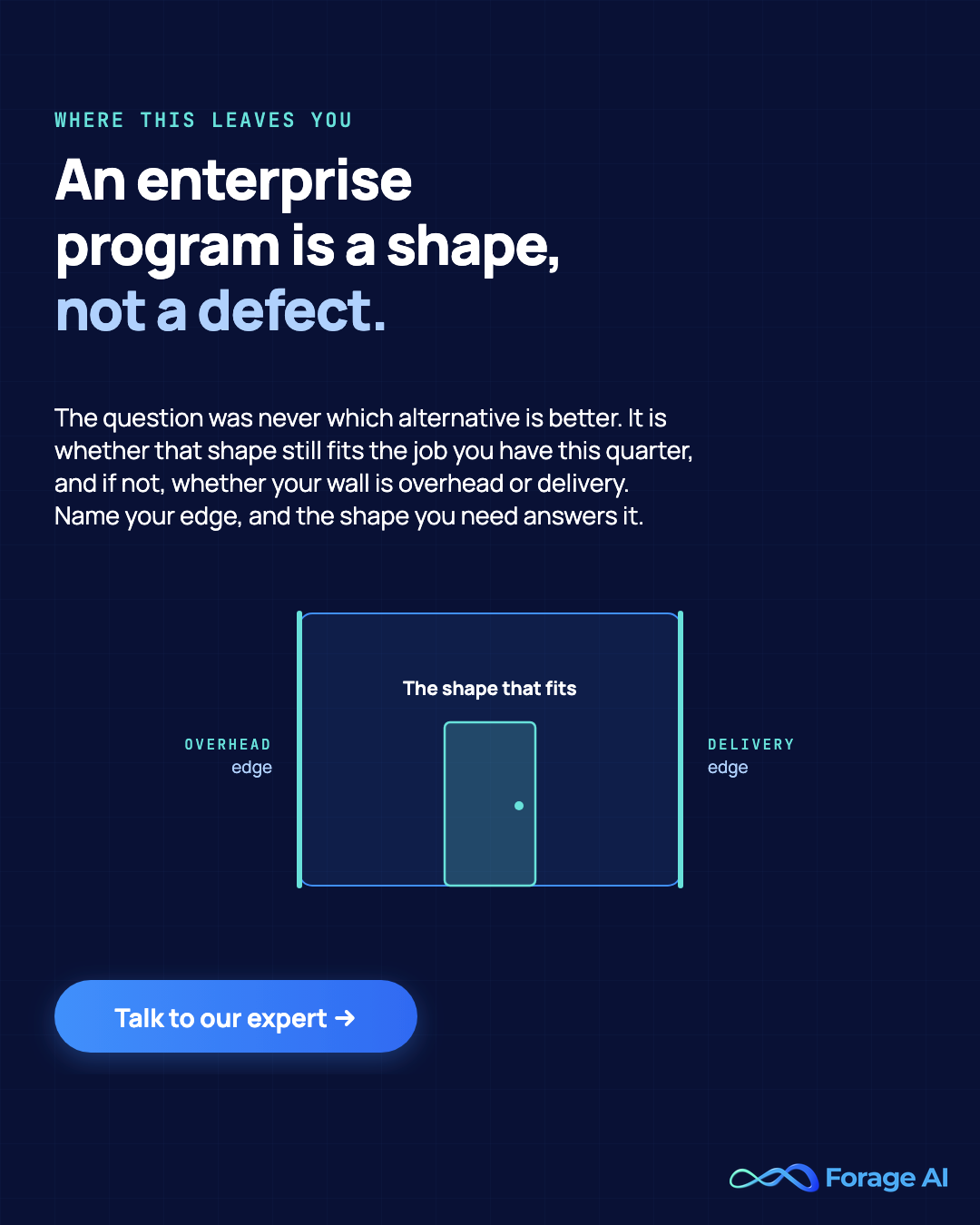
An enterprise program is a shape, not a defect. PromptCloud is priced, onboarded and contracted like a heavyweight Data-as-a-Service, roughly sixteen years of it, and that shape is exactly right for a large recurring buyer and exactly wrong for a small, urgent or uncommitted one.
So the question was never which alternative is better. It is whether an enterprise program still fits the job you have this quarter, and if not, whether your wall is overhead or delivery. Those two walls have opposite answers, and only one of them is fixed by leaving the managed model: overhead routes to a lighter self-serve tool, and delivery routes to a better managed partner, because the day you leave managed over quality is the day you become your own QA. Name your edge, ask the three questions, and the shape you need is the one that answers them.
Sources
- Capterra (accessed 16 July 2026): all ratings, sample sizes, sub-scores and verbatim reviewer quotes. Capterra and Software Advice share one Gartner-owned corpus.
- G2, Trustpilot, TrustRadius (accessed 16 July 2026): corroborated-via-secondary; all three return HTTP 403 to direct fetch.
- PromptCloud (promptcloud.com/pricing and /web-data-scraping-faqs, accessed 19 July 2026): pricing opacity, onboarding motion, contract term and one-month notice. PromptCloud’s own claims, including the 99.9% guarantee and enterprise logos.
- Mordor Intelligence (updated 8 July 2026): web scraping market sizing and CAGR.
- Imperva / Thales, Bad Bot Report (29 April 2026): bot share of web traffic, 2025 versus 2024.
- Foerderer, J. (August 2023): Should we trust web-scraped data? arXiv:2308.02231.
- NIST/SEMATECH e-Handbook of Statistical Methods, §6.2.1 and §6.2.2: acceptance sampling, consumer’s risk.
- Sambasivan, N. et al. (2021): Data Cascades in High-Stakes AI. Google Research, CHI ’21.
- Nagle, T., Redman, T. & Sammon, D. (2017): data-quality assessment findings, Harvard Business Review.
- Redman, T. C. (2012): the Rule of Ten heuristic, Harvard Business Review.
- Peukert, C. (August 2010): Switching Costs in IT Outsourcing, Ulm University.
- Forage AI (16 July 2026): binomial sampling arithmetic, computed and verified in-house.
- Vendor pricing pages (accessed 16 July 2026): every price point, vendor page only, never an aggregator.
Related Articles
- Web Scraping Companies vs Tools. The category distinction underneath this article’s four models.
- Bright Data Alternatives. Where the proxy and unblocking market sits if access is your bottleneck.
- Octoparse Alternatives. The no-code band examined on its own terms, with the same evidence standard.
- Top Zyte Alternatives. The API band compared, including the billing-visibility trade.
- Custom Web Scraping. What “custom” actually means once extraction logic stops being standard.