The Data-Driven Foundation of Modern Real Estate
Real estate has always depended on information. What’s changed in 2026 is not the importance of data, but the cost of working with the wrong kind of it.
The market is flooded with fragments: listings here, ownership records there, reports published weeks after conditions change. Information exists, but decision-ready intelligence is still scarce.
Most real estate teams don’t suffer from a lack of data. They suffer from data that arrives too late, in the wrong format, or disconnected from how their teams actually operate, even when that data is sourced through real estate web scraping or third-party vendors.
As competition intensifies, winning firms are not the ones collecting the most data. They are the ones that can:
- Identify opportunity earlier
- Prioritize the right assets and counterparties
- Act immediately, without manual research or operational drag
That shift has redefined what “good data” means. In 2026, value comes from relevance, context, timing, and activation, not raw volume.
This guide explores the best real estate data providers for 2026, comparing how they differ in depth, delivery, and operational impact. More importantly, it introduces a newer category of solution designed to solve the industry’s biggest unsolved problem: activating real estate intelligence directly inside day-to-day workflows.
Quick Digest
Fifteen providers at a glance, spanning six categories, each with what it is best for:
- Workflow intelligence: Forage AI, for teams who want intelligence to appear automatically inside their daily workflow, without spreadsheets, portals, or manual research.
- Data access & marketplaces: Bright Data and Datarade, for infrastructure-first teams and vendors evaluating multiple options across markets.
- U.S. analytics platforms: ATTOM, PropertyShark, and CoreLogic (Cotality), for analysts, lenders, and institutions needing U.S. depth, metro-level detail, or mortgage-risk integration.
- Commercial & global transaction data: CoStar Group and MSCI Real Assets (RCA), for brokers and institutional investors needing field-verified comps or global capital-flow history.
- Ownership, valuation & integration: Reonomy, HouseCanary, and Cherre, for teams unmasking LLC owners, running institutional valuations, or unifying fragmented data sources.
- Investor, leasing & niche data: PropStream, CompStak, Zonda, and Yardi Matrix, for individual investors, CRE leasing comps, new-construction tracking, and multifamily market data.
The 2026 Landscape: Three Models of Real Estate Data Solutions
When evaluated through an enterprise lens, today’s market organizes into three distinct models, each serving a very different audience.
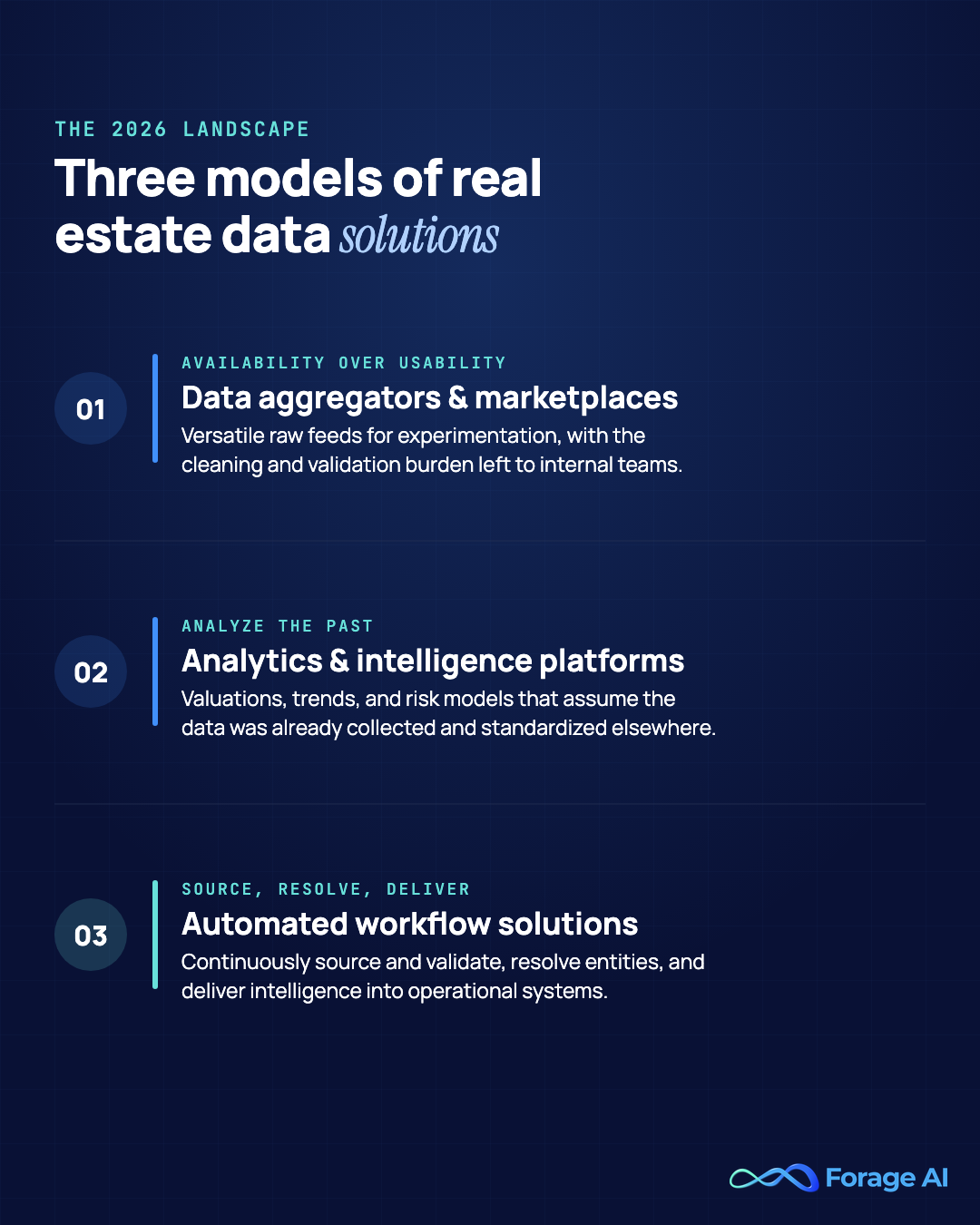
1. Data Aggregators & Marketplaces
These solutions prioritize availability over usability.
They offer versatile datasets, often sourced via real estate web scraping, bulk licensing, or third-party feeds, that allow for flexible experimentation, research, and early-stage exploration. This approach gives customers full control over cleaning, validation, entity resolution, and enrichment, but also places the operational burden squarely on internal teams, who must then stand up their own data-quality QA workflows to catch the corrupted, mismatched, and incomplete records raw feeds inevitably carry.
In many cases, these platforms function as real estate data feeds rather than intelligence systems.
Who they benefit
- Startups validating ideas
- Academic and research teams
- Open-source projects
- Teams with limited scope and tolerance for manual work
Who is it not for:
- Enterprise sales, investment, or operations teams that require accuracy, consistency, and repeatable outcomes
2. Analytics & Intelligence Platforms
These providers specialize in specific markets, primarily the U.S., and excel at real estate data analytics that analyze the past.
They aggregate structured datasets to deliver valuation models, market trends, risk assessments, and compliance insights, usually through dashboards, reports, or APIs. If you are weighing a provider whose primary delivery is an API, it is worth understanding what to expect from a real estate data API and how to evaluate one before you integrate it. Many rely on upstream data extraction for real estate before insights can be generated.
While powerful, these platforms assume that data collection, standardization, and integration already exist elsewhere.
Who they benefit
- Analysts and researchers
- Lenders and financial institutions
- Teams focused on underwriting, risk, and compliance
To perform analytics, these platforms require data, which must first be collected and standardized separately before being ingested into these platforms for generating insights.
3. Automated Workflow Solutions
This category addresses a core problem many modern businesses face: extract massive amounts of complex, unstructured data and deliver structured, usable insights quickly and automatically, without requiring extensive manual effort or internal infrastructure.
Instead of delivering raw datasets or static dashboards, these platforms act as real estate web data feed providers, designed to:
- Continuously source and validate data
- Resolve ownership and entity relationships
- Apply business logic and prioritization
- Deliver data directly into operational infrastructure
This often involves custom scraping solutions for real estate, combining web data, firmographic intelligence, and proprietary enrichment layers.
The goal is not the dataset alone, but flexible and repeatable action at scale.
Expert Insights
The three models are not tiers of quality, they are different jobs. Aggregators and marketplaces optimize for availability and hand the cleaning, validation, and entity resolution back to the buyer. Analytics platforms optimize for retrospective insight but assume collection and standardization already happened elsewhere. Automated workflow solutions optimize for repeatable action at scale, sourcing, validating, resolving ownership, and delivering into operational infrastructure. Matching the model to how your team actually operates matters more than the size of the dataset.
How to Evaluate a Real Estate Data Provider in 2026
Before comparing vendors, it’s important to align evaluation criteria with how enterprise real estate teams actually work today.
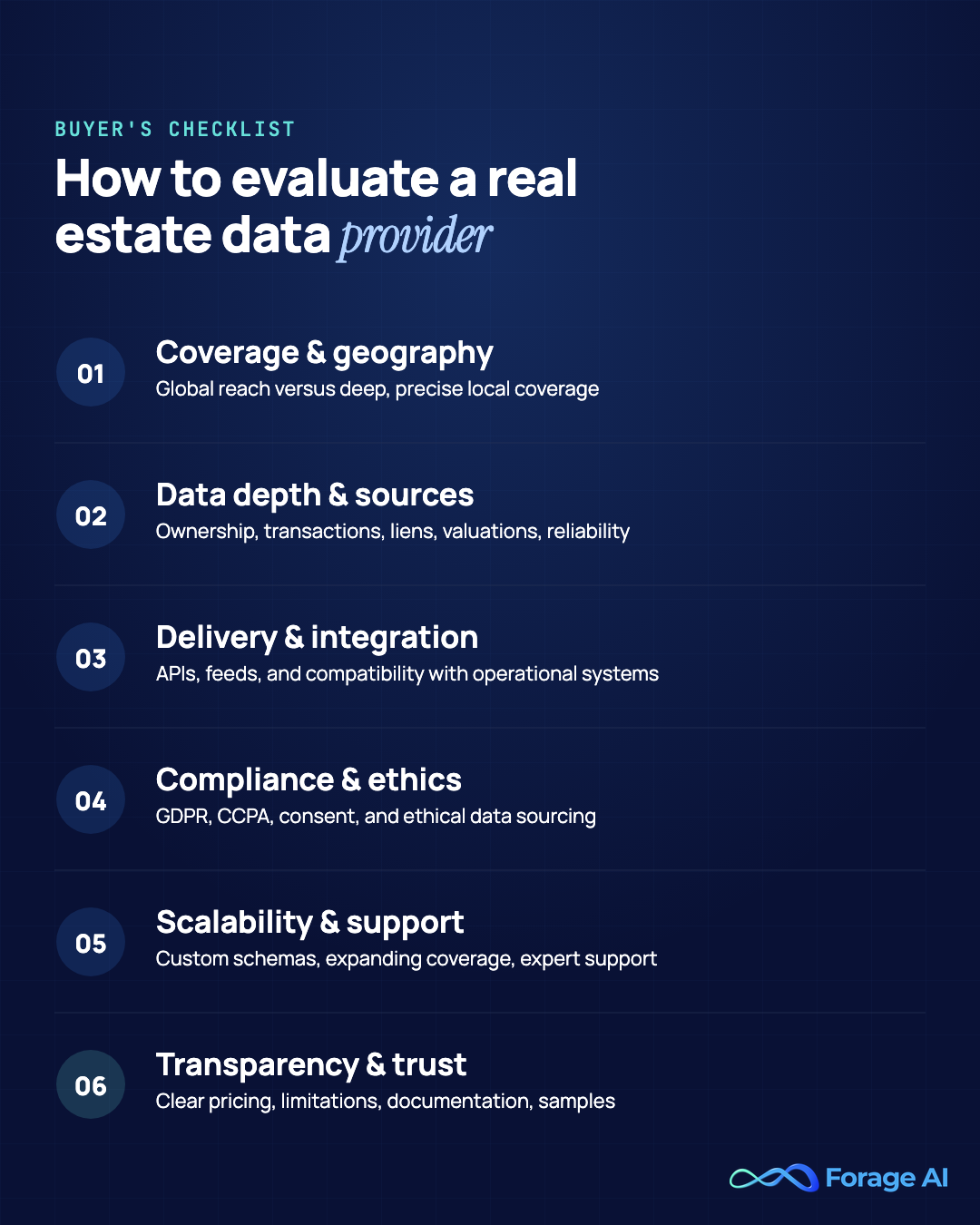
| Evaluation Dimension | What It Assesses | Why It Matters |
|---|---|---|
| Coverage & Geography | Global reach vs country-level or hyper-local coverage | Some use cases require worldwide visibility, while others demand deep, precise coverage within a single city or region |
| Data Depth & Sources | Types of data available (ownership, transactions, liens, foreclosures, valuations, development activity) and reliability of sources | Depth and source quality determine whether data can support analysis, decision-making, and operational workflows |
| Delivery & Integration | Data delivery methods (APIs, bulk files, dashboards, cloud feeds) and system compatibility | Data must integrate directly into operational systems like CRMs to create value, not remain siloed |
| Compliance & Ethics | Adherence to GDPR, CCPA, and regional privacy regulations; ethical data sourcing | Compliance and consent are baseline requirements and reduce legal and reputational risk |
| Scalability & Support | Ability to support custom schemas, expanding coverage, and evolving requirements | Providers must scale with growing data needs and provide expert support as use cases change |
| Transparency & Trust | Clarity around pricing, limitations, documentation, and data samples | Trust is built through transparency and clear communication, not marketing claims |
Coverage & geography is a tradeoff, not a scorecard. Some providers cover the entire globe at a shallow level; others go hyper-local in a single metro. Decide which axis your team actually needs before you shop, because global breadth and local depth are rarely the same product.
Data depth & sources determine what a dataset can actually support. Ownership records, transaction history, liens, foreclosures, and permit activity each carry different sourcing and verification burdens, so ask for a field-level data dictionary before you commit, not a marketing one-pager.
Delivery & integration is where coverage and depth go to waste. Confirm a provider can deliver into the CRM, warehouse, or internal system your team already works in, rather than as a file someone has to import by hand every week.
Compliance & ethics is the floor, not a differentiator. Ask specifically how a provider sources contact and ownership data, and whether that sourcing method would survive a review by your own legal or compliance team.
Scalability & support matters because your data needs will not stay static: new markets, new asset classes, new schema requirements. Evaluate providers on how easily they absorb that change, and whether real support shows up when they don’t.
Transparency & trust shows up before the contract, not after. A provider willing to share a real data sample and a real price is telling you something about how it will behave once you are locked in; vague pricing and locked-down samples are themselves a data point.
Expert Insights
Of the six evaluation dimensions, delivery and integration is the one teams most often underweight. Data must integrate directly into operational systems like CRMs to create value, not remain siloed. A provider can win on coverage, depth, and historical consistency and still fail in practice if its output never reaches the place where decisions are made. Compliance with GDPR, CCPA, and regional privacy regulations is a baseline, not a differentiator, and transparency around pricing, limitations, and data samples signals trust far more reliably than marketing claims.
Deep Dive: The Top Real Estate Data Providers of 2026
With the categories defined, we can now examine the leading providers, starting with the one built explicitly around workflow activation.
| # | Provider | Category | Best For |
|---|---|---|---|
| 1 | Forage AI | Custom workflow intelligence | Brokerages, investor teams, and sales ops leaders wanting intelligence inside their daily workflow |
| 2 | Bright Data | Data access infrastructure | Large enterprises and technical teams building proprietary real estate data systems |
| 3 | Datarade | Data marketplace | Businesses evaluating and comparing vendors across markets |
| 4 | ATTOM | Analytics platform | Analysts, lenders, and investors focused exclusively on U.S. real estate |
| 5 | PropertyShark | Analytics platform | Professionals operating in dense, high-activity urban metros |
| 6 | CoreLogic (Cotality) | Analytics platform | Mortgage firms, insurers, and enterprise-scale institutions |
| 7 | CoStar Group | Commercial real estate data platform | Commercial brokers, institutional investors, and lenders needing field-verified comps |
| 8 | MSCI Real Assets (RCA) | Global CRE transaction data | Institutional investors and lenders needing global capital-flow and pricing history |
| 9 | Reonomy | Ownership intelligence | CRE brokers and lenders identifying true property owners behind LLCs |
| 10 | HouseCanary | Automated valuation model | Institutional investors and lenders needing defensible, at-scale valuations |
| 11 | Cherre | Real estate data management platform | Institutional owners and asset managers unifying fragmented data sources |
| 12 | PropStream | Investor data & lead generation | Individual investors, wholesalers, and small teams sourcing off-market leads |
| 13 | CompStak | Crowdsourced lease & sale comps | CRE brokers and appraisers wanting deal-level comps without CoStar’s price tag |
| 14 | Zonda | New-construction housing data | Homebuilders, developers, and building-product suppliers |
| 15 | Yardi (Matrix / CommercialEdge) | Property management + market data | Multifamily owners and lenders already on the Yardi Voyager ecosystem |
1. Forage AI: Automated Workflow Intelligence
Forage AI is built for organizations where real estate data is not a side input, but a core operational dependency.
| Solution type | Custom Workflow Intelligence |
| Best for | Brokerages, investor teams, and sales operations leaders who want intelligence to appear automatically inside their daily workflow, without spreadsheets, portals, or manual research |
| Coverage | Global (custom-defined by use case) |
| Primary strength | Decision-grade real estate intelligence operationalized across workflows |
| Integration & delivery | Custom-built to integrate into any enterprise stack (CRM, internal systems, data warehouses, analytics tools) |
| Watch-out | Optimized for operational/revenue workflows, not raw global dataset distribution to data science teams |
How Forage AI is fundamentally different
Forage AI does not deliver datasets. It delivers decision-grade intelligence infrastructure.
Instead of pushing raw outputs from real estate web scraping, Forage AI:
- Designs custom pipelines aligned to business use cases
- Continuously validates and enriches intelligence
- Resolves complex entity and ownership relationships
- Surfaces what matters now, not everything
This includes structured property data, ownership intelligence, and real estate firmographic data providers layered directly into workflows.
Core strengths
Instead of treating data as a resource teams must manage, Forage AI delivers fully managed intelligence pipelines that automatically sync clean, structured property and ownership data directly into existing operation and infrastructure.
- Custom-built, fully managed pipelines
Designed for enterprise scale, tailored to your geography, asset classes, and workflows, without internal maintenance burden. - Entity and relationship intelligence
Properties are connected to owners, entities, portfolios, and behavioral signals, enabling network-level understanding rather than isolated records. - Operational activation
Intelligence arrives where teams work, triggering prioritization, outreach, or investment decisions in real time. - Infrastructure-agnostic integration
Forage AI integrates into your stack, not the other way around.
Consideration
Forage AI is optimized for operational efficiency and revenue workflows, not for distributing raw global datasets to data science teams.
Best for
Brokerages, investor teams, and sales operations leaders who want intelligence to appear automatically inside their daily workflow, without spreadsheets, portals, or manual research.
2. Bright Data: Global and Customizable Scale
Bright Data is a well-known provider of large-scale data access tooling.
| Solution type | Data Access Infrastructure |
| Best for | Large enterprises and technical teams building proprietary real estate data systems |
| Coverage | Worldwide |
| Primary strength | Large-scale raw and semi-structured data collection |
| Integration & delivery | API, cloud feeds |
| Watch-out | Requires significant internal effort to transform raw outputs into reliable, operational intelligence |
Bright Data’s real estate depth comes from two products: a proxy and unblocking layer (residential, ISP, and datacenter IPs plus a Web Unlocker API) that lets a buyer run their own scrapers against listing sites without getting blocked, and a pre-built dataset marketplace that sells already-scraped, structured property records directly. The dedicated Real Estate Datasets product spans 12 datasets and over 301.5 million records aggregated from Zillow, Realtor.com, Zoopla, and regional platforms across the US, UK, Australia, and other countries, delivered via CSV, JSON, or Parquet, or direct integration to Snowflake, AWS, GCP, or Azure.
Bright Data began as Luminati Networks in 2014; EMK Capital acquired a majority stake in 2017 for roughly $200 million, and the company rebranded to Bright Data in 2021, reporting around $300 million in annual recurring revenue as of December 2025. Real Estate Datasets start at $0.0025 per record with a $250 minimum order, and subscription refresh plans offer meaningful discounts over one-off pulls. The tradeoff shows up in the reviews below: this is infrastructure, not a finished intelligence product, and pricing at the entry tier runs notably higher per unit than at enterprise scale.
Reviewer signal: G2: 4.6/5 across 284 reviews. Capterra: 4.7/5 across 68 reviews.
| What Users Like | What Users Flag |
|---|---|
| Reliable, hard-to-flag IPs with a lower error rate than competing proxy providers | Pricing complexity at low volume, with entry-tier customers paying a notably higher per-unit rate than enterprise accounts |
| Support engineers respond quickly with workarounds and sometimes escalate fixes to engineering | Documentation gaps and a learning curve on initial setup |
| Zone-based proxy setup integrates cleanly and simplifies scraping for non-technical users | Some reviewers report being billed for failed requests on the Web Unlocker product |
3. Datarade: The Data Marketplace
Datarade serves as a discovery and procurement layer rather than a single data source.
| Solution type | Data Marketplace |
| Best for | Businesses in the evaluation phase, comparing vendors and exploring options across markets |
| Coverage | Worldwide |
| Primary strength | Dataset and provider discovery |
| Integration & delivery | Varies |
| Watch-out | A discovery and procurement layer rather than a single data source; delivery depends on the chosen provider |
For real estate specifically, Datarade functions as a discovery and comparison layer rather than a vendor itself: buyers browse a dedicated real estate data hub, filter by location and coverage, and compare listings from independent vendors, property records, foreclosure data, mortgage data, commercial real estate, side by side, then request free samples before committing. Its real estate category lists 347 datasets across those subcategories, with vendors including ATTOM, SafeGraph, and The Warren Group appearing alongside smaller specialists.
Datarade was founded in Berlin in 2018 and raised approximately €1.2M in pre-seed funding the following year. Browsing and comparing is free for buyers, one G2 reviewer specifically noted the platform charges nothing to use, with fees instead borne by the data providers who transact through it, so pricing for the actual datasets is set independently by each vendor and varies widely, from roughly $0.01 per API call to $1,500 per month subscriptions.
Reviewer signal: G2: 4.5/5 across 21 reviews, the only platform with a meaningful, verifiable review count for Datarade itself.
| What Users Like | What Users Flag |
|---|---|
| Free to browse and compare, with fees charged to data providers rather than buyers | Some navigation friction despite an otherwise clean interface, including links that exit to third-party provider sites |
| Simple interface paired with a responsive support team | At least one reviewer reported delays requesting a data sample, resolved only after contacting support directly |
| Side-by-side comparison across vendors saves research time, especially for smaller budgets | Data quality, pricing, and delivery SLAs vary by vendor since Datarade does not standardize them itself |
4. ATTOM: U.S. Market Depth and Consistency
ATTOM is known for its comprehensive U.S. property datasets, including transactions, valuations, tax data, and foreclosure information.
| Solution type | Analytics Platform |
| Best for | Analysts, lenders, and investors focused exclusively on U.S. real estate intelligence |
| Coverage | U.S. only |
| Primary strength | U.S. historical depth and consistency across markets |
| Integration & delivery | API, bulk data |
| Watch-out | Coverage is U.S. only, not suited to global use cases |
ATTOM aggregates and standardizes property records sourced from more than 3,000 U.S. county recorder, assessor, and building-permit offices, covering roughly 150-160 million residential and commercial parcels and over 99% of the U.S. population. The dataset spans property characteristics, tax assessments, deed and mortgage history, foreclosure filings, and environmental and climate risk, delivered via REST API, bulk file licensing, or the self-serve Property Navigator tool, which runs $499 per year for a professional plan with a 7-day free trial.
ATTOM traces back to RealtyTrac, founded in 1996, and rebranded to ATTOM Data Solutions in 2016 as its business shifted from foreclosure listings to broad property data licensing. It acquired ResiShares’ analytics platform in January 2026 to add price and rent forecasting. One structural point worth flagging: coverage and field population vary by county, ATTOM’s own documentation acknowledges some jurisdictions track attributes others don’t, and publishes coverage reports to help buyers spot the gaps before they build on top of the data.
Reviewer signal: No independently verifiable star rating exists on G2, Capterra, or TrustRadius. This is typical of enterprise B2B data-licensing vendors sold through direct sales rather than self-serve signup; we’re reporting that gap honestly rather than citing an unconfirmed number.
| What Users Like | What Users Flag |
|---|---|
| Vendor-collected testimonials cite daily data updates that are easy to ingest into other platforms | An independent review describes being repeatedly transferred between support staff without follow-up |
| Foreclosure and mortgage data depth called out specifically by title insurance and private lending customers | No published tiered pricing for the core API and bulk products, custom quotes only, which frustrates smaller buyers estimating ROI |
| At least one independent review praised support going out of its way to resolve a recurring issue | Most enterprise contracts run annual, a poor fit for buyers with seasonal or project-specific data needs |
5. PropertyShark: Metro-Level Analytics
PropertyShark focuses on granular insights in major metropolitan areas, particularly New York City and California.
| Solution type | Analytics Platform |
| Best for | Professionals operating in dense, high-activity urban markets |
| Coverage | U.S. metros (particularly New York City and California) |
| Primary strength | Metro-level insights: zoning analysis, ownership research, and detailed urban market data |
| Integration & delivery | Platform, files |
| Watch-out | Focused on dense urban metros, not broad national or global coverage |
PropertyShark aggregates public property records, ownership history, comparable sales, liens and mortgages, zoning, permits, and violations, from county and municipal sources into on-demand reports, with top tiers adding LLC owner unmasking and real owner phone numbers. Coverage spans 46 U.S. states, but depth is uneven: it is strongest in New York City, where it claims full five-borough coverage refreshed roughly every two weeks, and other Northeast and gateway metros, with data thinner and slower to update in secondary and rural markets.
Founded in 2003 by real estate investor Matthew Haines, PropertyShark was acquired by Yardi Systems in 2010 to feed deep property records into Yardi’s broader property management suite, and has since grown past 4 million registered users. Pricing runs three published tiers: Pro at $59.95 per month, Elite at $79.95, and Platinum, which adds the LLC owner-unmasking, at $169.95, each roughly 17% cheaper billed annually, with a free trial available.
Reviewer signal: Trustpilot: rated Excellent at 4.7/5. G2 has no PropertyShark reviews yet, itself a data point for a product with this much tenure.
| What Users Like | What Users Flag |
|---|---|
| Accurate title records and ownership data that reviewers say streamlines underwriting | Billing and auto-renewal friction, including reports of charges after attempting to cancel |
| User-friendly search with quick access to comparable sales data | Listing data lag: reviewers report properties shown as for-sale weeks after they actually sold (PropertyShark notes it does not control listing data, which comes from listing agents) |
| Long-tenure loyalty, at least one reviewer called it their default platform after 5+ years of daily use | Mixed support responsiveness, some reviewers call it reliable, others report multi-day delays on report-replacement requests |
6. CoreLogic (Cotality): Enterprise Industry Intelligence
CoreLogic delivers integrated data, analytics, and risk modeling for the mortgage and financial services ecosystem.
| Solution type | Analytics Platform |
| Best for | Mortgage firms, insurers, and enterprise-scale institutions |
| Coverage | U.S. only |
| Primary strength | Risk & BI integration: integrated data, analytics, and risk modeling for the mortgage and financial services ecosystem |
| Integration & delivery | API, cloud platforms |
| Watch-out | Typically designed for large organizations with complex compliance and reporting needs |
CoreLogic aggregates property records at the county level, tax assessor, deed, and permit data, and layers on proprietary automated valuation models, climate and flood-risk analytics, and insurance underwriting data. Its MLS distribution arm, Trestle, is a RESO-standardized single access point that reportedly handles more than half of industry listings, letting technology providers pull live data from multiple MLSs through one credential instead of integrating with each separately. Trestle is also the one CoreLogic product with real published pricing: broker data feeds run $30-100 per month per connection, with technology-provider feeds tiered by contract volume.
CoreLogic rebranded globally to Cotality in March 2025, though the corelogic.com domain and product names like CoreLogic Matrix and CoreLogic Realist persist in the market. The company was taken private by Stone Point Capital and Insight Partners in a roughly $6 billion deal that closed in June 2021, and acquired Prime Ecosystem in January 2025 to expand its contractor and claims solutions internationally. Its core data and analytics products remain enterprise, quote-only, no public pricing exists outside Trestle.
Reviewer signal: Fragmented across products rather than one unified score: G2’s aggregated CoreLogic page shows 3.9/5 across 55 reviews spanning multiple sub-products (Realist, RealQuest, HPI). CoreLogic Matrix does not yet have enough TrustRadius reviews for an overall score.
| What Users Like | What Users Flag |
|---|---|
| Data depth and reliability for decision-making, reviewers describe report formats as comprehensive and customizable | A dated, unintuitive UI is the most repeated complaint across both Realist and Matrix reviews |
| MLS workflow efficiency, TrustRadius reviewers of Matrix specifically praise fast listing retrieval and trend analysis | RealQuest reviewers report data running roughly two months behind with a growing volume of errors |
| Responsive support cited in a subset of reviews, though inconsistent across products | Core products carry no public pricing, every quote starts as a sales conversation |
7. CoStar Group: The Commercial Data Incumbent
CoStar Group is the publicly traded (NASDAQ: CSGP) research engine most commercial real estate professionals learned the industry on.
| Solution type | Commercial Real Estate Data Platform |
| Best for | Commercial brokers, institutional investors, and lenders who need the deepest field-verified U.S., UK, and Canadian commercial property and comps database |
| Coverage | U.S., Canada, UK, and France (launched June 2026); residential exposure via Apartments.com and Homes.com |
| Primary strength | Roughly 1,600+ in-house researchers plus aerial and drone survey work feeding an 8.5M+ property record database built over 39 years |
| Integration & delivery | CoStar Suite platform, CoStar Real Estate Manager, data feeds and API for enterprise accounts |
| Watch-out | Pricing is opaque and enterprise-oriented, with annual contracts that auto-renew and add-on modules priced separately |
CoStar’s advantage is not a clever algorithm, it is decades of paid human research: field staff verify listings, vacancy, and lease terms building by building, which is exactly the kind of ground-truth data that is hardest for a newer entrant to replicate at scale. That field-research model is also why the platform commands premium pricing, third-party buyer data puts typical annual subscriptions anywhere from roughly $3,000 to $40,000 or more depending on modules, seats, and geography, with individual add-ons like COMPS cited around $485 per user per month.
CoStar completed its roughly $2.1 billion acquisition of Matterport in February 2025, adding 3D digital-twin capture to its property records, and in 2026 expanded the CoStar platform into France, extending its commercial footprint beyond the English-speaking markets it built its name on. For a single-market or smaller shop, that breadth is often more than needed; for a brokerage or institution operating across major U.S. or UK metros, it remains the default comps and market-data reference.
Reviewer signal: G2: 3.7/5 across 203 reviews (aggregated across CoStar’s product line).
| What Users Like | What Users Flag |
|---|---|
| Breadth and depth of property data, reviewers say almost any building’s information is readily available | Price is the most repeated complaint, with add-on modules like COMPS drawing specific pushback |
| Strong onboarding, with dedicated specialists offering tutorials and live demos | Data accuracy gaps reported by some users on individual property records |
| Ease of use for property search and appraisal workflows | Slow support response times and an unintuitive order/navigation flow noted by several reviewers |
8. MSCI Real Assets (Real Capital Analytics): Global Commercial Transaction Data
MSCI Real Assets, built on the Real Capital Analytics (RCA) database MSCI acquired in 2021, is the closest thing the industry has to a global system of record for commercial property deals.
| Solution type | Commercial Real Estate Transaction & Capital Markets Data |
| Best for | Institutional investors, lenders, and researchers who need global CRE transaction pricing and capital-flow history |
| Coverage | Global, data collected across more than 170 countries |
| Primary strength | Over 20 years of verified global transaction data, deals, buyers, sellers, and lenders, now backed by MSCI’s index and analytics infrastructure |
| Integration & delivery | Web platform (app.rcanalytics.com), institutional data feeds, integrated into MSCI’s broader real estate index suite |
| Watch-out | No published pricing and no meaningful independent review-platform track record; evaluation runs almost entirely on reputation and a sales conversation |
What RCA built before the acquisition, and what MSCI has scaled since, is a transaction-level record of who bought what from whom, at what price, and how it was financed, tracked across more markets than most competitors even attempt. That data now feeds MSCI’s commercial property price indexes (RCA CPPI), which institutional investors use as a benchmark the way equity investors use a stock index.
MSCI closed its purchase of RCA on September 13, 2021 for an aggregate cash price of approximately $949 million, a figure that signals how central transaction-level data has become to institutional real estate strategy. This is the one entry on this list with genuinely global reach rather than U.S.-only or metro-specific coverage, which makes it the reference point for cross-border capital flows even though, like most enterprise data vendors in this category, it carries no meaningful presence on consumer review platforms.
Reviewer signal: No listing or review data found on G2, Capterra, or TrustRadius. This is common for enterprise-only data platforms sold through direct sales relationships rather than self-serve signup, and we are reporting that gap honestly rather than inventing a score.
| What Users Like | What Users Flag |
|---|---|
| Depth of verified global transaction history spanning two decades | No published pricing, every engagement starts as a custom sales conversation |
| Trusted as a pricing benchmark (RCA CPPI) by institutional investors | No independent review-platform data exists to benchmark buyer satisfaction |
| Backed by MSCI’s broader index and analytics infrastructure | Built for institutional users; overkill for single-market or small-team buyers |
9. Reonomy: Ownership Intelligence
Reonomy, now operating as an Altus Group business, exists to answer one question competitors often can’t: who actually owns this building.
| Solution type | Ownership Intelligence |
| Best for | CRE brokers, lenders, and investors doing U.S. deal-sourcing or prospecting who need to identify true property owners behind LLCs |
| Coverage | U.S. only, all 50 states |
| Primary strength | LLC-piercing entity resolution that unmasks the real owner behind shell companies, paired with direct integrations into county assessors, Secretary of State filings, and exclusive data partnerships |
| Integration & delivery | Web application, Bulk Data Feed, and API access on request through sales |
| Watch-out | Billing and cancellation friction shows up repeatedly in reviews, and coverage is U.S. commercial only with no residential or international data |
Commercial property is routinely held inside LLCs specifically to obscure who is behind them, which makes ownership resolution a genuine technical problem, not just a data-aggregation one. Reonomy’s core mechanic ties assessor and filing records together to trace a property back to a real person or entity, then layers on contact information so a broker or lender can actually reach them. Pricing starts around $400 per month per user for an annual seat, with Bulk Data Feed and API access requiring a sales conversation.
Altus Group acquired Reonomy in November 2021, folding it into a broader real estate intelligence portfolio. The tradeoff buyers report most often is billing, not data quality: multiple reviewers describe continued charges after a cancellation request that required repeated follow-up to resolve, worth confirming in writing before signing.
Reviewer signal: Capterra: 4.1/5 across 33 verified reviews (4.3 on ease of use, 4.1 on customer service).
| What Users Like | What Users Flag |
|---|---|
| Easy-to-learn interface with fast onboarding | Contact and email data accuracy complaints despite the subscription cost |
| Consolidates owner and sales information in one place with strong prospecting filters | Billing and cancellation friction, with reports of charges continuing after a cancellation request |
| Analytics flagged as useful for identifying properties likely to transact | No CRM integration and limited team-collaboration features |
10. HouseCanary: Institutional-Grade Valuation
HouseCanary builds automated valuation models for buyers who cannot afford to be wrong: lenders pricing risk, and investors bidding on portfolios sight unseen.
| Solution type | Automated Valuation Model & Analytics |
| Best for | Institutional investors, lenders, and capital markets teams needing defensible, at-scale residential valuations via API |
| Coverage | U.S. only, 114M+ properties across 19,000+ ZIP codes |
| Primary strength | Independently tested valuation accuracy trusted by major Wall Street investment banks for pre-bid due diligence through portfolio disposition |
| Integration & delivery | API (Data Explorer and Analytics APIs), enterprise Solutions Platform, and per-report valuation tools |
| Watch-out | Pricing is opaque with reported six-figure annual minimums for institutional API access, and public review data is too sparse to independently validate satisfaction |
The core product is a valuation model, not a listings database, HouseCanary estimates what a property is actually worth, ranks comparable properties on a 1-100 similarity scale, and produces forecasts institutional buyers use before committing capital. Users report cutting CMA turnaround from 30-45 minutes down to 5-10, a meaningful difference at portfolio scale. Individual valuation reports run roughly $10-12 each on entry-level plans; enterprise and bulk API access is quote-only.
The accuracy that makes HouseCanary useful for standard housing stock is also its known limit: the model performs worse on atypical homes that fall outside normal comps, roughly 5-10% of the market by HouseCanary’s own framing. The company has also spent years in litigation with Amrock over trade-secret misappropriation, most recently a second jury verdict of roughly $175 million in March 2026, a costly but real signal of how defensible its valuation methodology is considered to be.
Reviewer signal: G2 (HouseCanary Data): 4.5/5, but based on only 2 reviews, too thin a sample to treat as a reliable signal on its own.
| What Users Like | What Users Flag |
|---|---|
| Cuts CMA and valuation turnaround time dramatically for high-volume users | Accuracy drops for atypical homes that don’t fit standard comps |
| Large, accessible dataset at a comparatively low cost per data point for the volume delivered | Reports can be data-heavy and need explanation before handing to a client |
| Comparable-property ranking (1-100 scale) called out as a standout feature | Cost adds up for high-volume users whose CMAs don’t convert to closed deals |
11. Cherre: The Data Integration Layer
Cherre does not sell a proprietary dataset. It sells the connective tissue that makes everyone else’s data usable in one place.
| Solution type | Real Estate Data Management Platform |
| Best for | Institutional owners, investors, and asset managers who need to unify fragmented internal and third-party data sources into one governed system |
| Coverage | Primarily U.S., built on integrations with major providers like CoStar, Yardi, and Trepp |
| Primary strength | A property knowledge-graph architecture with AI-based entity resolution that automatically matches and reconciles records across 50+ data providers without manual ETL work |
| Integration & delivery | Cloud platform, pre-built connector library, secure SFTP ingestion, API, and an AI layer (Agent.STUDIO) |
| Watch-out | Pricing is enterprise-only and effectively undisclosed, and there is no substantive independent customer review base to verify satisfaction against |
The problem Cherre solves is expensive and unglamorous: institutional real estate teams reportedly spend 30-40% of their analytical capacity just reconciling data from different sources before any actual analysis starts. Cherre’s knowledge-graph approach automatically matches a property record from CoStar against the same property in Yardi against the same property in a firm’s internal deal system, without an analyst manually stitching spreadsheets together, and layers SOC 2 compliance on top for institutional buyers who need that assurance.
The company raised a $30 million Series C in September 2024, with participation from principals at Nuveen Real Estate, RXR, and TA Realty, bringing total funding to roughly $105 million, and launched an AI-powered layer called Agent.STUDIO in July 2025. Industry estimates put typical annual contracts anywhere from $200,000 to over $1 million depending on portfolio size and integration count, and Cherre publishes none of it, so buyers are largely working from case studies and investor names rather than a public price list or review base.
Reviewer signal: No reliable independent customer review data found on G2, Capterra, or TrustRadius. This is a genuine gap, not an oversight, and we are reporting it rather than substituting an unrelated score.
| What Users Like | What Users Flag |
|---|---|
| Solves a real, costly pain point: institutional teams report losing 30-40% of analytical capacity to manual data reconciliation | High cost and no published pricing make procurement evaluation slow |
| SOC 2 compliance and security posture cited as a differentiator for institutional buyers | Advanced configurations reportedly require real technical expertise to set up |
| Backed and used by major real estate players including Nuveen Real Estate, RXR, and TA Realty | No dedicated mobile app, and no independent review base to check satisfaction against |
12. PropStream: Self-Serve Investor Data
PropStream is built for the individual investor or small team who wants nationwide property data and lead generation in one subscription, not an enterprise procurement process.
| Solution type | Real Estate Investor Data & Lead Generation Platform |
| Best for | Individual real estate investors, wholesalers, and small teams finding and contacting off-market or distressed property leads |
| Coverage | U.S. only, 150M+ property records nationwide |
| Primary strength | An all-in-one self-serve platform pairing nationwide property data with built-in skip tracing, direct mail, and a mobile Driving for Dollars app |
| Integration & delivery | Web dashboard, iOS/Android app, CSV export, add-on skip tracing and direct-mail tools |
| Watch-out | Data coverage and accuracy vary by county, and the product is built for individual-investor workflows rather than enterprise or institutional bulk-data needs |
The pitch is breadth in one dashboard: 308M+ deeds, 185M+ mortgage records, 41M+ pre-foreclosure and distressed-property records, and 70M+ MLS-backed comps, searchable through more than 165 filters, then routed directly into skip tracing and outbound campaigns without leaving the platform. Pricing is published and tiered: Essentials at $99/month, Pro at $199/month, Elite at $699/month, each cheaper when billed annually, with a 7-day free trial that includes 50 leads.
Stewart Title acquired PropStream for $175 million in November 2021, and the company has since acquired BatchLeads and BatchDialer to round out its lead-engagement suite. Where PropertyShark goes deep on a handful of metros, PropStream goes wide across the whole country at investor-friendly pricing, the tradeoff being that data freshness and accuracy vary noticeably by county, which reviewers confirm.
Reviewer signal: G2: 4.7/5 across 193 reviews.
| What Users Like | What Users Flag |
|---|---|
| Breadth of nationwide property and owner data across 165+ search filters in one dashboard | Data accuracy and freshness complaints in specific counties |
| Built-in skip tracing and the Driving for Dollars mobile tool cited as strong lead-gen differentiators | Reports of slow or unhelpful support, including account access issues without clear explanation |
| Several reviewers describe customer support as fast and helpful | Billing and cancellation disputes reported around the free trial, plus filter bugs for certain property types |
13. CompStak: Crowdsourced Lease Comps
CompStak solved commercial leasing’s data problem by paying brokers in access instead of cash: contribute a comp, get free use of the database.
| Solution type | Crowdsourced Lease & Sale Comps |
| Best for | CRE brokers, appraisers, and mid-market investors who want granular, deal-level lease and sale comps without CoStar’s price tag |
| Coverage | U.S. only |
| Primary strength | Deal-level, non-anonymized lease and sale comps sourced directly from working brokers, more granular than providers that anonymize or average their data |
| Integration & delivery | CompStak Exchange (free for verified brokers and appraisers who contribute data), CompStak One enterprise platform and API |
| Watch-out | Coverage depends on active local broker participation, so smaller or emerging markets and multifamily specifically run thinner than office, retail, and industrial |
The exchange model is the whole idea: a broker who submits a real lease comp, starting rent, effective rent, concessions, term, gets free access to every other comp in the database, which keeps the data continuously current in a way that a purchased, static dataset cannot match. Users specifically call the deal-level (not averaged) granularity more accurate than what CoStar publishes, though CompStak’s own users estimate accuracy runs closer to 90-95% given the crowdsourced source.
CompStak raised a $50 million Series C in November 2021 and launched Portfolios, a real-time portfolio-benchmarking product on its CompStak One platform, in March 2025. The Enterprise tier’s auto-renewal terms draw specific complaints, reviewers cite a six-month opt-out notice even on accounts that go unused, which is worth flagging before signing a multi-year deal.
Reviewer signal: G2: CompStak Exchange rated 3.5/5 across 6 reviews. CompStak Enterprise has no G2 reviews yet, so treat both as directional given the small sample.
| What Users Like | What Users Flag |
|---|---|
| Easy-to-use interface with granular search and filtering | Auto-renewal terms criticized, including a six-month opt-out notice on unused accounts |
| Deal-level, non-averaged data seen by users as more accurate than aggregator competitors | Crowdsourced data is not fully verified; users self-estimate roughly 90-95% accuracy |
| Crowdsourced contribution model keeps the database continuously updated | Multifamily and smaller/emerging-market coverage runs thinner than office, retail, and industrial |
14. Zonda: New-Construction Housing Data
Zonda is the one provider on this list that does not compete on existing-home data at all. It tracks homes before they are built.
| Solution type | New-Construction Housing Data & Market Intelligence |
| Best for | Homebuilders, land developers, and building-product suppliers who need lot-level new-construction data rather than existing-home resale data |
| Coverage | U.S. and Canada, Canadian presence via its Urban Analytics and Livabl acquisitions |
| Primary strength | A lot-level new-home community database built on decades of on-the-ground field research, combined with proprietary consulting |
| Integration & delivery | Enterprise data platform, custom consulting, published market reports, and consumer-facing marketplaces (NewHomeSource, Livabl) |
| Watch-out | A pending acquisition by CoStar Group could change pricing, product roadmap, or platform integration, so confirm deal status before signing a long-term contract |
Zonda’s data traces back to Metrostudy, acquired by Hanley Wood in 2013, and its field-research heritage still defines the product: lot-level tracking of new-home communities, permits, pricing, and builder activity that general real estate data providers, focused on existing-home resale, simply do not collect. That specificity is why homebuilders and building-product suppliers use Zonda for forecasting rather than a broader platform like ATTOM or CoreLogic.
CoStar Group announced a definitive agreement to acquire Zonda for $800 million in cash on May 29, 2026, a deal expected to close in the second half of 2026. No independent review-platform data exists for Zonda, consistent with an enterprise consulting-plus-data model sold through direct relationships, and we are not substituting a manufactured score for that gap.
Reviewer signal: No reviews found on G2, Capterra, or TrustRadius. SourceForge lists a Zonda product page explicitly marked as not yet reviewed.
| What Users Like | What Users Flag |
|---|---|
| Lot-level new-home community data with a field-research heritage competitors don’t replicate | No independent review-platform data exists to check buyer satisfaction |
| Proprietary consulting layered on top of the data, not just raw records | Pending CoStar acquisition (announced May 2026) creates near-term uncertainty on pricing and roadmap |
| Specific, differentiated coverage of a niche (new construction) other providers on this list don’t touch | No published pricing; every engagement starts as a custom conversation |
15. Yardi (Matrix / CommercialEdge): Multifamily Market Data
Yardi Matrix draws its edge from a source most competitors don’t have: live data from the property management software running the buildings themselves.
| Solution type | Property Management + Market Data Platform |
| Best for | Multifamily owners, lenders, and property managers already on or evaluating the Yardi Voyager ecosystem who want market data that plugs directly into their operating software |
| Coverage | U.S. only |
| Primary strength | Deep integration with Yardi’s widely used Voyager property management software, feeding market data from real operating properties rather than third-party estimates |
| Integration & delivery | Yardi Matrix web platform, CommercialEdge (exclusive connectivity for Voyager clients), SOAP-based web services for exporting property and rent-roll data |
| Watch-out | Coverage is U.S. only, pricing is not published, and independent review-platform data is too sparse to validate typical customer experience |
Because Yardi’s Voyager software already runs the back office for a large share of U.S. multifamily properties, Yardi Matrix can source rent, occupancy, and supply data from properties actually operating on the platform rather than reconstructing it from public filings or surveys. That gives it a genuine edge specifically in multifamily, tracking over 92,000 multifamily properties and 18 million units across 135 U.S. markets, alongside office, industrial, self-storage, and student housing data through CommercialEdge.
Yardi does not publish Matrix pricing, and third-party estimates circulating online could not be verified against an official source, so we are not repeating an unconfirmed number here. In 2026 the company rolled out an affordable-housing data platform and revised multifamily supply and completions forecasts, signaling continued investment in the product rather than a legacy afterthought bolted onto the property management business.
Reviewer signal: G2 (Yardi Matrix): approximately 3.8/5 from only 2 reviews, too thin a sample to treat as a reliable independent signal.
| What Users Like | What Users Flag |
|---|---|
| Fast access to market data that reviewers say speeds up decisions | At least one review flagged specific pages not loading properly |
| Described as a robust research tool for property- and market-level multifamily analysis | No published pricing to benchmark against before a sales conversation |
| Efficient way to view current market conditions inside a familiar Yardi workflow | Independent review volume is too thin to verify broader sentiment patterns |
Head-to-Head Comparison: 2026 Snapshot
| Provider | Solution Type | Primary Strength | Coverage | Best For | Integration & Delivery |
|---|---|---|---|---|---|
| Forage AI | Custom Workflow Intelligence | Decision-grade real estate intelligence operationalized across workflows | Global (custom-defined by use case) | Mid-to-large enterprises, institutional investors, enterprise brokerages, proptech platforms | Custom-built to integrate into any enterprise stack (CRM, internal systems, data warehouses, analytics tools) |
| Bright Data | Data Access Infrastructure | Large-scale raw and semi-structured data collection | Worldwide | Enterprises, data teams | API, cloud feeds |
| Datarade | Data Marketplace | Dataset and provider discovery | Worldwide | Vendor evaluation | Varies by vendor |
| ATTOM | Analytics Platform | U.S. historical depth across 3,000+ counties | U.S. only | Analysts, lenders, investors | API, bulk data |
| PropertyShark | Analytics Platform | Metro-level ownership and zoning insights | U.S. metros (strongest in NYC) | Urban analysts | Platform, files |
| CoreLogic (Cotality) | Analytics Platform | Risk & BI integration for mortgage and insurance | U.S. only | Large institutions | API, cloud platforms |
| CoStar Group | Commercial Real Estate Data Platform | Field-verified comps from 1,600+ in-house researchers | U.S., Canada, UK, France | Commercial brokers, institutional investors | Platform (CoStar Suite), API |
| MSCI Real Assets (RCA) | Global CRE Transaction Data | 20+ years of verified global transaction and capital-flow data | Global (170+ countries) | Institutional investors, lenders, researchers | Platform, institutional data feeds |
| Reonomy | Ownership Intelligence | LLC-piercing entity resolution | U.S. only | CRE brokers and lenders prospecting owners | Platform, Bulk Data Feed, API |
| HouseCanary | Automated Valuation Model | Institutionally trusted valuation accuracy | U.S. only | Institutional investors, lenders | API, Solutions Platform |
| Cherre | Data Management Platform | Knowledge-graph entity resolution across 50+ sources | Primarily U.S. | Institutional owners, asset managers | Cloud platform, connectors, API |
| PropStream | Investor Data & Lead Generation | Nationwide data plus built-in skip tracing | U.S. only | Individual investors, wholesalers | Web dashboard, mobile app |
| CompStak | Crowdsourced Comps | Deal-level, non-anonymized lease and sale comps | U.S. only | CRE brokers, appraisers, mid-market investors | Exchange platform, Enterprise API |
| Zonda | New-Construction Housing Data | Lot-level new-home community database | U.S. and Canada | Homebuilders, developers, suppliers | Enterprise platform, consulting |
| Yardi (Matrix / CommercialEdge) | Property Management + Market Data | Live data sourced from operating Voyager properties | U.S. only | Multifamily owners, lenders on Yardi | Platform, CommercialEdge, web services |
The Future of Real Estate Data: From Insight to Integration
Looking across these providers, a clear trend emerges.
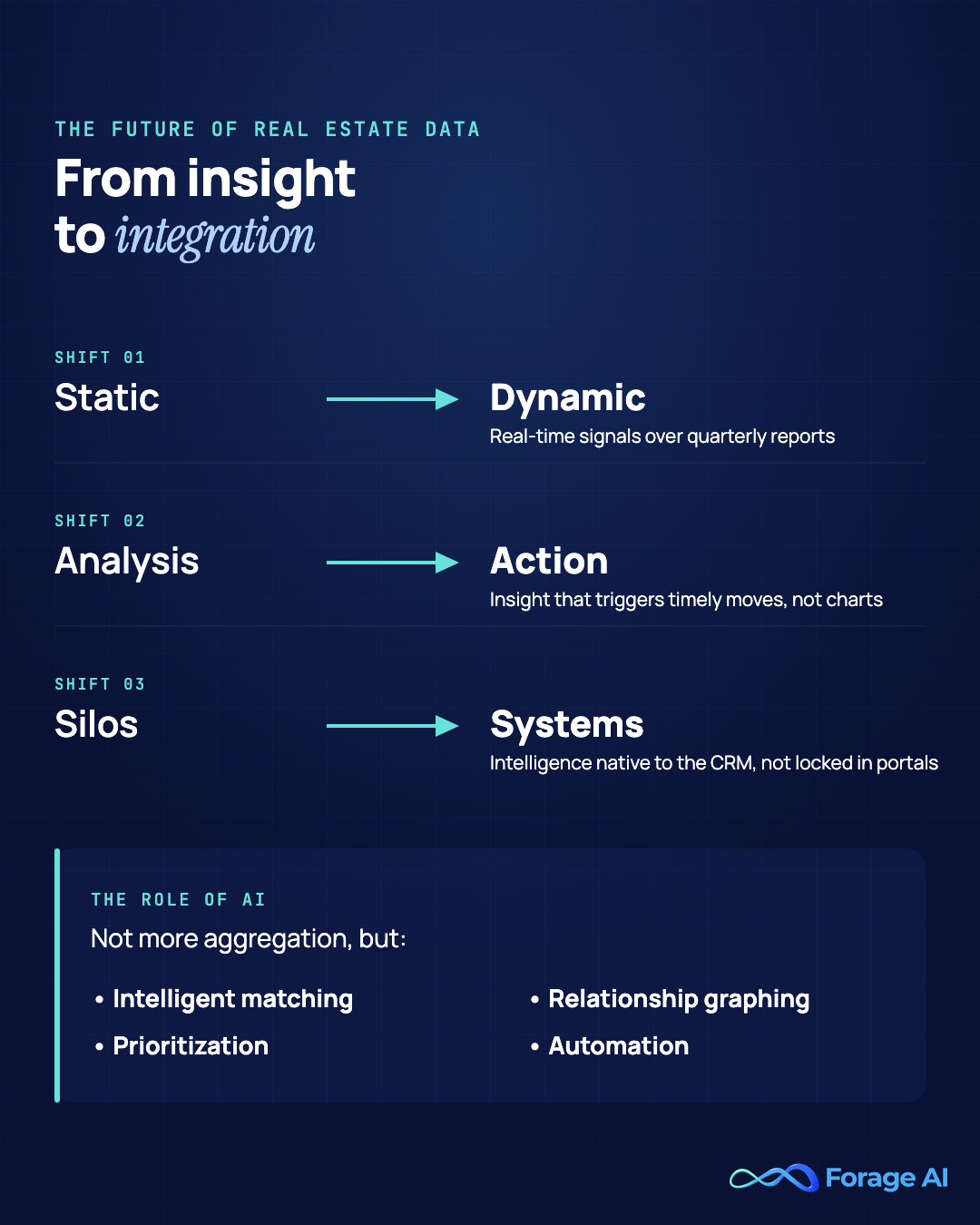
From static to dynamic
Quarterly reports and static dashboards can’t keep up with fast-moving markets. Teams increasingly need real-time signals.
From analysis to action
Predictive insight is valuable only when it triggers timely action. Alerts like “this owner just listed” matter more than retrospective charts.
From silos to systems
Data locked inside portals slows teams down. Intelligence that lives natively in CRMs compounds value every day.
The role of AI
The next phase of real estate data is not more aggregation, it’s intelligent matching, relationship graphing, prioritization, and automation. These are precisely the AI technologies transforming real estate data, from agentic extraction to predictive valuation, that workflow-native platforms are built to operate on.
Expert Insights
The direction of travel across all four shifts is the same: from static to dynamic, from analysis to action, and from silos to systems. The next phase of real estate data is not more aggregation, it is intelligent matching, relationship graphing, prioritization, and automation. An alert like “this owner just listed” is worth more than a retrospective chart, and intelligence that lives natively in a CRM compounds value every day rather than sitting locked inside a portal. The advantage shifts to teams that close the gap between insight and action.
Frequently Asked Questions
What are the three models of real estate data solutions in 2026?
The market organizes into three models. Data aggregators and marketplaces prioritize availability and hand cleaning, validation, and enrichment back to internal teams. Analytics and intelligence platforms aggregate structured datasets to deliver valuation models, market trends, and risk insights, mostly for the U.S. Automated workflow solutions continuously source and validate data, resolve ownership and entity relationships, apply business logic, and deliver intelligence directly into operational infrastructure.
Which real estate data providers offer global versus U.S.-only coverage?
Genuinely global coverage is rarer than it looks. Bright Data and Datarade offer worldwide reach as infrastructure and marketplace layers, MSCI Real Assets covers commercial transactions across 170+ countries, and Forage AI offers global coverage that is custom-defined by use case. Everything else on this list, ATTOM, PropertyShark, CoreLogic, CoStar (plus UK/Canada/France), Reonomy, HouseCanary, Cherre, PropStream, CompStak, Zonda, and Yardi Matrix, is U.S.-focused, with several going deeper still into specific metros or asset classes. The right choice depends on whether your use case requires worldwide visibility or deep, precise coverage within a single market.
Who is Forage AI best for?
Forage AI is best for brokerages, investor teams, and sales operations leaders who want intelligence to appear automatically inside their daily workflow, without spreadsheets, portals, or manual research. It is built for organizations where real estate data is a core operational dependency rather than a side input. It is optimized for operational efficiency and revenue workflows, not for distributing raw global datasets to data science teams.
How should I evaluate a real estate data provider?
Align evaluation criteria with how your team actually works. Assess coverage and geography, data depth and sources, delivery and integration, compliance and ethics, scalability and support, and transparency and trust. Delivery and integration is the most often underweighted, because data must integrate directly into operational systems like CRMs to create value rather than remain siloed.
Is there a single best real estate data provider?
No. There is no universally best real estate data provider, only the provider aligned to how your organization operates. If you need raw data access or experimentation, marketplaces and access platforms may suffice. If you need analytical depth for specific markets, traditional intelligence platforms remain valuable. If your business depends on continuous, accurate, operational real estate intelligence, then infrastructure matters more than datasets.
Conclusion: Choosing Your Intelligence Partner for 2026
There is no universally “best” real estate data provider. There is only the provider aligned to how your organization operates.
- If you need raw data access or experimentation, marketplaces and access platforms may suffice.
- If you need analytical depth for specific markets, traditional intelligence platforms remain valuable.
- If your business depends on continuous, accurate, operational real estate intelligence, then infrastructure matters more than datasets.
For organizations operating at scale, Forage AI is built to be that intelligence layer, turning fragmented data into reliable, actionable signals embedded directly into how teams work.
The real question for 2026 isn’t:
What data do we need?
It’s:
How do we eliminate friction between insight and action?
That answer determines who leads, and who reacts.
Connect with Forage AI to explore what a workflow-first real estate data strategy looks like for your team.