Grepsr rates 4.8 out of 5 across 85 Capterra reviews, with 64 five-star ratings and none below four (accessed July 2026). Its closest reviewed managed substitute rates 4.2 across 14. The scraping API that decisively fixes Grepsr’s most-cited complaint bills between $0.06 and $16.08 per 1,000 requests, on a difficulty tier you cannot see until you start scraping.
Three shapes of trade-off. None is simply “better.”
That is what every list of Grepsr alternatives leaves out. The roundups sort by category and hand you an inventory, when what decides your answer is which wall you hit, because a control wall and a cost wall point in opposite directions. Name your wall, see what genuinely answers it, and see what each answer takes away before you move.
Quick Digest
- Why teams leave a 4.8: A rating measures the vendor’s median customer, not your workload. Switching is routine (average tenure four years, Peukert 2010).
- The five walls: Control, turnaround, price visibility, drift, platform friction. A control wall and a cost wall have opposite answers, so category-sorted lists fail.
- The customization ceiling: Grepsr’s most-cited complaint, advanced changes route through its team (Capterra, December 2025), is a property of the concierge model, not a defect; every managed provider here has a version.
- How to read the ratings: Every score carries its sample size. Capterra, GetApp and Software Advice share one Gartner corpus, and Grepsr’s 4.8 (n=85) beats most substitutes.
- The 9 alternatives: Grouped by the wall each answers, with pricing, review evidence with n, and an honest watch-out apiece. ParseHub and Import.io are covered separately: neither is general-purpose today.
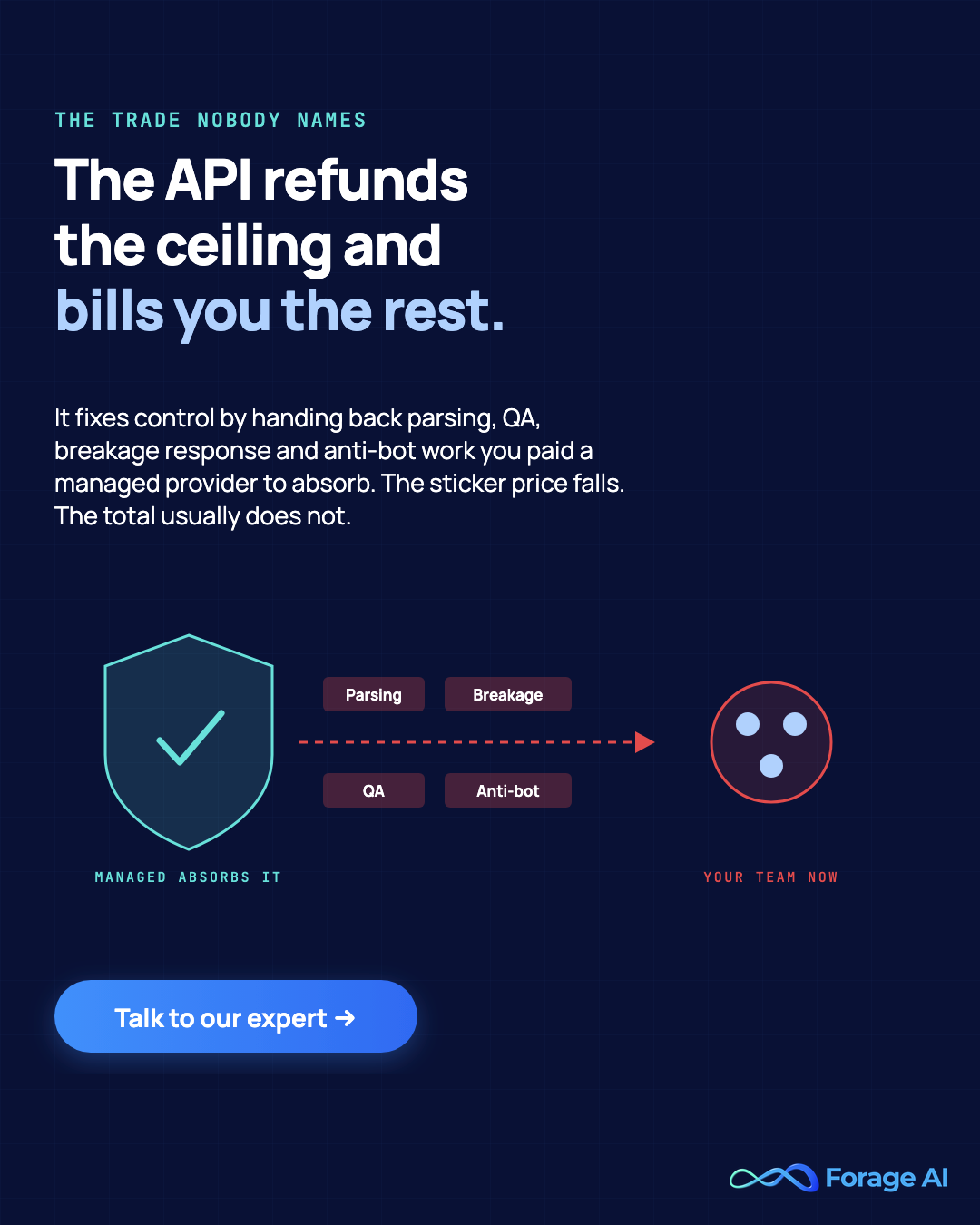
- The trade nobody names: Scraping APIs fix the ceiling by handing back parsing, QA, breakage and anti-bot work. Bots were 53% of web traffic in 2025, so that work costs more every year.
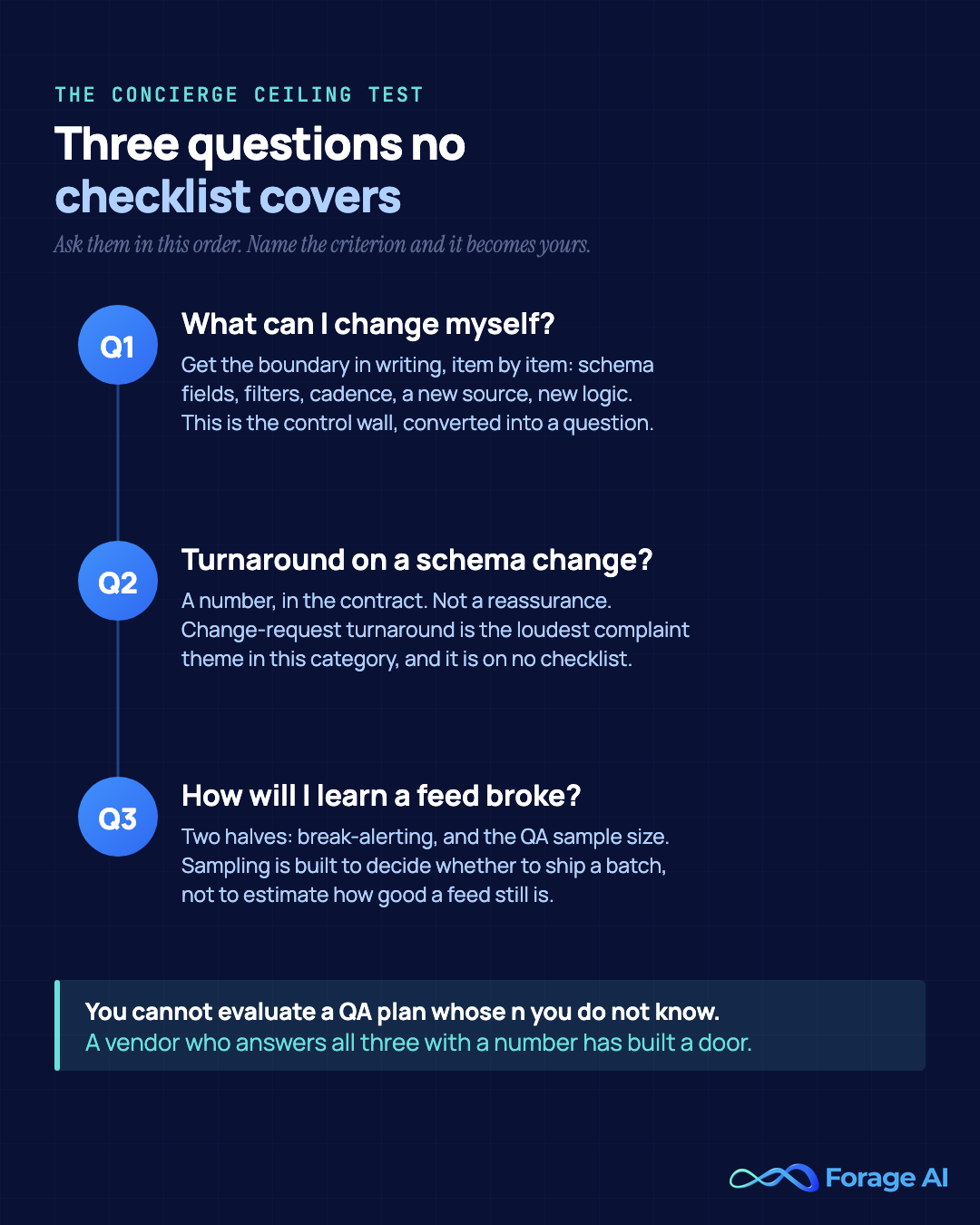
- The Concierge Ceiling Test: Three questions no checklist covers, what can I change without a ticket, your contractual turnaround on a schema change, and how I learn a feed broke and at what QA sample size.
- The exit: Own the scrapers before you sign, export the dataset, hold the schema constant, parallel-run before cutover.
Why teams leave a provider they rate 4.8 out of 5
The rating is not the question. Teams leave managed data vendors on one specific edge that rarely shows up in an aggregate score.
Grepsr has run fully managed web data extraction since 2012, owning discovery, extraction, cleaning, QA, maintenance and delivery, plus a free Chrome extension. You receive data, not a pipeline.
The 4.8 is real, and better than most of what follows. Its Capterra sub-scores read Customer Support 5.0, Ease of Use 4.8, Value for Money 4.8, Functionality 4.7 (85 reviews, July 2026). <!– –> That 5.0 is the highest support score on the roster.
So the frame is fit, not failure. Changing a managed vendor is routine procurement: the closest measured analogue, US credit unions switching IT outsourcing, puts average tenure at four years. <!– –> Nor is the market leaving done-for-you: web scraping services grow at 18.62% CAGR, faster than software, from $1.34B in 2025 to a projected $3.49B by 2031 (Mordor Intelligence, July 2026). <!– –> More alternatives is not a reason to switch; a wall you hit is. Call it the concierge ceiling.
Quick Summary
Q: Why do teams look for Grepsr alternatives when they rate it 4.8 out of 5?
A: A rating measures the median customer, not your workload. Teams leave on one edge, usually control, turnaround, cost visibility or drift, and switching is routine, not a verdict (average tenure four years, Peukert 2010). Grepsr’s sub-scores, Support 5.0 and Value 4.8 on 85 Capterra reviews (July 2026), beat most substitutes.
Which wall did you actually hit?
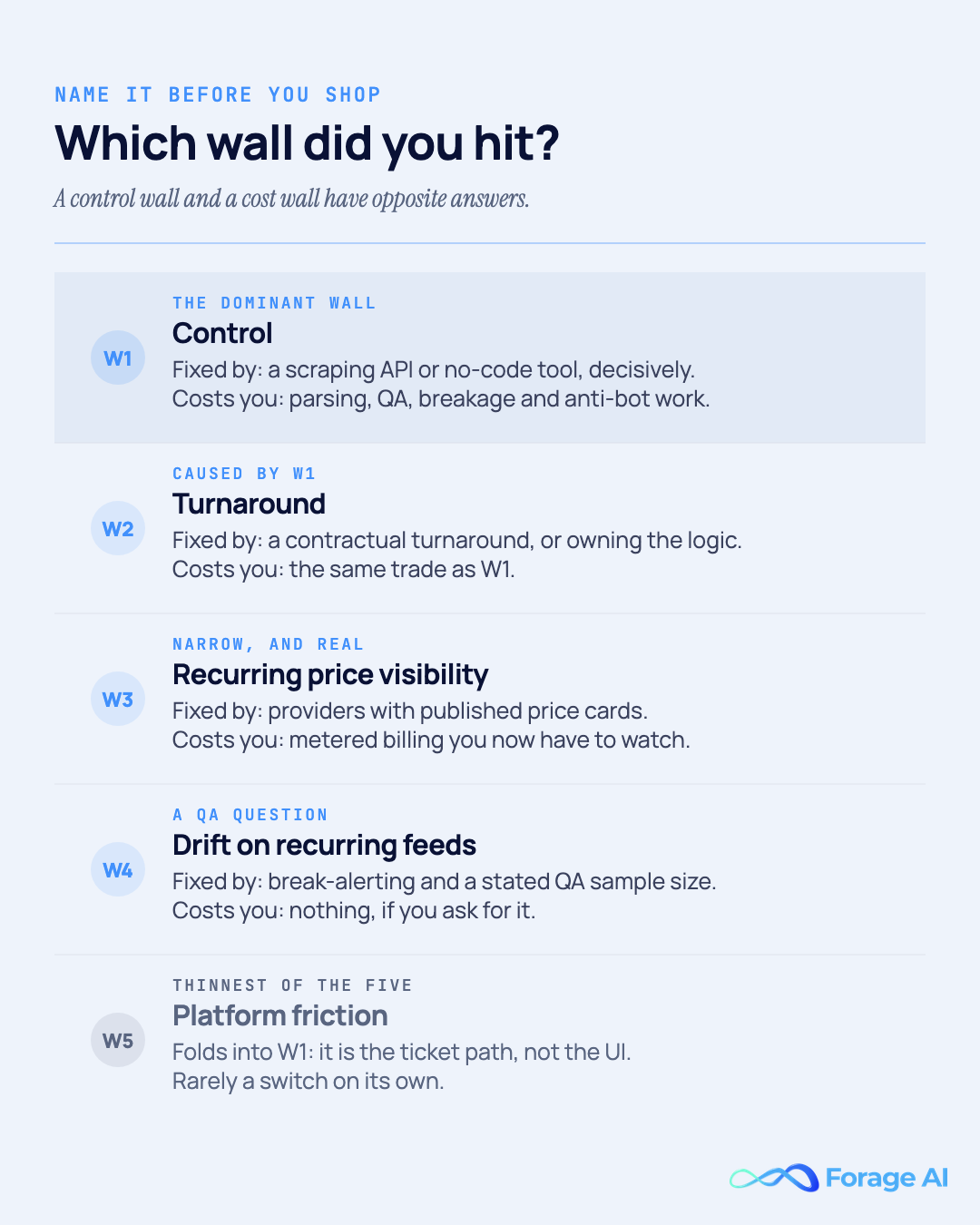
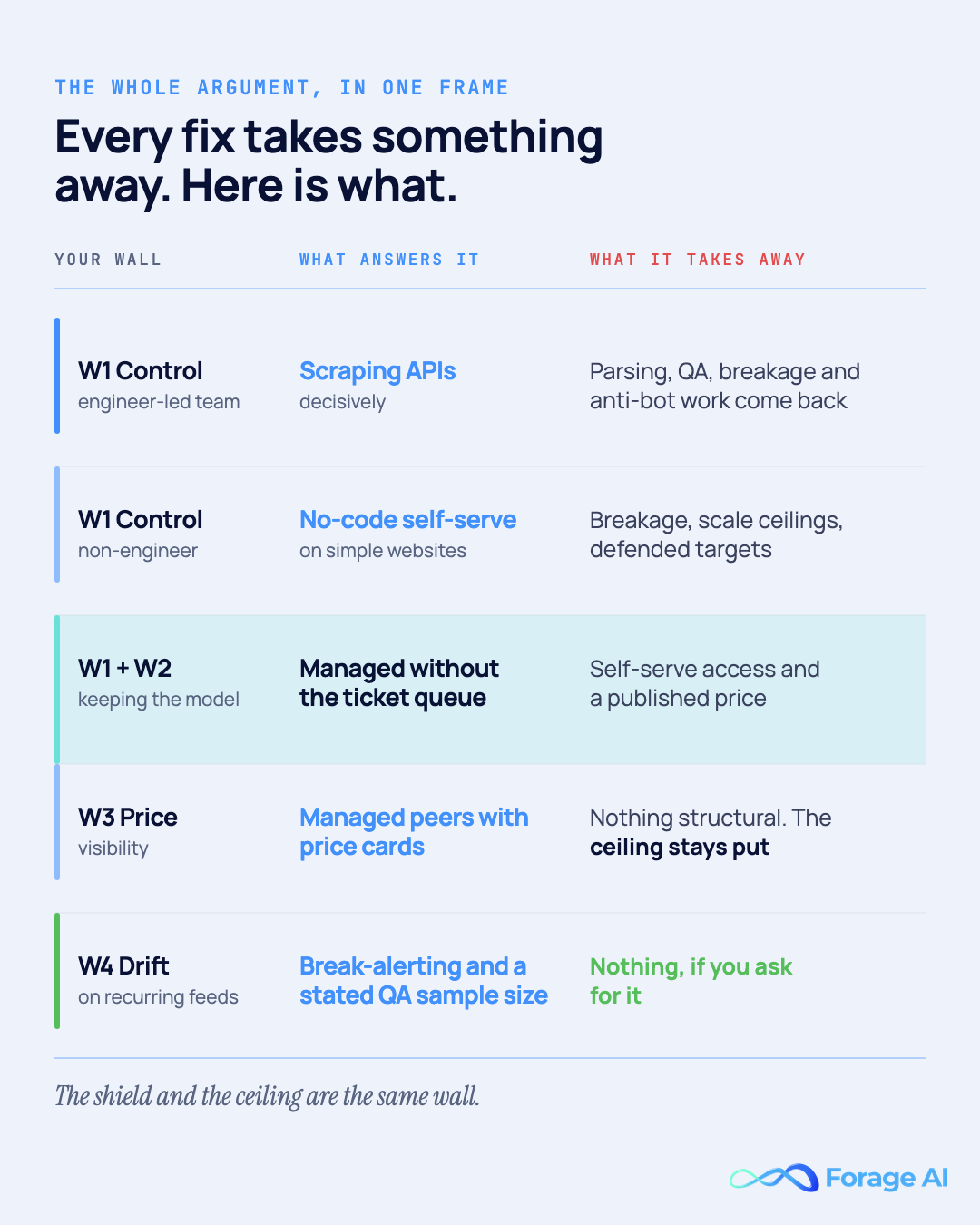
The diagnosis is the whole thing, because a control wall and a cost wall have opposite answers. Five walls appear in Grepsr’s public review record, graded here by recency and specificity rather than by how bad they sound.
| Wall | What it sounds like in your team | What the evidence says | What actually fixes it | What that costs you |
|---|---|---|---|---|
| W1 Control | “We can’t change the extraction logic ourselves.” | “Limited hands on control for deep customization. Advanced changes or new logic usually require coordination with the Grepsr team.” Aditya M., Data Consultant, IT & Services, 51-200 employees, Dec 17 2025 | A scraping API or no-code tool, decisively. Or a managed provider without the ticket queue. | The API and no-code routes hand back parsing, QA, breakage and anti-bot work. |
| W2 Turnaround | “The change request is in a queue across a timezone.” | “At times, turnaround time for highly customized requests could be improved, particularly for large-scale projects.” Ishan M., Data Analyst, Financial Services, May 7 2026 (newest review on record) | A contractual change-request turnaround, or owning the logic. | Same trade as W1. Speed you control is speed you maintain. |
| W3 Recurring price visibility | “We can’t forecast next year without a sales call.” | Starter Pack $350 one-time on simple standard websites (listed as reduced from $700). Growth Pack and Enterprise Partnership custom-quoted. Billed on records, not requests, monthly in arrears (grepsr.com/pricing and /faq, July 2026) | Providers with published price cards. | A card trades the sales call for metered billing you now watch. |
| W4 Drift on recurring feeds | “The numbers moved and nobody flagged it.” | “Sometimes the data quality consistency is missing from one quarter to another” (Anthony V., Automotive, Oct 16 2024, rated 4.0). “Incorrect sku count on report vs website” (Jill T., Data Analyst, Dec 7 2023, rated 4.0) | Break-alerting and a stated QA sample size. A QA question, not a vendor question. | Nothing, if you ask for it. See the three questions below. |
| W5 Platform friction | “The interface fights us.” | Thinnest of the five in the public record. In practice it folds into W1: the friction is the ticket path, not the UI. | Rarely a switch on its own. | n/a |
Sources: Capterra Grepsr reviews (4.8/5, 85 reviews, accessed 2026-07-16); grepsr.com/pricing and grepsr.com/faq (accessed 2026-07-16).
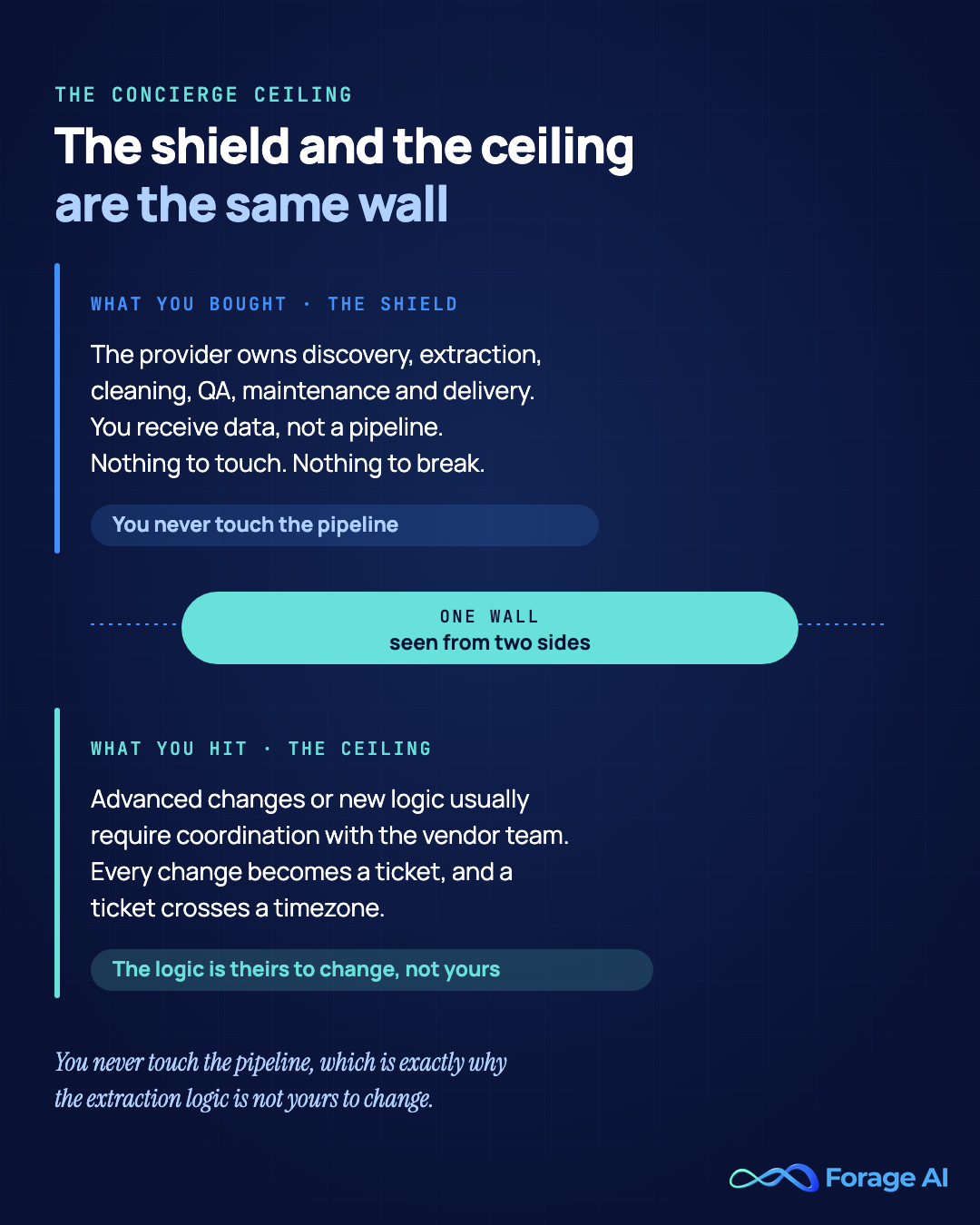
W1 is the dominant wall, and W2 is caused by it: because you cannot change the logic yourself, every change becomes a ticket, and a ticket crosses a timezone. But W1 is a critique of the managed category, not of Grepsr. Every managed provider below has the ceiling, one explicitly worse (its own reviewers report zero control over the extraction software). The shield and the ceiling are one wall seen from two sides: Grepsr’s pitch is that you never touch anything but the data you asked for, which is precisely why the logic is theirs to change.
> Common misconception. “Grepsr gives you no control” is false, and disprovable in thirty seconds. Grepsr ships a free Chrome extension for point-and-click scraping, and its platform lets you request and retrieve data yourself. One reviewer, a CIO, notes self-service was not there originally and that Grepsr has since launched it. The accurate claim is narrower: inside a managed engagement, the extraction logic is the vendor’s to change, not yours.
Two more corrections the public record gets wrong. “Grepsr is slow” is false: turnaround is its most-praised attribute, and its own FAQ states a typical project completes in days, not weeks. W2 is narrow, covering highly customized requests on large-scale projects. And the $350 is one-time, not monthly. Three third parties render it as recurring and two invent a free tier the vendor’s page does not offer.
The honest claim on W3 is narrow: the recurring number is unknowable before a sales call, not that the terms are predatory. Billing in arrears, with pausable crawls and a sample dataset before production, is friendlier than several alternatives below. And sometimes the wall is not the vendor: reviewers report reworking the ask to get the right fields back, and a timezone lag can be an escalation path nobody negotiated.
Quick Summary
Q: Which Grepsr wall did you actually hit, and does it change the answer?
A: It changes everything, because a control wall and a cost wall have opposite answers. The most-cited wall is control: advanced changes route through the Grepsr team (Capterra, December 2025), a property of the concierge model, not a defect, so most of the roster does not fix it. If the wall is price visibility, published pricing exists elsewhere; if it is drift, the fix is alerting and QA terms, not a new vendor.
How we picked these alternatives, and how to read the ratings
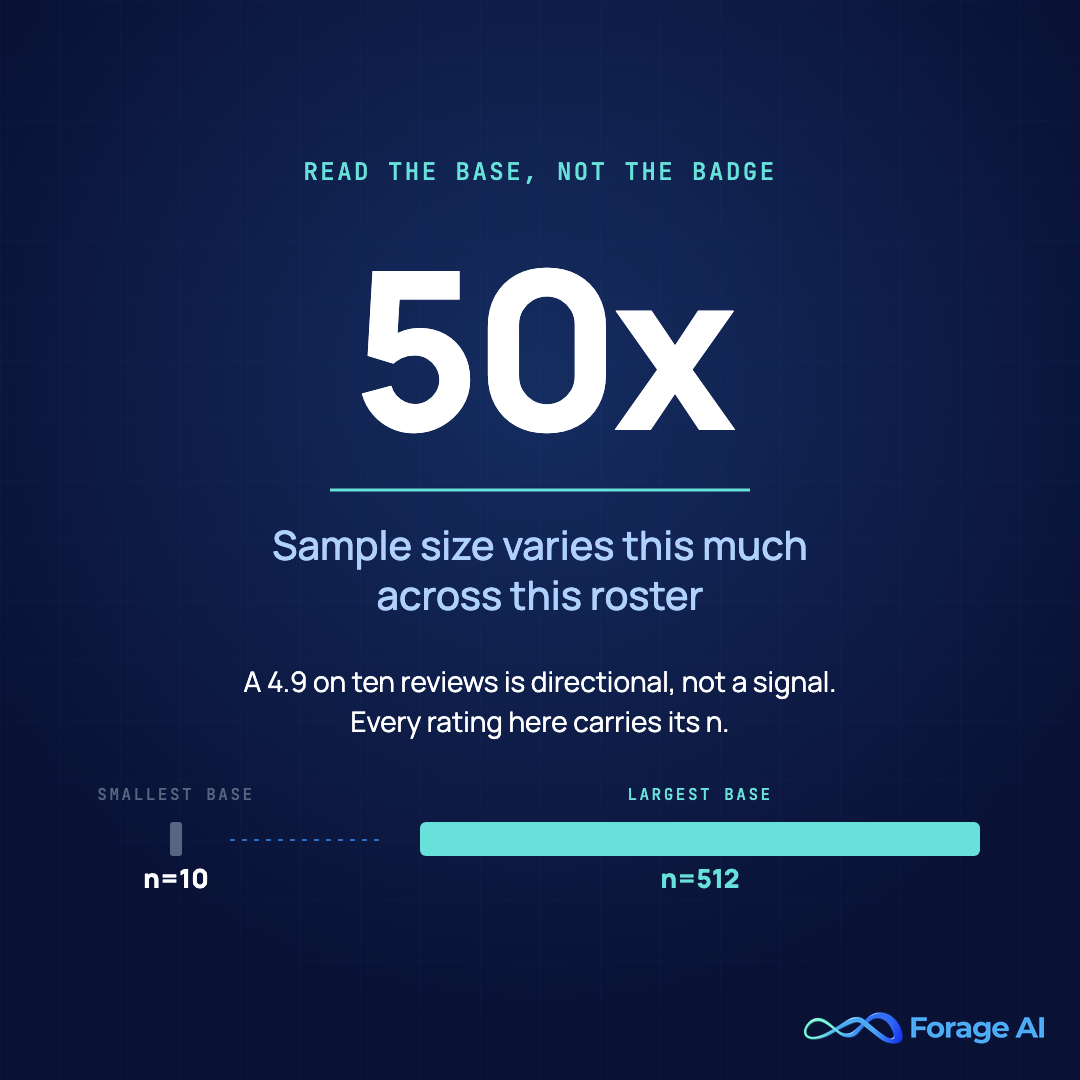
Naming the wall narrows the roster; reading the evidence behind each candidate is the other half, and it starts with the number most lists omit. Every rating here carries its sample size. A 4.9 on ten reviews and a 4.3 on 348 are not the same claim, and printing them side by side without the n implies a precision that does not exist.
| Factor | What we checked | Why it decides |
|---|---|---|
| Model | Managed, scraping API, or no-code self-serve | Determines who owns the pipeline after you sign |
| The wall it answers | W1 control, W2 turnaround, W3 price visibility, W4 drift | The only axis that maps an alternative to your reason for leaving |
| Published pricing | Vendor page only, never an aggregator | Aggregators mislabel tiers, units and billing periods routinely |
| Review base | Rating with n and recency | A score without a base is noise |
| Independent evidence | Anything beyond one review corpus | Three websites in one network are one source |
| The honest watch-out | The real one, not a decorative one | An alternative with no downside has not been researched |
Grepsr alternatives at a glance
| Alternative | Model | Best for | The wall it answers |
|---|---|---|---|
| 1. Forage AI | Managed | Teams needing extraction logic to move without owning the pipeline | W1, W2, W4 |
| 2. ScrapeHero | Managed | Teams needing a managed price point readable before a call | W3 |
| 3. PromptCloud | Managed | Enterprise teams with recurring sources, no scraping engineers | W2 (partial) |
| 4. Datahut | Managed | Cost-sensitive teams wanting managed retail feeds | W3 |
| 5. Zyte | Scraping API | Python and Scrapy teams that want the logic in their hands | W1, W2 |
| 6. Bright Data | Scraping API | Teams whose bottleneck is access to defended targets | W1 |
| 7. Oxylabs (and ScrapingBee) | Scraping API | Mid-market teams wanting a price card and enterprise IP access | W1, W3 |
| 8. Apify | Scraping API | Technical-ish teams wanting prebuilt scrapers fast | W1, W2 |
| 9. Octoparse | No-code | Analysts on stable, simple websites | W1, W3 |
ParseHub and Import.io appear on most rival lists and are covered below the roster, in a separate band. Neither is a general-purpose alternative as of July 2026.
Three notes on method. We listed only things actually in the category, not the RPA and document-capture tools directories pad these lists with. No vendor paid for placement. And Capterra, GetApp and Software Advice share one Gartner-owned corpus, so the same 4.8 on three sites is one dataset, not three. G2, Trustpilot and TrustRadius 403 to direct fetch, so their figures are corroborated via secondary sources and labelled as such; where sources conflict, we report both.
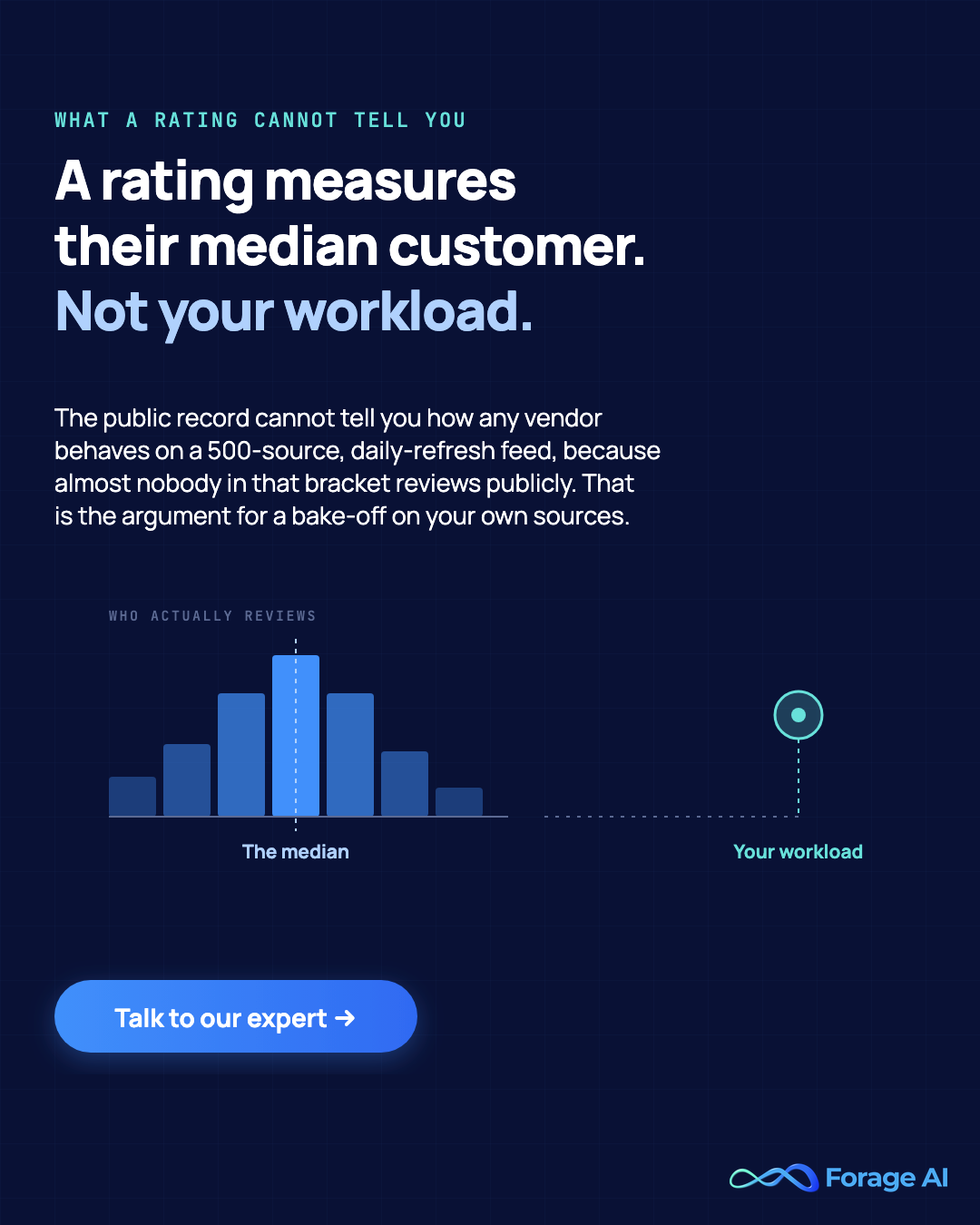
The same standard applies to Grepsr, and to us. Grepsr’s 85 reviews hold 64 five-star and 21 four-star ratings and nothing below four, on a small-business-skewed base, so the public record cannot tell you how it behaves on a 500-source, daily-refresh enterprise feed. For our own entry we show named client testimonials and a first-party G2 4.8, and flag that we hold no third-party review count comparable to Grepsr’s 85 rather than argue from a badge. Ratings drift; last checked July 2026.
Quick Summary
Q: How should you read the ratings in a Grepsr alternatives list?
A: Always with sample size and date. A 4.9 on 10 is not a 4.3 on 348, and Capterra, GetApp and Software Advice share one Gartner corpus rather than confirming each other. A high score on a thin, small-business base cannot tell you how a vendor behaves on your workload, the case for a bake-off on your own sources.
9 Grepsr alternatives, mapped to the wall each one answers
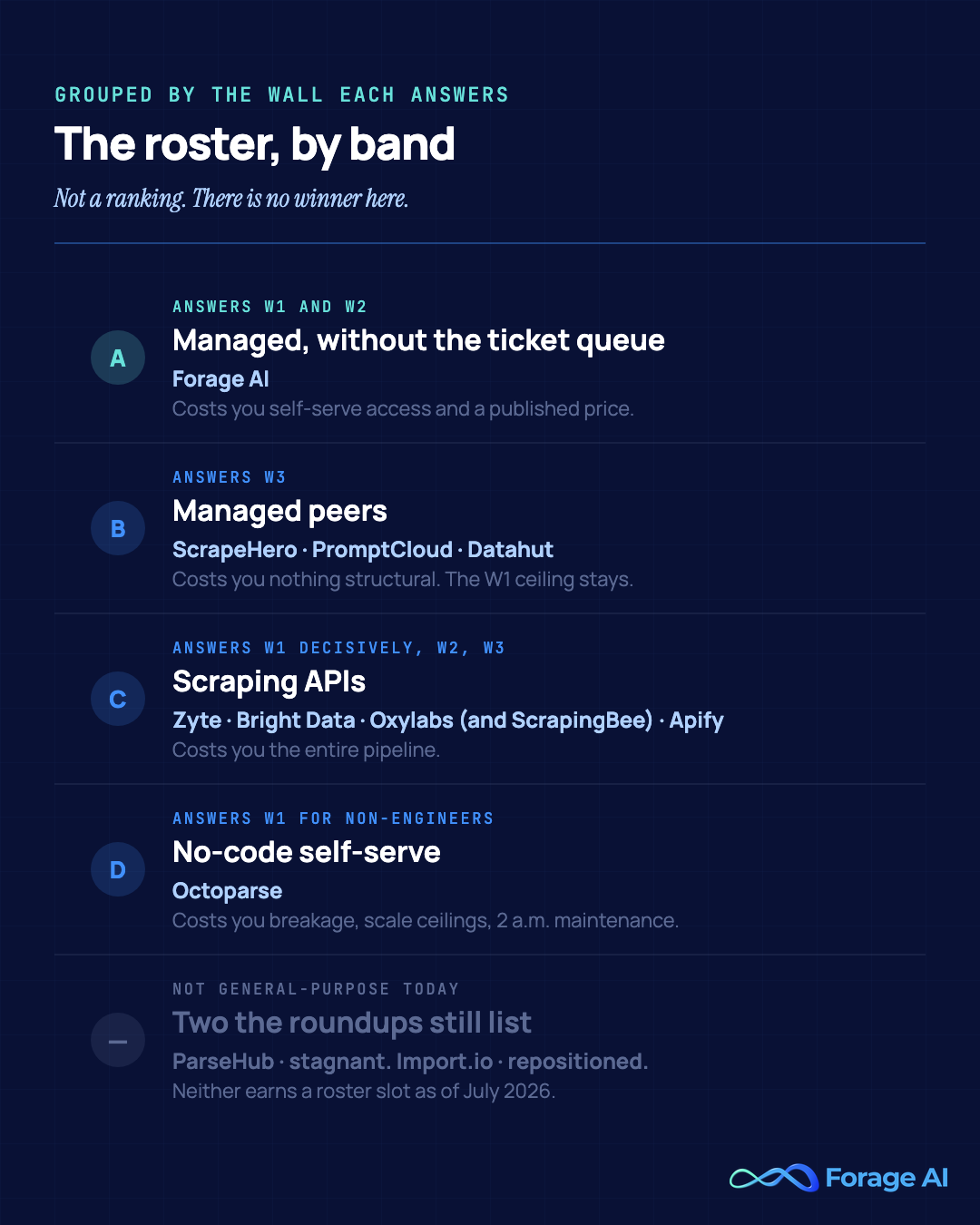
Entries are grouped into four bands by the wall they answer, managed without the ticket queue, managed peers, scraping APIs, and no-code. Every rating carries its n and access date, and every entry carries both a strength and a “not for” line, because an alternative with no downside has not been researched. Read only the band that matches your wall; the others are there so you can see what you are choosing against, and each entry closes with the single condition under which it beats staying on Grepsr.
Band A: managed, without the ticket queue
Answers W1 and W2 while keeping the managed model. Costs you self-serve access and a published price. This band is for a reader whose wall is control or turnaround but who has no wish to take a pipeline back in-house.
1. Forage AI
| Attribute | Detail |
|---|---|
| Model | Managed (fully managed custom contract) |
| Best for | Teams needing extraction logic to keep moving without taking the pipeline back |
| The Grepsr wall it answers | W1, W2, W4 |
| Pricing (as published) | Not published. Custom contract, no per-unit card |
| Who owns maintenance | The vendor |
| Watch-out | Not self-serve, not pay-as-you-go, no price card, no sandbox. Every engagement starts with a conversation |
| Attribute | Detail |
|---|---|
| Ratings (with n, accessed 2026-07-16) | G2 4.8 / 5, shown first-party on forage.ai. We hold no third-party review count comparable to Grepsr’s 85, and we say so rather than manufacture one |
| Evidence quality | Named first-party client testimonials, a different evidence class from the third-party platform sentiment (Capterra and G2 verbatims) used for every competitor row here. Labeled as such, not passed off as anonymous platform reviews |
| What customers are saying | “Forage’s consistent performance and reliability in maintaining the pipelines they’ve set up for us have exceeded our expectations.” Dave Thornton, CEO, Vested. “What sets Forage AI apart is that they don’t just provide off-the-shelf solutions; instead, they delve deep into our requirements.” Rachel DeMel, Director of Product & Content Strategy, Expert Institute. “The Forage AI team has an uncommon ability to cut through the hype.” Kevin Black, Partner, 22C Capital. (Named client testimonials, forage.ai) |
| What customers complain about | Documented externally: no self-serve access, no published pricing, no free trial or sandbox to evaluate independently. Reviewers also raise UI navigation and documentation depth |
| Source | G2 (first-party display) and named client testimonials on forage.ai. A third-party review count comparable to the competitor rows here does not exist for us, and we do not claim one |
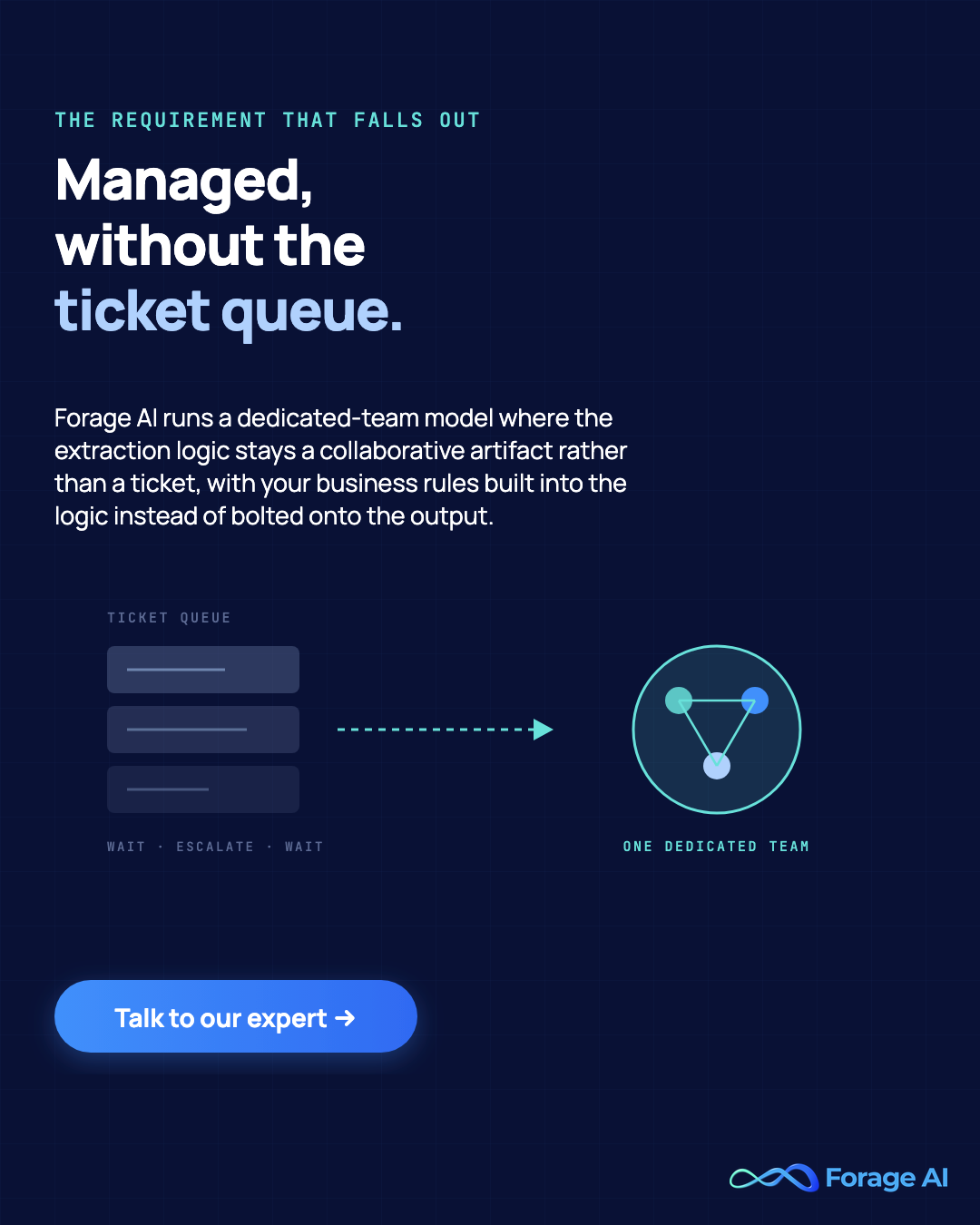
Forage AI runs fully managed web data extraction on a custom-contract, dedicated-team model. The team owns the whole chain: discovery, crawling infrastructure, extraction logic (XPath, NLP and custom-trained models), cleaning and normalization, multi-layer QA, monitoring and delivery, with your business rules and taxonomies built into the logic rather than bolted onto the output. As with any managed provider, you receive data, not a pipeline.
Read the eight entries below and a requirement falls out that no vendor name satisfies on its own. If your wall is the customization ceiling, the managed peers do not fix it, and the APIs fix it by handing back the pipeline you paid to be rid of. What is left is narrow: a managed provider where extraction logic is a collaborative artifact rather than a ticket in a queue. That is the slot Forage AI is built for, answering W1 control, W2 turnaround and W4 drift while keeping you out of the pipeline.
Who it’s for: teams where the data is the product and the schema keeps changing, which is the case the two client testimonials above describe directly. Expert Institute’s note that Forage does not ship off-the-shelf solutions but delves deep into requirements, and Vested’s on pipelines maintained reliably over time, are the customization-ceiling answer stated by customers rather than by us. The third testimonial, 22C Capital’s Kevin Black on an “uncommon ability to cut through the hype,” speaks to the same posture from the buyer’s chair: scope defined with you, not sold to you. The standout strength is that the logic is meant to move with the workload instead of freezing at contract signing.
The watch-out is real, and it is the same structural trade Grepsr makes: you do not touch the pipeline here either, there is no published price, no pay-as-you-go and no sandbox, and every engagement starts with a conversation. On price visibility specifically, Forage sits behind Grepsr, which at least publishes a $350 entry, and we would rather say that than pretend otherwise.
Against Grepsr, the difference it claims is not price or a badge but where the extraction logic lives: a collaborative artifact that moves with you rather than a ticket in someone else’s queue.
Not for: anyone who wants pay-as-you-go, a sandbox, or hands on the code.
Band B: managed peers, the same model with different trade-offs
Answers W3 with published price points, sometimes W2. Costs you nothing structural, because the W1 ceiling stays exactly where it was. This band is the honest test of the article’s thesis: same model, different vendors, and the control ceiling never moves. If the managed versus automated web scraping distinction is what you are weighing, that comparison runs it properly.
2. ScrapeHero
| Attribute | Detail |
|---|---|
| Model | Managed (with a self-serve cloud tier) |
| Best for | Enterprise teams needing large-scale ongoing extraction across complex websites |
| The Grepsr wall it answers | W3 |
| Pricing (as published) | Cloud $5/mo to $750/mo (400 free credits monthly). Managed reported at Business $199/mo per website, On-Demand $550 per website per refresh, Enterprise from $1,500/mo. One comparison source cites managed “from $450/month”; both reported |
| Who owns maintenance | The vendor |
| Watch-out | Credits expire monthly, no rollover. Email-only support, no phone or video |
| Attribute | Detail |
|---|---|
| Ratings (with n, accessed 2026-07-16) | Capterra 4.7 (n=26) · G2 4.7 (n≈63, corroborated-via-secondary). One aggregator’s “89 on G2” appears to be 63 + 26 mislabelled; not used |
| Evidence quality | Moderate base, mixed recency; praise runs 2021 to 2024 |
| What reviewers praise | “For the level of service they offer, they are very competitively priced” (Apr 2024). “Professional, fast, and flexible… spot on, every single time” (Aug 2023). Sub-hour support response in business hours |
| What reviewers complain about | “The cost of service is significantly high” (Feb 2024), contradicting the April praise. Multi-week turnaround on urgent asks. Missing granular field customization. Cloud versus Managed tiering causes pricing confusion |
| Source | Capterra; G2 seller listing (corroborated-via-secondary) |
ScrapeHero is a US-based managed provider (founded 2014) built for large-scale, ongoing extraction across complex websites, with a self-serve Cloud tier sitting under the done-for-you managed service. In practice it suits price, product and inventory monitoring across many retail and marketplace domains, where the per-site model is legible even as it adds up. It is the roster’s closest structural analogue to Grepsr: the same concierge model, the same you-receive-data posture, all plans bundling proxies, infrastructure, bandwidth and maintenance.
ScrapeHero earns its slot on one thing: it publishes managed price points where Grepsr shows a custom-quote wall. Business at $199/mo per website, On-Demand at $550 per website per refresh, Enterprise from $1,500/mo. That is a genuine W3 win and the cleanest reason it belongs here, and because it stays managed, you hand no maintenance back to get it.
Who it’s for: a team whose wall is genuinely recurring-price visibility, running feeds across many complex sites, that wants a number before a sales call rather than a control lever it will not use. Support is fast in business hours, sub-hour by its own reviewers, and that is the standout. Reviewers also call it “professional, fast, and flexible” and “spot on, every single time,” though those praise notes date to 2023 and 2021, older than the cost complaint.
The counterweight is the rest of the comparison. It does not beat Grepsr on control (its own base cites missing granular field customization), not on turnaround (multi-week on urgent asks), and is a regression on support in reach: email-only, no phone or video, against Grepsr’s 5.0. Its base also splits on price, a February 2024 “the cost of service is significantly high” against an April 2024 “very competitively priced.” That split is real; take both or neither. Cloud-tier credits expire monthly with no rollover, and the Cloud-versus-Managed tiering is a documented source of pricing confusion.
The vendor claims Fortune 50 clients and 98% retention across 14,000-plus customers, figures worth treating as its own marketing until verified. Against Grepsr specifically, it wins on published pricing and loses on control, turnaround and support, which is the entire managed-peer pattern in a single row.
Not for: anyone whose wall is control or turnaround.
3. PromptCloud
| Attribute | Detail |
|---|---|
| Model | Managed (data-as-a-service) |
| Best for | Enterprise teams with several recurring sources and no in-house scraping engineers |
| The Grepsr wall it answers | W2 (partially) |
| Pricing (as published) | Conflict, unreconciled: Capterra lists a $150/mo start with no free trial; a vendor-adjacent source lists $49 per website monthly-refresh entry rising to $3,999+/mo enterprise. Both reported, neither picked |
| Who owns maintenance | The vendor |
| Watch-out | No weekend support, recurring across sources. Price floor too high for small teams |
| Attribute | Detail |
|---|---|
| Ratings (with n, accessed 2026-07-16) | Capterra 4.2 (n=14) · G2 4.6 (n=16, corroborated-via-secondary) |
| Evidence quality | Thin on both platforms, and several praise quotes date to 2023 |
| What reviewers praise | Support responsiveness dominates. Data arrives usable: “data well structured and needed no further processing.” Reliability across a multi-year engagement (Sept 2023) |
| What reviewers complain about | Onboarding friction (Mar 2020). Pricing opacity. Limited data-freshness visibility. No weekend cover |
| Source | Capterra; G2 (corroborated-via-secondary) |
PromptCloud is a managed data-as-a-service provider (founded 2009, Bangalore) that runs recurring extraction feeds for enterprise teams with several sources and no in-house scraping engineers. Typical deployments are multi-source feeds for market-intelligence and pricing teams that want structured data delivered, not a platform to operate. It is the closest reviewed managed comparator to Grepsr on this roster, which is exactly why it is instructive.
The honest read leads: PromptCloud is a lateral move, not an upgrade. Its Capterra 4.2 (n=14) sits below Grepsr’s 4.8 (n=85). Its most-praised attribute is support responsiveness, which is also Grepsr’s strongest attribute at 5.0 (n=85). It shares the same W1 ceiling and the same W3 opacity, so nothing structural changes if you move.
Where it can help is narrow. If your specific complaint is queue latency, reviewers describe data that arrives usable, “data well structured and needed no further processing,” and a multi-year engagement that “never faced any issues.” That is a second managed opinion on the same workload rather than a fix for the model. Being managed, it hands you no maintenance back; the only thing you spend is another procurement cycle on a peer that scores lower on a thinner base, with onboarding friction and no weekend cover the recurring negatives.
Who it’s for: a team on several recurring sources, comfortable at a $500-plus monthly floor, whose wall is turnaround specifically and who wants to test a different managed vendor on the same feed. Watch-out: no weekend support, onboarding friction in the older reviews, and pricing two sources cannot reconcile, a $150/mo Capterra floor against a $49-per-website entry rising past $3,999/mo enterprise.
Against Grepsr, it is the rare entry whose honest verdict is do not switch for the model, only for a specific second opinion on latency.
Not for: anyone whose wall is W1. The ceiling is identical.
4. Datahut
| Attribute | Detail |
|---|---|
| Model | Managed (full-service only) |
| Best for | Cost-sensitive teams wanting managed retail and e-commerce feeds |
| The Grepsr wall it answers | W3 (cost), and only that |
| Pricing (as published) | Volume-based, reported $40/mo to $10,000/mo, but the only retrievable source is a 2019 article |
| Who owns maintenance | The vendor |
| Watch-out | No free trial, upfront payment required, a worse commercial posture than Grepsr’s bill-in-arrears |
| Attribute | Detail |
|---|---|
| Ratings (with n, accessed 2026-07-16) | Capterra 4.9 (n=10; Ease 4.9 · Service 5.0 · Value 4.8) |
| Evidence quality | A 4.9 on ten reviews is directional, not a signal. Never read it against a larger base without the n |
| What reviewers praise | “The service is top notch and it saved a ton of money for my startup” (CEO). “Quality datasets in competitive pricing.” Handles anti-scraping defenses |
| What reviewers complain about | Zero control over the extraction software, full-service only. Setup takes considerable time. Poor fit for small or one-off tasks. Needs client follow-ups to pin requirements |
| Source | Capterra |
Datahut is a budget-oriented managed provider (HQ Kerala, India) that produces retail and e-commerce feeds full-service, meaning it owns the pipeline end to end and you configure nothing. It is a fit for a startup or analytics team standing up its first competitive-price or catalog feed on a fixed budget. Its Capterra 4.9 (n=10, with Service 5.0 and Value 4.8) is genuinely warm and genuinely small: ten reviews is directional, not a signal, and it should never be read against a larger base without the n.
Datahut is the clearest proof of this article’s argument, and the proof sits in its own review base: reviewers report zero control over the extraction software. It has the same W1 ceiling as Grepsr, arguably a lower one. If the ceiling were a Grepsr defect rather than a property of the concierge model, the budget managed option would not carry a worse version of it. That is the reason to include Datahut at all.
What it does well its base says plainly: “the service is top notch and it saved a ton of money for my startup” from a CEO, “quality datasets in competitive pricing,” and it handles anti-scraping defenses on the retail targets it specializes in. S3 and Pentaho integration round out the pitch. The standout is price on stable retail feeds.
Who it’s for: a lean team where the wall is genuinely cost, on retail feeds, with requirements that do not move. Being managed, it hands no maintenance back to you. Watch-out: setup takes real time, there is no free trial and payment is upfront, a worse commercial posture than Grepsr’s bill-in-arrears, and the only retrievable pricing record is roughly seven years old, so treat any $40-to-$10,000/mo number as a conversation starter.
Against Grepsr, it is cheaper and worse on control, the budget end of the same managed trade.
Not for: anyone whose wall is control.
Band C: scraping APIs, the decisive fix for the ceiling
Answers W1 decisively, W2 (no ticket queue), and W3 (public per-unit pricing). Costs you the entire pipeline. These fit teams with engineers to spend, where the price of control is that every job downstream of egress, parsing, QA, breakage and monitoring, becomes yours. The section after the master table prices that trade.
5. Zyte
| Attribute | Detail |
|---|---|
| Model | Scraping API, with a managed tier available |
| Best for | Python and Scrapy teams wanting API-first control with a managed fallback |
| The Grepsr wall it answers | W1 decisively, W2 |
| Pricing (as published) | Zyte API from $0.13 per 1,000 successful HTTP responses on pay-as-you-go, against a full published spread of $0.06 to $16.08, a ~268x range. At a $500/mo commitment, $0.06 to $0.61 per 1K HTTP and $0.48 to $7.68 per 1K browser. Zyte Data managed: Standard $500/mo, Custom $1,000/mo. $5 trial credit |
| Who owns maintenance | You, on the API tier |
| Watch-out | The per-request price depends on an auto-assigned site-difficulty tier you cannot see until you start scraping |
| Attribute | Detail |
|---|---|
| Ratings (with n, accessed 2026-07-16) | Capterra 4.4 (n=43; Ease 4.5 · Service 4.4) · G2 4.3 (n=114, corroborated-via-secondary) · Trustpilot conflict: 4.0 (n=24) versus 3.1 (n not stated at source), neither directly observed, both reported |
| Evidence quality | The best cross-platform agreement on the roster |
| What reviewers praise | “The service is extremely reliable, rapidly scalable and has the lowest latency amongst its peers” (Capterra). Deep Scrapy integration; Zyte authored Scrapy. Uptime |
| What reviewers complain about | Billing shock, the sharpest recent negative in the dataset: reviewers cite charges 40x higher than anticipated. Cloudflare-protected websites push you into pricier tiers. Support contradicts itself: Capterra says responsive including weekends, a Trustpilot snippet says 24 to 48 hours and nothing weekends. Both reported |
| Source | Capterra; G2 and Trustpilot (corroborated-via-secondary) |
Zyte is a scraping API (founded 2010 as Scrapinghub, rebranded 2020, based in Cork) built by the team that authored Scrapy, with a managed Zyte Data tier available as a fallback. Teams already running Scrapy spiders get the most from it, treating the API as managed egress and unblocking under code they own. This is the first entry that leaves the managed model, so read the trade before the pitch.
Zyte is the cleanest escape from the control ceiling on this page. You change the extraction logic yourself, today, no ticket. W1 is answered decisively and W2 falls out as a side effect, because there is no queue to sit in. Its Capterra 4.4 (n=43) and G2 4.3 (n=114) are the best cross-platform agreement on the roster, and reviewers call it “extremely reliable, rapidly scalable and has the lowest latency amongst its peers,” with the deepest Scrapy integration you will find anywhere.
Here is the exchange, and it is the most interesting trade in the piece. Escaping the ceiling means taking the pipeline back: parsing, QA, breakage response and anti-bot work all return to your team, which is exactly what a Grepsr customer paid to be rid of. Zyte also swaps Grepsr’s W3 for a worse version of the same wall. Grepsr’s recurring number is invisible until a sales call; Zyte’s per-request price is invisible until you start scraping, because the difficulty tier is auto-assigned and the published spread runs $0.06 to $16.08 per 1,000 requests, a ~268x range. <!– –> The sharpest recent negative in the whole dataset is billing shock, reviewers citing charges 40x higher than anticipated when Cloudflare-protected targets push them into pricier tiers. You escape the control ceiling and walk into a billing one. The managed Zyte Data tier, Standard $500/mo and Custom $1,000/mo, is the escape hatch when you want that control without staffing it, and a $5 trial credit lets you probe how the difficulty tiers price your targets before you commit.
Against Grepsr specifically, Zyte is the one roster entry that beats it on control decisively while being worse than it on cost predictability, the sharpest single trade in the piece.
Not for: teams without Python and Scrapy capacity, or without the appetite to own parsing, QA and breakage.
6. Bright Data
| Attribute | Detail |
|---|---|
| Model | Scraping API and enterprise proxy network |
| Best for | Teams whose bottleneck is access: beating aggressive anti-bot at scale |
| The Grepsr wall it answers | W1, plus hard targets |
| Pricing (as published) | Residential proxies at regular rates: pay-as-you-go $8.00/GB · $7.00/GB at 141GB ($499/mo) · $6.00/GB at 332GB ($999/mo) · $5.00/GB at 798GB ($1,999/mo) · custom above 1TB. Advertised rates are promo-gated; quote the regular card |
| Who owns maintenance | You |
| Watch-out | Price is the consistent complaint across five years of reviews |
| Attribute | Detail |
|---|---|
| Ratings (with n, accessed 2026-07-16) | Capterra 4.7 (n=68) · Trustpilot 4.4 (n≈970, corroborated-via-secondary). G2 seller-page figures are all-product aggregates and are not printed as product counts |
| Evidence quality | Deep and long-running, and the complaint theme is stable across five years, which makes it credible |
| What reviewers praise | Unblocking on defended targets. Specific and fresh: “lower error rate compared to other solutions available” (Feb 2026) |
| What reviewers complain about | Price, consistently, since roughly 2021. A September 2025 one-star reviewer reports “high data fetching failure rates” and being “charged for queries that did not return real data” |
| Source | Capterra; Trustpilot (corroborated-via-secondary) |
Bright Data is a scraping API layered on the largest commercial proxy network in the category (founded 2014 as Luminati, a Hola VPN division). Its center of gravity is access, and it is the usual choice when the job is scraping heavily-defended retail, travel or search results at volume, where raw reach is the whole problem. If your extraction keeps failing because the target fights back, this is the band’s strongest coverage, and it delivers control as a matter of course because you own the logic on top of it.
Bright Data is the access answer. Reviewers who run defended targets are specific and fresh about it, one February 2026 review citing a “lower error rate compared to other solutions available,” and its Capterra 4.7 (n=68) rests on a deep, long-running base rather than a cluster. If W1 plus hard targets is your combination, nothing else here matches it.
The exchange is total. This is a scraping API, so you inherit the entire pipeline, parsing, QA, breakage, monitoring and the proxy management itself, everything a managed provider absorbed. And the cost complaint is the most stable theme in its record: price, consistently, since roughly 2021. The watch-out worth reading twice is a September 2025 one-star report of “high data fetching failure rates” and being “charged for queries that did not return real data,” a cost-control failure of a different kind from Zyte’s, landing on the same team.
Two things most lists get wrong. Pre-2020 reviews may still say “Luminati,” and “Brighter Data” is an unrelated company; do not merge them. Advertised residential rates are promo-gated, so quote the regular card, $8.00/GB pay-as-you-go stepping down with volume. The network’s scale is the reason unblocking succeeds where cheaper datacenter proxies are simply blocked, which is what you are paying the premium for.
Its residential card, $8/GB pay-as-you-go stepping down to $5/GB above 798GB, is the apples-to-apples comparison against Oxylabs’ $6/GB entry below. Against Grepsr, it trades the concierge relationship for raw capability, the right trade only when access, not delivery, is what keeps breaking.
Not for: anyone who wanted to stop owning a pipeline. You inherit all of it.
7. Oxylabs (and ScrapingBee)
| Attribute | Detail |
|---|---|
| Model | Scraping API and premium proxies (two products, one corporate parent) |
| Best for | Mid-market teams wanting enterprise IP access without a sales cycle to see a price |
| The Grepsr wall it answers | W1, W3 |
| Pricing (as published) | Oxylabs: Residential from $6/GB · Dedicated Datacenter from $2.25/IP · Web Scraper API from $49/mo with a free trial. ScrapingBee: Freelance $49/mo (250k credits) · Startup $99/mo · Business $249/mo · Business+ $599/mo. Vendor pages only |
| Who owns maintenance | You |
| Watch-out | Credit burn on JavaScript rendering. Oxylabs’ price steps between tiers are steep |
| Attribute | Detail |
|---|---|
| Ratings (with n, accessed 2026-07-16) | Oxylabs: Capterra 4.7 (n=23) · Trustpilot conflict: 3.8 (n=738) versus 4.7 (n≈1,100, vendor-adjacent), both reported. ScrapingBee: Capterra 4.9 (n=137) · TrustRadius 6/10 (n=1, and n=1 is not a rating) |
| Evidence quality | Both bases have shape worth noting: 20 of Oxylabs’ 23 Capterra reviews fall inside an eight-week window in late 2024, and ScrapingBee’s 137 hold 128 five-stars with nothing below four and six quotes sharing one date. We note the shape and allege nothing |
| What reviewers praise | Oxylabs: “took seconds to set it up” (Nov 2024); a developer reports a 90% success rate with data in five seconds (Oct 2024). ScrapingBee: “Rock-solid web scraping that powers our production AI app” (Jan 2026); “It just worked and worked consistently” (Jan 2026) |
| What reviewers complain about | Oxylabs: “Price steps between tiers are steep” (Oct 2024); “Web-Unblocker couldn’t pass through Cloudflare” (Dec 2024); “Their customer support is horrible” (May 2025, rated 2.0), contradicting the platform’s support praise. ScrapingBee: “Credits are consumed quickly when using JavaScript rendering” and pricing that “can get expensive as usage scales” (both Jan 2026) |
| Source | Capterra; Trustpilot and TrustRadius (corroborated-via-secondary) |
Oxylabs (founded 2015, Vilnius) is a premium proxy network plus a Web Scraper API, pitched at self-serve and mid-market teams that want enterprise-grade IP access without a sales cycle just to see a price. Oxylabs suits a data team that wants proxies and a scraper API under one roof; ScrapingBee, which it has owned since June 2025, suits a developer who wants a single endpoint to render JavaScript and rotate proxies without managing either. That shared ownership is why the two share one entry here.
Lead with the fact most rival lists get wrong: Oxylabs acquired ScrapingBee in June 2025. Both founders stayed, it runs as a separate entity and integration is gradual, but listing them as two independent alternatives overstates your options by one, and every pre-June-2025 ScrapingBee review describes a differently-owned company.
Both answer W1 and W3: you own the logic, and both publish price cards, Oxylabs residential from $6/GB and a Web Scraper API from $49/mo, ScrapingBee from $49/mo to $599/mo. The praise is concrete, “took seconds to set it up” and a 90% success rate with data in five seconds on Oxylabs, “rock-solid web scraping that powers our production AI app” on ScrapingBee, whose Capterra 4.9 (n=137) is the roster’s warmest mid-size base.
The exchange, again, is the pipeline. These are APIs, so parsing and QA stay yours. Read the ratings with their shape: 20 of Oxylabs’ 23 Capterra reviews (4.7, n=23) fall inside one eight-week window in late 2024, and its own base carries a “their customer support is horrible” two-star from May 2025 that contradicts the setup praise. Oxylabs’ base also flags coverage gaps, a “Web-Unblocker couldn’t pass through Cloudflare” from December 2024, so even best-in-class access is not universal. ScrapingBee’s defining complaint is credit burn on JavaScript rendering, pricing that “can get expensive as usage scales.”
Who it’s for: a team that wants a price card and no sales call. Watch-out: ScrapingBee gates JavaScript rendering and premium proxies at its Business tier and above, which is the crux of the credit-burn complaint, and use the vendor pages, because rival comparison posts inflate ScrapingBee’s mid-tier by roughly 50% and its Business tier by 2.4x.
Not for: teams that need someone else to own parsing and QA.
8. Apify
| Attribute | Detail |
|---|---|
| Model | Scraping API and Actor marketplace |
| Best for | Technical-ish teams who want to rent or assemble prebuilt scrapers fast |
| The Grepsr wall it answers | W1, W2 |
| Pricing (as published) | Free $0 (with $5 usage) · Starter $29/mo · Scale $199/mo · Business $999/mo. 1 compute unit = 1GB RAM for 1 hour. Overage $0.2/CU falling to $0.13/CU on Business. Residential proxies $7 to $8/GB metered separately. Unused credits expire monthly, no rollover |
| Who owns maintenance | You, plus whoever maintains the community Actor you rented |
| Watch-out | Usage-based billing is the defining complaint, and the structure explains it |
| Attribute | Detail |
|---|---|
| Ratings (with n, accessed 2026-07-16) | Capterra 4.8 (n=512; Ease 4.7 · Service 4.6). The largest sample on this roster by a distance, bigger than Grepsr’s 85 <!– –> |
| Evidence quality | The best on the page: large base, fresh (praise and complaints both dated May and June 2026), internally consistent. A reported flat 5.0 on 614 Trustpilot reviews is near-mathematically implausible and is not printed |
| What reviewers praise | “Actor Store… configured in about 20 minutes” (Jun 2026). “Thousands of verified places per run, no scraper to build” (Jun 2026). “Customer support is top-tier… actually human” (May 2026) |
| What reviewers complain about | “Usage-based billing needs active watching” (Jun 2026). “Pricing model takes a while to fully understand” (Jun 2026). “Fragility of community-maintained Actors” (Jun 2026). Learning curve (May 2026) |
| Source | Capterra |
Apify is a scraping API wrapped around an Actor marketplace (founded 2015, Prague), where an Actor is a prebuilt or rentable scraper you run rather than build. It fits teams prototyping a new source this week, or standing up many small scrapers, where a rentable Actor beats a from-scratch build. It is aimed at engineer-led teams that want to assemble something fast and can live with usage-based billing, and it answers W1 and W2 by letting you configure or fork logic without a vendor ticket.
If this page prints one rating with confidence, it is this one. Apify’s Capterra 4.8 (n=512) sits on six times Grepsr’s base, and it is fresh and internally consistent, with praise and complaints both dated May and June 2026. <!– –> Reviewers describe an “Actor Store… configured in about 20 minutes” and “thousands of verified places per run, no scraper to build,” with support that is “top-tier… actually human.” For speed to a working scraper, nothing here is quicker.
The exchange is ownership. This is an API, so you take the pipeline back, and Apify’s own record shows the two costs precisely. The watch-out has a mechanism, which is what makes it credible: compute-unit billing (one unit is 1GB of RAM for one hour), plus separately-metered proxy GB, plus credits that expire monthly with no rollover, produces a bill somebody has to watch, and “usage-based billing needs active watching” is the defining complaint. The second cost is structural: the marketplace’s appeal is prebuilt Actors, and community-maintained Actors are fragile. The thing that makes it fast is the thing that breaks. Reliability at the platform layer is not the worry, uptime “never failed us” and support draw specific praise, only the community-Actor layer is.
Against Grepsr, it trades a managed relationship for speed and a bill somebody has to watch, which is a good trade only when engineers, not a vendor, are the ones iterating.
Not for: teams that hired a managed provider precisely so nobody would watch a bill.
Band D: no-code self-serve, control for people who don’t write code
Answers W1 for non-engineers and W3 via public price cards. Costs you breakage, scale ceilings and 2 a.m. maintenance. This is the analyst’s lane, genuinely powerful on stable targets and quick to stall once a site starts defending itself.
9. Octoparse
| Attribute | Detail |
|---|---|
| Model | No-code visual scraper (legal entity Octopus Data Inc.) |
| Best for | Analysts pulling structured data from stable, simple websites |
| The Grepsr wall it answers | W1, W3 |
| Pricing (as published) | Free tier: 10 tasks, 50,000 rows/month export · Standard $69/mo (~$58 annual) · Professional $249/mo (~$209 annual) · Enterprise custom. Vendor page only: one aggregator renders these as “/year” (off by 12x) and another says $79/mo |
| Who owns maintenance | You |
| Watch-out | Struggles with dynamic and defended websites, which is what a managed provider was hired for |
| Attribute | Detail |
|---|---|
| Ratings (with n, accessed 2026-07-16) | Capterra 4.7 (n=106) · G2 4.8 (n=52) · Trustpilot 4.1 (n=96) · TrustRadius 7.0 out of 10 (n=13) (last three corroborated-via-secondary) |
| Evidence quality | The spread is the fact. The same product scores a full grade lower on the platform with the smallest base. Distribution is bimodal (85 five-stars, 3 one-stars), so its detractors are angry rather than lukewarm, a different shape from Grepsr’s zero-below-four |
| What reviewers praise | “This is the best program for extracting data from the web without writing code” (Aug 2024). “I have been able import data from web to a spreadsheet in minutes” (Sep 2024) |
| What reviewers complain about | “It can struggle with dynamic websites occasionally” (Jun 2025), corroborating an older anti-bot complaint with a current date. “Unable to solve my business problem with Cloudflare anti-bot technology” (Aug 2023). Inconsistency and price fit (Oct 2024) |
| Source | Capterra; G2, Trustpilot, TrustRadius (corroborated-via-secondary) |
Octoparse is a no-code visual scraper (founded 2016, legal entity Octopus Data Inc.) built for non-technical analysts who want point-and-click, template-driven extraction with cloud scheduling. It is the tool for a marketing or research analyst pulling a recurring list from a stable directory or catalog without involving engineering. It answers W1 for people who do not write code and W3 through a public price card: a genuine free tier of 10 tasks and 50,000 rows a month, then Standard at $69/mo and Professional at $249/mo.
Octoparse is the roster’s best answer for a non-engineer who wants the logic in their own hands. Reviewers call it “the best program for extracting data from the web without writing code” and report going “from web to a spreadsheet in minutes.” For a stable, simple target and an analyst rather than an engineer, it is the cleanest fit here, and the standout is that a business user owns the logic outright. Its 500-plus prebuilt templates are the draw for common targets, and cloud scheduling lets recurring jobs run without your machine on.
The exchange is that you own everything else too, breakage, scale ceilings and the 2 a.m. maintenance, with a visual builder instead of code but no one behind it. Report the spread, not the headline: a Capterra 4.7 (n=106), a Trustpilot 4.1 (n=96) and a TrustRadius 7.0 out of 10 (n=13) are one product measured three ways, and its distribution is bimodal, 85 five-stars against three angry one-stars, a different shape from Grepsr’s zero-below-four. We will not claim a mechanism for the gap, because we did not verify one. The decisive watch-out: a June 2025 reviewer reports it struggling with dynamic websites, corroborating an older Cloudflare complaint with a current date. Dynamic and defended websites are exactly why you hired a managed provider.
Against Grepsr, it trades enterprise robustness for a price card and a business user’s autonomy, which holds only while the targets stay simple.
Not for: complex or heavily-defended targets.
Two you’ll see recommended that aren’t really alternatives anymore
ParseHub and Import.io sit on nearly every rival list. Neither earns a roster slot as of July 2026, for opposite reasons, and both reasons are checkable in an afternoon.
ParseHub is operating, not discontinued, and it is stagnant. The website, pricing page and app gateway all returned 200 on 16 July 2026, with no sunset notice and no acquisition on record. What is absent is maintenance: last funding was a seed round in January 2017, headcount is 1 to 10, and exactly one Capterra review has landed since 2022. The article cannot honestly characterize current ParseHub sentiment, because there isn’t any. That absence is the finding. Do not confuse it with Parse, Facebook’s backend service shut down in 2017, whose obituary is what searches for “ParseHub shut down” actually surface.
Import.io is not dormant. It has been repositioned out of the category. Neuralogics acquired it on 14 October 2025, the homepage headline now reads “Real-time pricing intelligence for Retail & Brands,” and it launched Aperture, an AI-native pricing-intelligence platform, in March 2026. That is a narrowing from general-purpose web data extraction into retail price and assortment monitoring, and it is why the entry moved here rather than into Band D.
| ParseHub | Import.io | |
|---|---|---|
| Status (accessed 2026-07-16) | Operating, stagnant | Operating, repositioned |
| Model | No-code visual scraper (desktop app) | Retail price intelligence, self-service and fully-managed tiers |
| Rating (with n, accessed 2026-07-16) | Capterra 4.5 (n=16) | Capterra 4.3 (n=13) |
| Evidence quality | Frozen: one review since 2022, every con dates to 2021 or 2022 | A time capsule: one review from February 2026, then nothing until November 2020. Every con describes the pre-acquisition product |
| Pricing (as published) | Not directly observable. The vendor page is JavaScript-rendered; third-party sources conflict three ways on the same tier | Base tiers not published. Overage rates only: Starter $0.056/query · Standard $0.040/query · Advanced $0.029/query. 14-day free trial, no card |
| Why it is not in the roster | Maintenance-mode: no funding round in nine years, 1 to 10 employees, no current sentiment to read | Repositioned to retail price monitoring. Real roadmap risk on a multi-year general-extraction contract |
| Still worth a look if | You are a solo analyst, the budget is tiny and the target is stable | Your requirement is competitor pricing specifically, where the narrowing works in your favour |
| Not for | Almost any enterprise buyer | General-purpose extraction |
Sources: Capterra (accessed 16 July 2026); vendor pages and acquisition announcements (accessed 16 July 2026).
Grepsr and the 9 alternatives, side by side
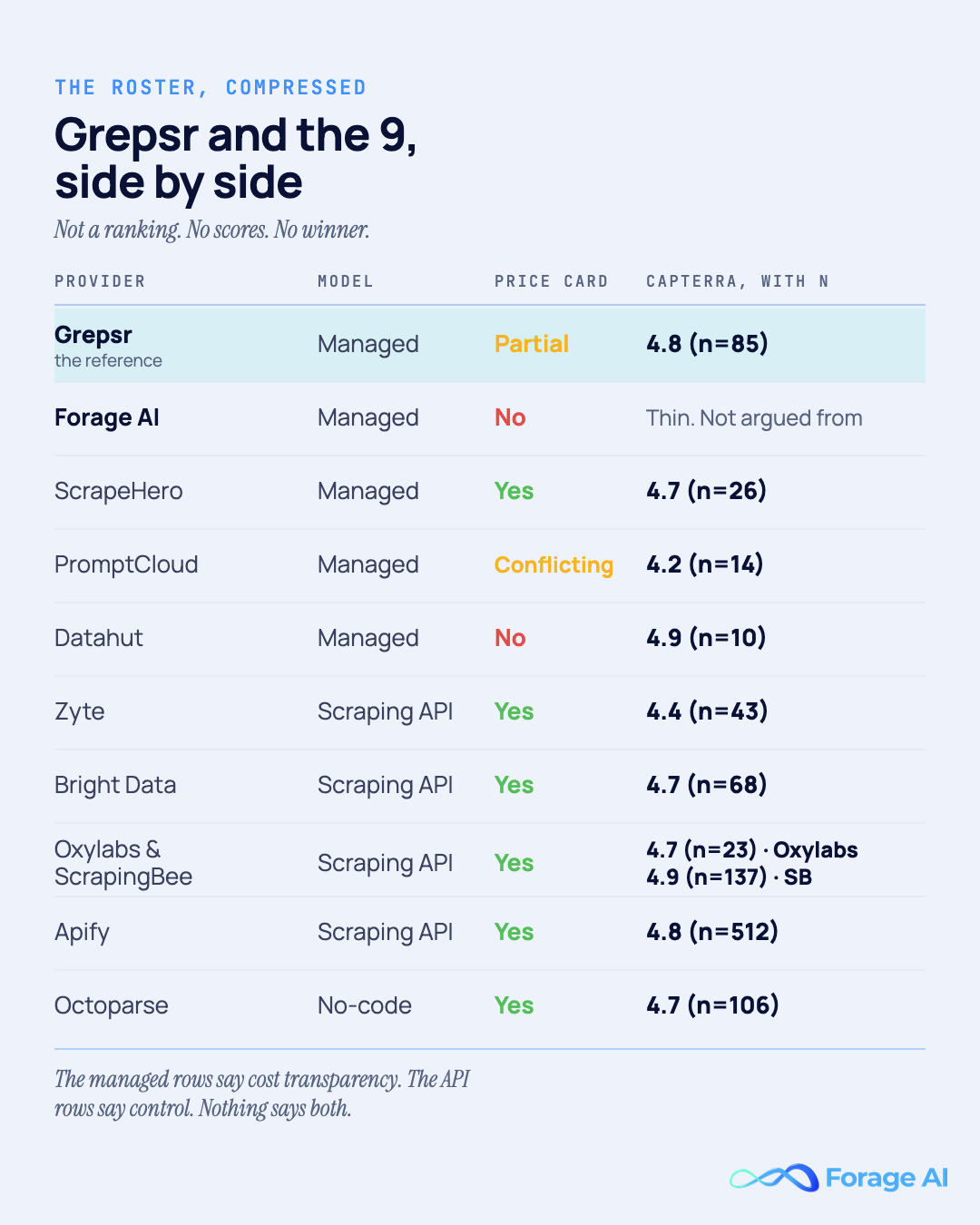
This grid closes the roster by compressing it against Grepsr. It is not a ranking, there are no scores, and there is no winner. Read the last column, “better than Grepsr when,” as the decision aid: it reduces every alternative to the single condition under which it beats staying put.
| Provider | Model | Pricing (published?) | Rating (with n, accessed Jul 2026) | Best for | Better than Grepsr when… |
|---|---|---|---|---|---|
| Grepsr (reference) | Managed | Partial: $350 one-time entry; above that, custom-quoted | Capterra 4.8 (n=85) | Standard recurring delivery, stable extraction logic | n/a |
| Forage AI | Managed | No | Thin public base; not argued from | Data-as-product teams with changing schemas | Extraction logic has to keep moving and you will not take the pipeline back |
| ScrapeHero | Managed | Yes (managed tiers reported) | Capterra 4.7 (n=26) · G2 4.7 (n≈63) | Large-scale ongoing feeds | You need a managed price point readable before a sales call |
| PromptCloud | Managed | Conflicting | Capterra 4.2 (n=14) · G2 4.6 (n=16) | Recurring enterprise sources | You want a second managed opinion on queue latency |
| Datahut | Managed | No (2019 sources only) | Capterra 4.9 (n=10) | Budget retail feeds | Cost is genuinely the wall. Not control |
| Zyte | Scraping API | Yes | Capterra 4.4 (n=43) · G2 4.3 (n=114) | Scrapy-native teams | You want the extraction logic in your hands today |
| Bright Data | Scraping API | Yes | Capterra 4.7 (n=68) · Trustpilot 4.4 (n≈970) | Defended targets at scale | Access, not delivery, is the bottleneck |
| Oxylabs (and ScrapingBee) | Scraping API | Yes | Oxylabs Capterra 4.7 (n=23) · ScrapingBee Capterra 4.9 (n=137) | Mid-market API buyers | You want a price card and no sales cycle |
| Apify | Scraping API | Yes | Capterra 4.8 (n=512) | Engineer-led teams | You want prebuilt scrapers running this week |
| Octoparse | No-code | Yes | Capterra 4.7 (n=106) · Trustpilot 4.1 (n=96) · TrustRadius 7.0/10 (n=13) | Analysts, simple websites | A non-engineer needs to own the logic |
Ratings from Capterra (primary), with G2, Trustpilot and TrustRadius corroborated-via-secondary. Pricing from vendor pages only. Both drift; re-check before you sign. ParseHub and Import.io are covered in the band above and are not rows here, because neither is a general-purpose alternative as of July 2026.
Read down the last column and the shape of the choice appears. The managed rows say cost transparency. The API rows say control. Nothing says both. Also worth saying plainly: Grepsr’s 4.8 is higher than most rows in this table, and the largest base belongs to a competitor, not to it. The highest number in the rating column is not the recommendation. The largest base is a better signal than the highest score. The takeaway fits one line: buy the base, not the badge, and buy the wall, not the brand.
Quick Summary
Q: Which Grepsr alternative should you actually look at?
A: It depends on the wall. Published managed pricing, the managed peers, though none beats Grepsr on control or support. Genuine control on complex targets, only the scraping APIs, and they deliver it by handing you the pipeline. Non-engineers on simple sites, the no-code tools, until the target gets defended. If the wall is control without owning the pipeline, the answer is a managed provider without the ticket queue. Grepsr’s own 4.8 out of 5 (85 Capterra reviews, July 2026) is higher than most rows in the grid.
The trade nobody names: leaving managed hands the maintenance back
The grid says nothing delivers both, and that carries a price nobody quotes. Every competing page hands a Grepsr customer an API link without naming what just changed.
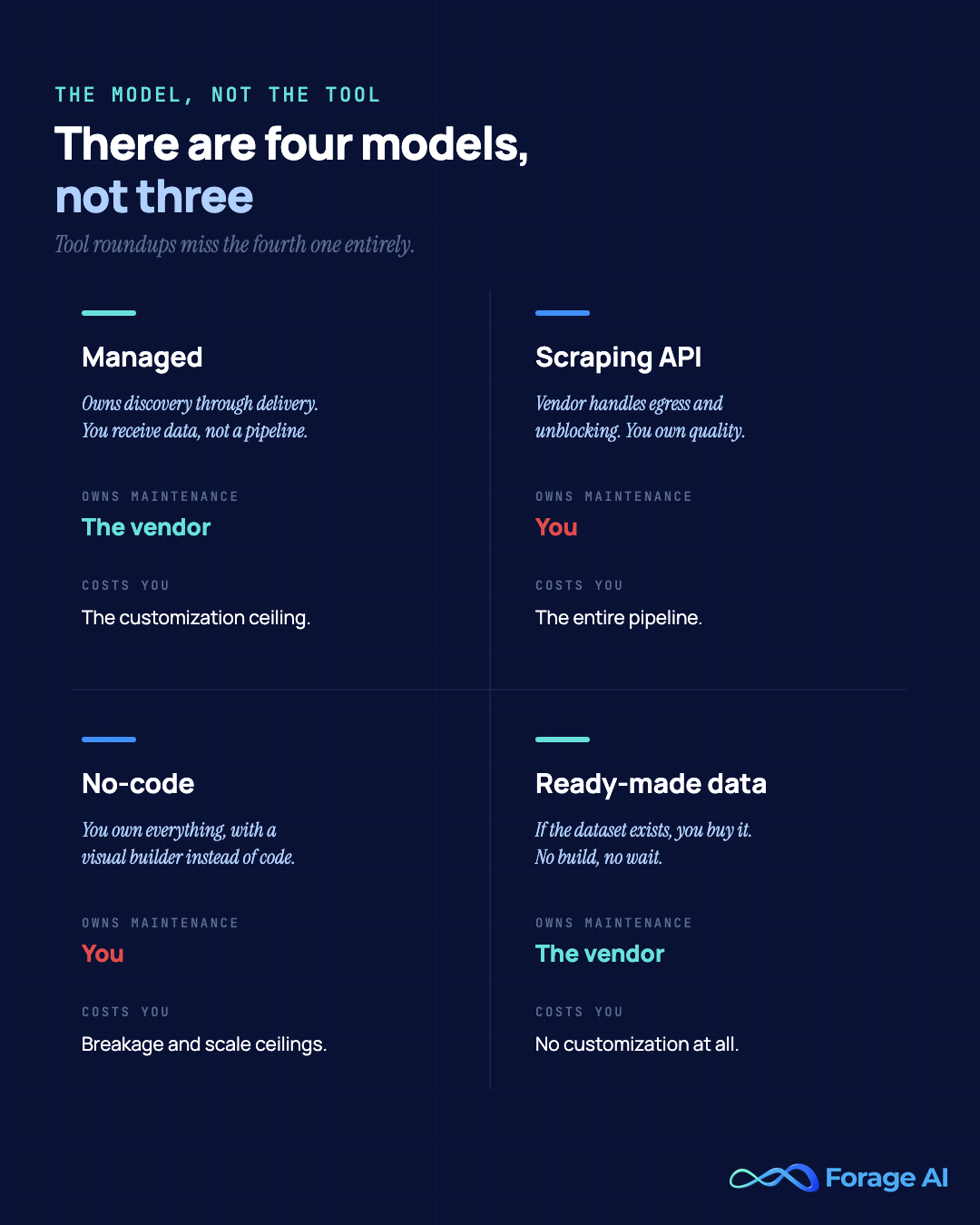
There are four models, not three. Managed (the provider owns discovery through delivery; you receive data). Scraping API (the vendor handles egress and unblocking; you write parsers and own quality). No-code (you own everything, with a visual builder instead of code). And ready-made datasets, the model tool-roundups miss: if a standard dataset exists, you buy it, no build, no wait, no customization.
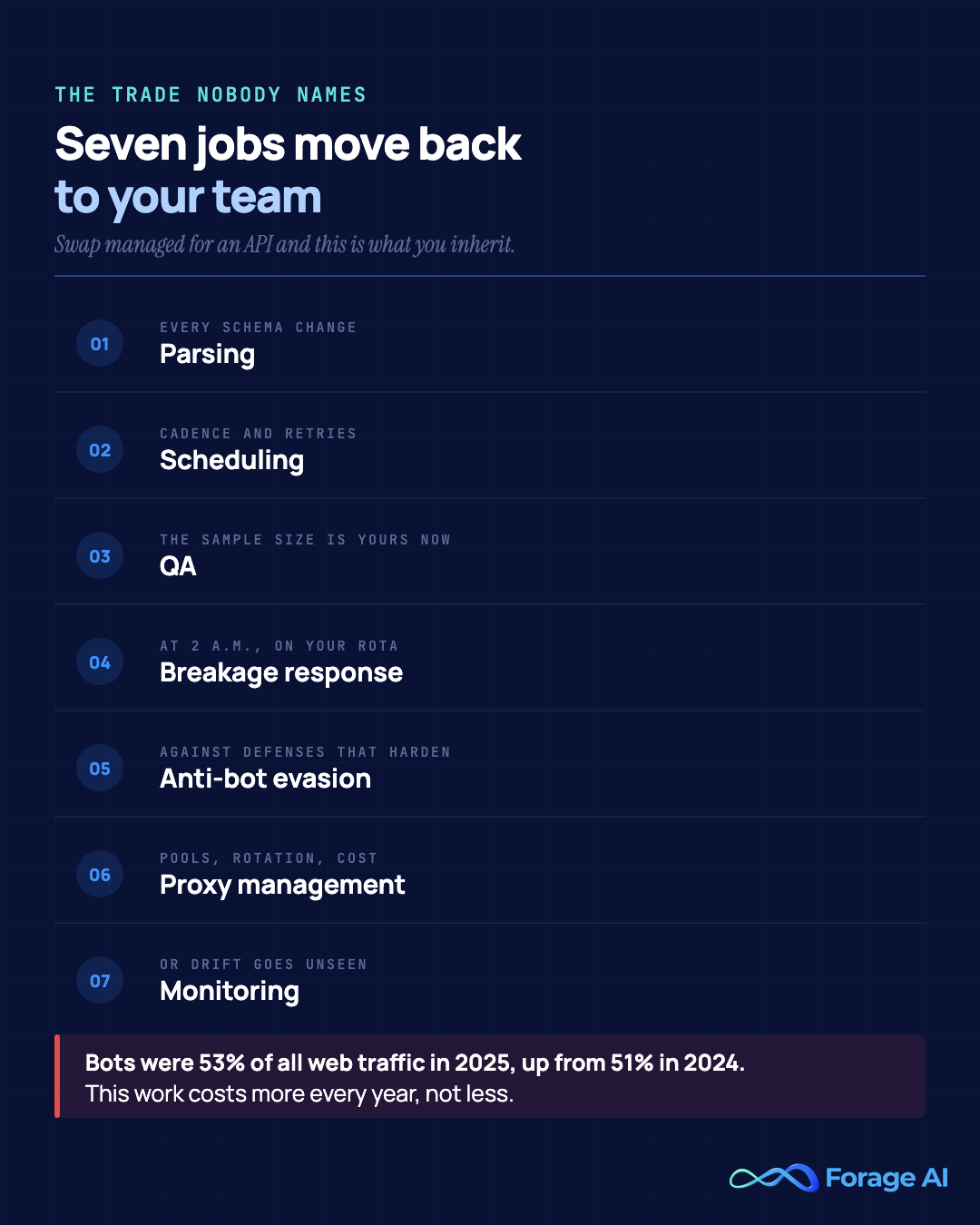
“Taking the maintenance back” is concrete: parsing, scheduling, QA, breakage response, anti-bot evasion, proxy management, monitoring. It is an escalating cost. Automated bots were 53% of all web traffic in 2025, up from 51% in 2024, and 27% of bot attacks now target APIs directly (Imperva/Thales Bad Bot Report, April 2026). <!– –> The defenses your scrapers meet harden every year, whoever runs them.
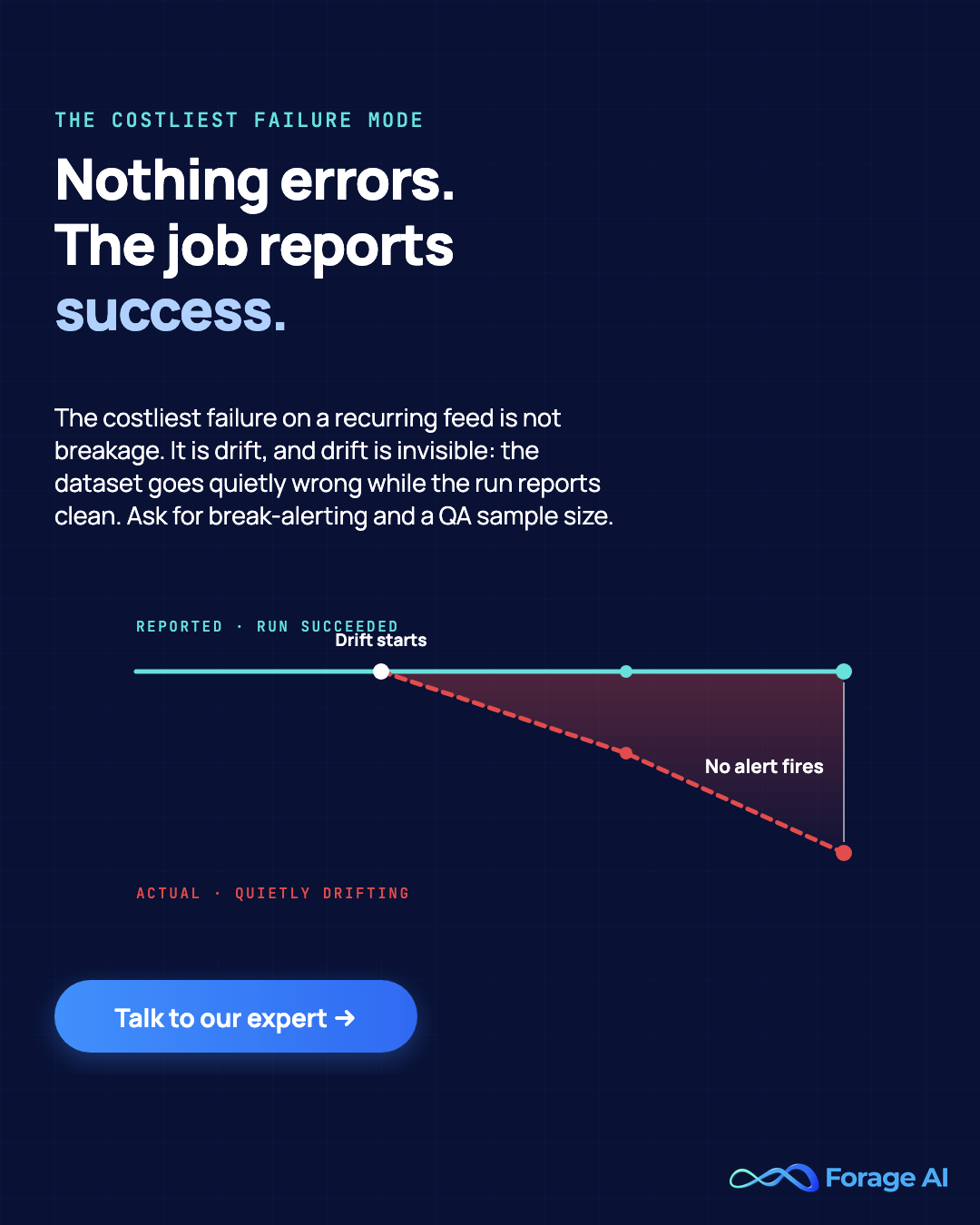
The costliest failure mode is not breakage. It is drift, and drift is invisible. A scraper run 10 minutes after publication missed 2.1% of items; at an 8-hour lag it missed 5.4%, with samples showing statistically significant bias (Foerderer, 2023). <!– –> Nothing errors. The job reports success. The dataset is quietly wrong.
> Common misconception. Swapping a managed provider for a scraping API does not fix the control ceiling for free; it fixes it by handing back the parsing, QA, breakage and anti-bot work you paid a managed provider to absorb. Bots hit 53% of all web traffic in 2025, so that work gets more expensive every year.
One fairness note, because the misread is everywhere: the claim that “web scrapers miss 77% of data” is a serious misreading of this literature. Those figures come from naïve academic heuristics built to make a point, not from any measurement of a commercial provider.
So it is a trade, not an upgrade. Converting a managed line item into engineering headcount lowers the sticker price, rarely the total, which is what teams find in what they discover after bringing scraping in-house. It is also why a reader whose wall is W1, W2 or W4 should shop for a better managed partner, not a different model.
Quick Summary
Q: Can you replace a managed provider like Grepsr with a scraping API?
A: Yes, and it is a trade, not an upgrade. The API fixes the control ceiling by returning parsing, QA, breakage response and anti-bot work to your team, and that work is escalating: bots were 53% of all web traffic in 2025, up from 51% in 2024 (Imperva/Thales, April 2026). The sticker price falls; the total usually does not.
How should you choose? Three questions nobody puts on the checklist
You have the list. The method is three questions, in this order, on no evaluation checklist for this topic. Call it the Concierge Ceiling Test.
Q1. What can I change myself, without a ticket? Get the boundary in writing, item by item: schema fields, filters, cadence, a new source, new extraction logic. The differences between vendors’ answers are the comparison, W1 as a purchasing question.
Q2. What is your contractual turnaround on a schema change? Not “we’re responsive.” A number, in the contract. Change-request turnaround is the loudest complaint theme across this category and appears on no evaluation checklist anywhere.
Q3. How will I learn a feed broke, and what is your QA sample size? The evidence asks for alerting explicitly: one reviewer wants “automated alerts if a crawler is not working… visibility for the customer would be great as it would enable us to react faster.” On sample size, the arithmetic below is why the number matters.
Grepsr manually QAs a randomized sample per SLA terms, which is normal and defensible. What matters is what sampling is built to do. NIST’s handbook settles it: acceptance sampling decides whether a lot is likely acceptable, not how good it is. It answers “should we ship this batch?” not “is this feed still measuring what it measured last quarter?”
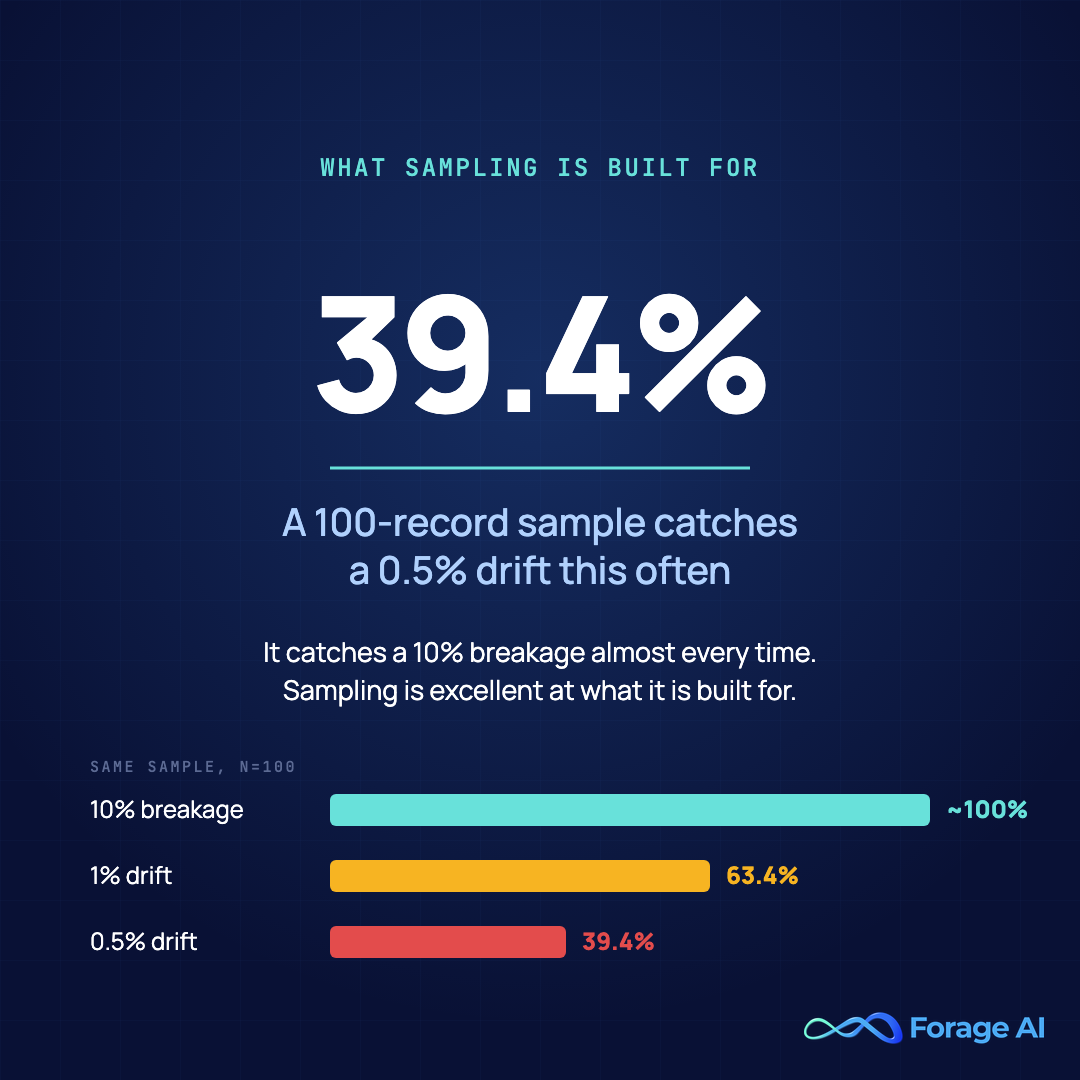
The probability a random sample of n records catches a defect present at rate p is `1 – (1 – p)^n`:
# Probability a random sample of n records catches a defect at rate p
# P = 1 - (1 - p)^n     (computed and verified by Forage AI, 2026-07-16)

n = 100
p = 0.10   ->  P = 0.99997   # 10% breakage: caught, essentially always
p = 0.01   ->  P = 0.634     # 1% drift: caught 63.4% of the time
p = 0.005  ->  P = 0.394     # 0.5% drift: caught 39.4% of the time

# To reach a 95% chance of catching a defect at rate p:
p = 0.01   ->  n = 299
p = 0.001  ->  n = 2,995
<!– –>
Sampling is excellent at what it is built for. A 100-record sample catches a 10% breakage rate essentially every time, which is why reliability reputations here are earned. It is weak on partial drift, exactly where reviewers say quality goes missing.
These are not anybody’s published numbers, and that is the point. Grepsr’s sample sizes are not public, and neither are most vendors’. You cannot evaluate a QA plan whose n you do not know. Quality engineering has had a name for your exposure for seventy years: consumer’s risk, the probability a sampling plan accepts a lot that is actually bad. For the wider frame, we keep a framework for evaluating data quality.
Run the test and the requirement is a managed provider that can answer Q1 with a real boundary and Q2 with a real number. Forage AI is built to answer both, on a dedicated-team model rather than a ticket queue.
Quick Summary
Q: How should you choose between Grepsr and its alternatives?
A: Ask what you can change without a ticket, your contractual turnaround on a schema change, and your vendor’s QA sample size. The third matters because sampling decides whether to ship a batch, not a feed’s quality (NIST/SEMATECH): a 100-record sample catches a 10% breakage almost every time and a 0.5% drift under 40%. If a vendor cannot tell you their sample size, that is your answer.
What does switching off a managed provider actually involve?
The test tells you which vendor to sign. It does not tell you how to leave the one you have.
A managed exit is contractual before it is technical, which is why nobody writes this section. Five steps, only one engineering.
- Establish who owns the scrapers you paid to have built. Ask before you sign, not on the way out; this clause decides whether an exit is a migration or a rebuild.
- Export the historical dataset, in a format you can read, before notice starts.
- Hold the schema constant. The new feed must land in the same shape or every downstream consumer breaks on cutover day.
- Check notice periods and billing mechanics. Grepsr bills monthly in arrears and its crawls pause or cancel from the dashboard, which makes its exit mechanically cleaner than several alternatives on this roster.
- Parallel-run the new provider before you cut over. Never flip.
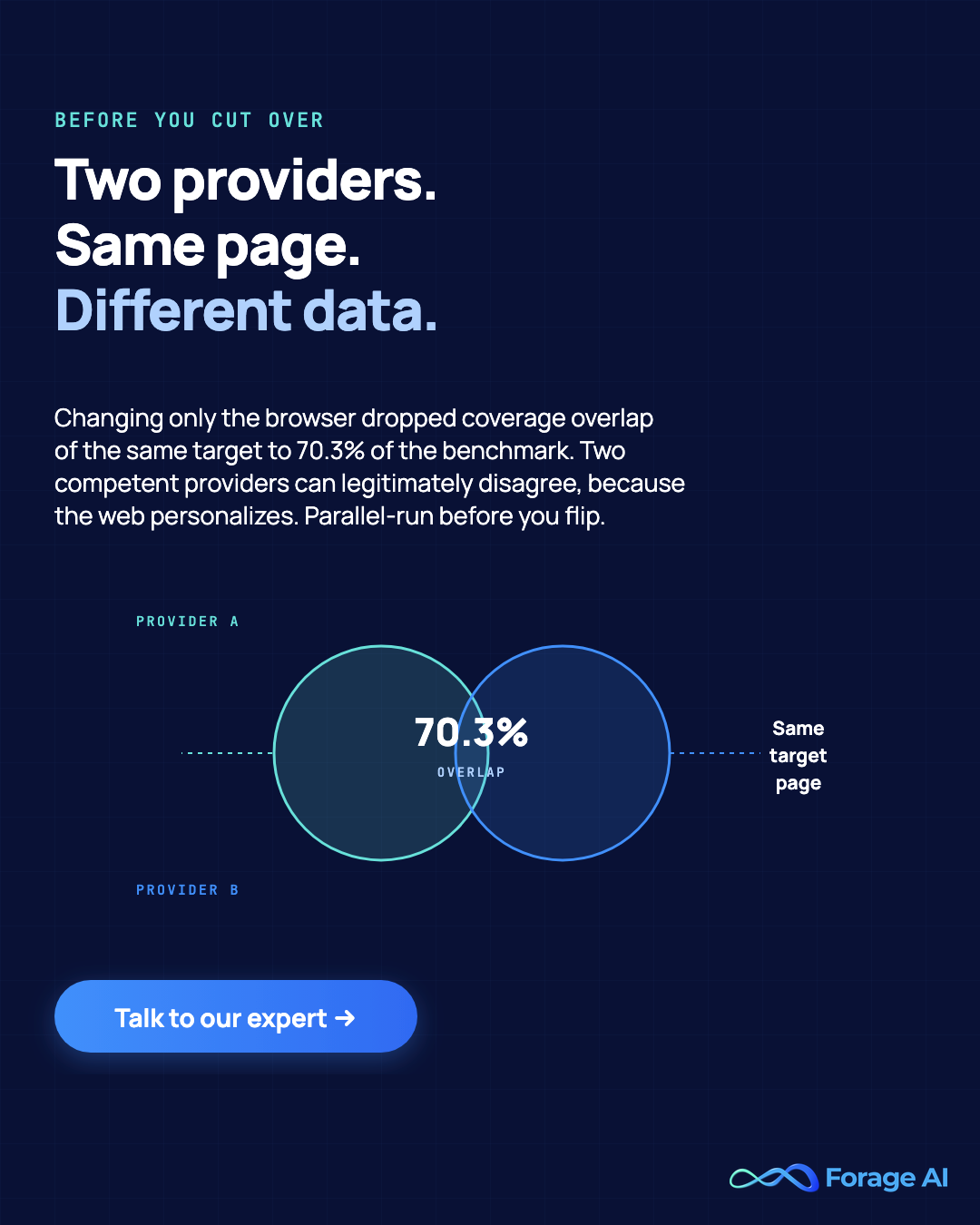
The parallel run is where most bake-offs go wrong, because two providers side by side will not match, and that is expected rather than proof either is wrong.
> Common misconception. Mismatched numbers during a parallel run are not proof the new provider is wrong. Foerderer’s experiment held time constant and changed only the requester: a different browser dropped coverage overlap of the same target to 70.3% of the benchmark, a system language change to Spanish gave 73.7%, and different US locations ranged from 61.8% to 69.2% (2023). Two competent providers scraping the same page at the same second can legitimately return materially different datasets, because the web personalizes. Control the request configuration before you draw a conclusion.
Switching itself is unremarkable: roughly 3% of annual expense per switch in the closest measured analogue, credit-union IT outsourcing rather than data feeds. <!– –> Treat it as the literature’s nearest estimate, not a quote. If the real question is whether to bring extraction in-house, that is a different calculation, and build or buy your web data extraction runs it.
Expert Insights
Expert Insights
Christian Peukert’s panel of US credit unions from 1999 to 2009, covering 69,638 observations and 3,357 observed switches, produced an average per-period switching cost near 3% of annual expense, across a decomposed range of −1.1% to 7.3% (Ulm University, August 2010). <!– –> A different industry in a different decade, which is why it is the closest thing to a measured switching cost, not a business-case number.
Nithya Sambasivan and colleagues at Google Research interviewed 53 AI practitioners and found 92% reported data cascades, compound downstream failures originating in data, with 45.3% reporting two or more in one project. <!– –> Cascades were “opaque and delayed, with poor indicators and metrics” (Sambasivan et al., CHI ’21, 2021), <!– –> exactly what a reviewer means when quality consistency goes missing quarter to quarter.
Tadhg Nagle, Thomas Redman and David Sammon ran 75 data-quality assessments over two years and found 47% of newly-created records held at least one critical, work-impacting error, with only 3% of quality scores acceptable under the loosest standard applied (Harvard Business Review, 2017). <!– –> It cuts both ways: your Grepsr feed may be cleaner than the internal data you compare it against.
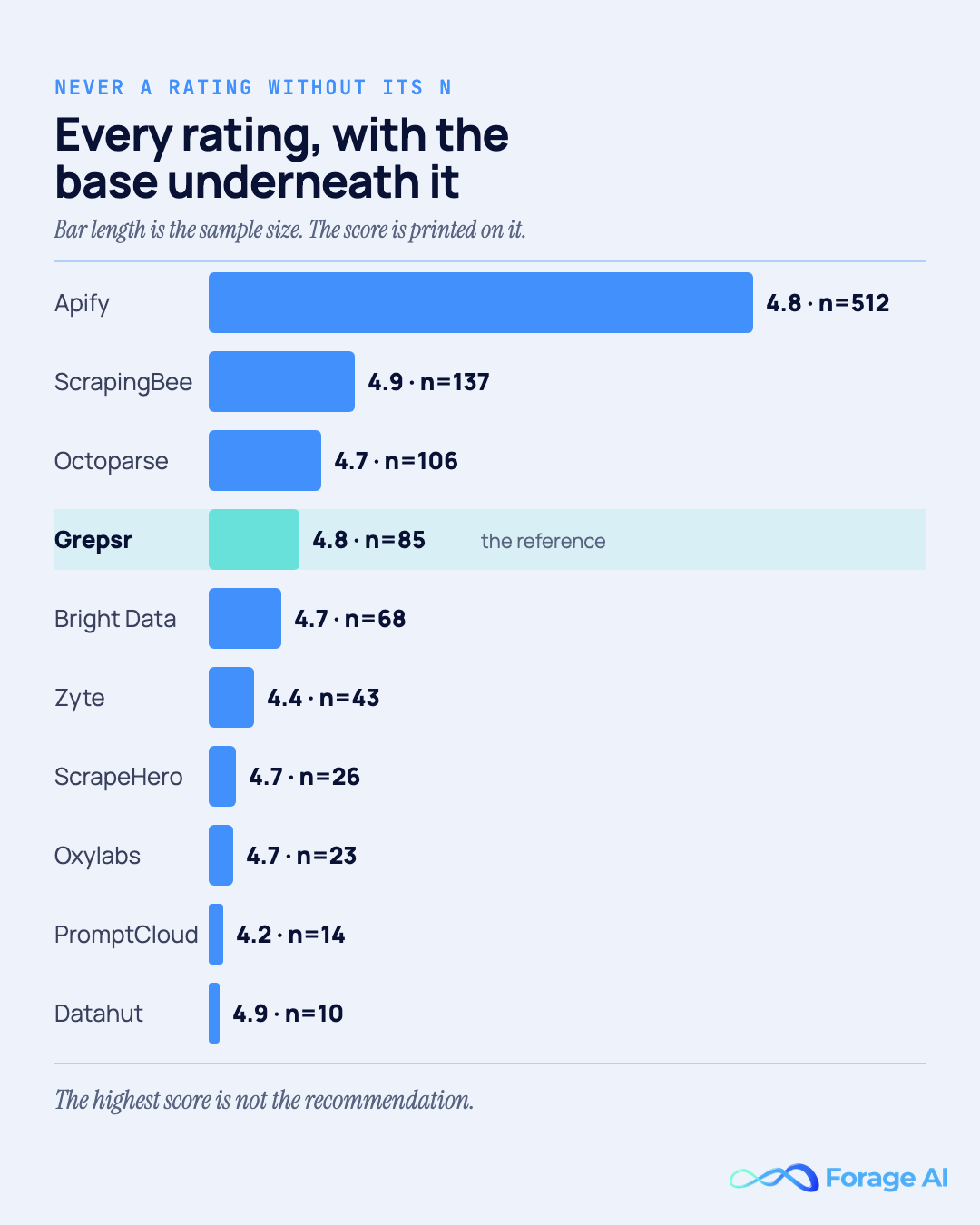
Read the roster’s evidence rather than its scores and one number stands apart. Apify’s Capterra 4.8 sits on 512 reviews, six times the base behind Grepsr’s 4.8 (accessed 16 July 2026). <!– –> Every other entry rests on 10 to 137 reviews, so sample size varies by a factor of fifty and treating any two star ratings as comparable evidence is a category error.
Jens Foerderer, then Professor of Information Systems at the Technical University of Munich, framed the mechanism precisely: “The key argument of this paper is that naïve web scraping procedures can lead to sampling bias in the collected data… sampling bias emerges from web content being volatile (i.e., being subject to change), personalized (i.e., presented in response to request characteristics), and unindexed (i.e., abundance of a population register)” (2023). <!– –> Volatile, personalized, unindexed: three words for why a pipeline you own degrades without throwing errors.
A standards body with no stake in the outcome, the NIST/SEMATECH e-Handbook of Statistical Methods §6.2.1, is clearest on what sampling is for: “The main purpose of acceptance sampling is to decide whether or not the lot is likely to be acceptable, not to estimate the quality of the lot.” <!– –> <!– –> The field’s heuristic for what bad data costs comes from Thomas C. Redman, who coined it: “It costs ten times as much to complete a unit of simple work when the data are flawed in any way as it does when they’re perfect” (2012), a rule of thumb, as he says himself. <!– –>
FAQ
What is a managed web scraping service?
The provider owns the whole chain, discovery, extraction, cleaning, QA, maintenance and delivery, so you receive data, not a pipeline. The same thing that makes it easy caps your control: if you are not touching the pipeline, you are not changing the extraction logic.
How much does Grepsr cost, and what is beyond the $350?
The Starter Pack starts at $350 for a one-time extraction on simple sites (listed as reduced from $700). Growth Pack and Enterprise Partnership are custom-quoted, and recurring work is billed monthly in arrears with a setup fee (grepsr.com/pricing and /faq, July 2026). The correction most sources get wrong: the $350 is one-time, not monthly, and the managed service has no free tier or trial.
Can I replace Grepsr with a scraping API?
Only if you are ready to own maintenance. An API fixes the control ceiling decisively, by returning parsing, QA, breakage response and anti-bot work to your team. The sticker price falls; the total usually does not.
Are there free or open-source Grepsr alternatives?
Yes, genuine free tiers exist among the no-code tools; one offers 10 tasks and 50,000 rows of monthly export, and Grepsr ships a free Chrome extension. Free is not free to operate: you inherit breakage, scale ceilings and 2 a.m. maintenance.
How do I switch away from Grepsr, and who owns the scrapers?
Establish scraper ownership before you sign. Then export the historical dataset, hold the schema constant, check notice and billing mechanics, and parallel-run before cutting over. Expect the two providers’ numbers to differ, which is the web personalizing, not a defect (Foerderer, 2023).
Grepsr or ScrapeHero, which managed service?
Pricing transparency against everything else. ScrapeHero publishes managed price points where Grepsr custom-quotes above its entry tier, but does not beat Grepsr on control, turnaround, or support (Grepsr’s Customer Support scores 5.0). Ratings: ScrapeHero 4.7 across roughly 63 G2 and 26 Capterra; Grepsr 4.8 across 85 Capterra (July 2026).
Where this leaves you
The shield and the ceiling are the same wall, seen from two sides. You bought a provider so you would never touch the pipeline, and the reason you cannot change the extraction logic is that you never touch the pipeline. Every managed row pays that price; the APIs refund it and hand you the invoice for everything else.
So the question was never which alternative is better. It is whether your vendor can tell you where the ceiling sits when you ask: what you can change without a ticket, the turnaround on a schema change, the QA sample size. A provider who answers all three with a number has built a door in the wall; one who cannot has the wall anyway, and finds it the way the December 2025 reviewer did, on the day the logic had to move.

Sources
- Capterra (accessed 16 July 2026): all ratings, sample sizes, sub-scores and verbatim reviewer quotes. Capterra, GetApp and Software Advice share one Gartner-owned corpus.
- G2, Trustpilot, TrustRadius (accessed 16 July 2026): corroborated-via-secondary; all three return HTTP 403 to direct fetch.
- Mordor Intelligence (updated 8 July 2026): web scraping market sizing and CAGR.
- Imperva / Thales, Bad Bot Report (29 April 2026): bot share of web traffic, 2025 versus 2024.
- Foerderer, J. (August 2023): Should we trust web-scraped data? arXiv:2308.02231.
- NIST/SEMATECH e-Handbook of Statistical Methods, §6.2.1 and §6.2.2: acceptance sampling, consumer’s risk.
- Sambasivan, N. et al. (2021): Data Cascades in High-Stakes AI. Google Research, CHI ’21.
- Nagle, T., Redman, T. & Sammon, D. (2017): data-quality assessment findings, Harvard Business Review.
- Redman, T. C. (2012): the Rule of Ten heuristic, Harvard Business Review.
- Peukert, C. (August 2010): Switching Costs in IT Outsourcing, Ulm University.
- Forage AI (16 July 2026): binomial sampling arithmetic, computed and verified in-house.
- Vendor pricing pages (accessed 16 July 2026): every price point, vendor page only, never an aggregator.
Related Articles
- Octoparse Alternatives. The no-code band examined on its own terms, with the same evidence standard.
- Bright Data Alternatives. Where the proxy and unblocking market sits if access is your bottleneck.
- Top Zyte Alternatives. The API band compared, including the billing-visibility trade.
- Web Scraping Companies vs Tools. The category distinction underneath this article’s four models.
- Custom Web Scraping. What “custom” actually means once extraction logic stops being standard.